

September 27, 2026
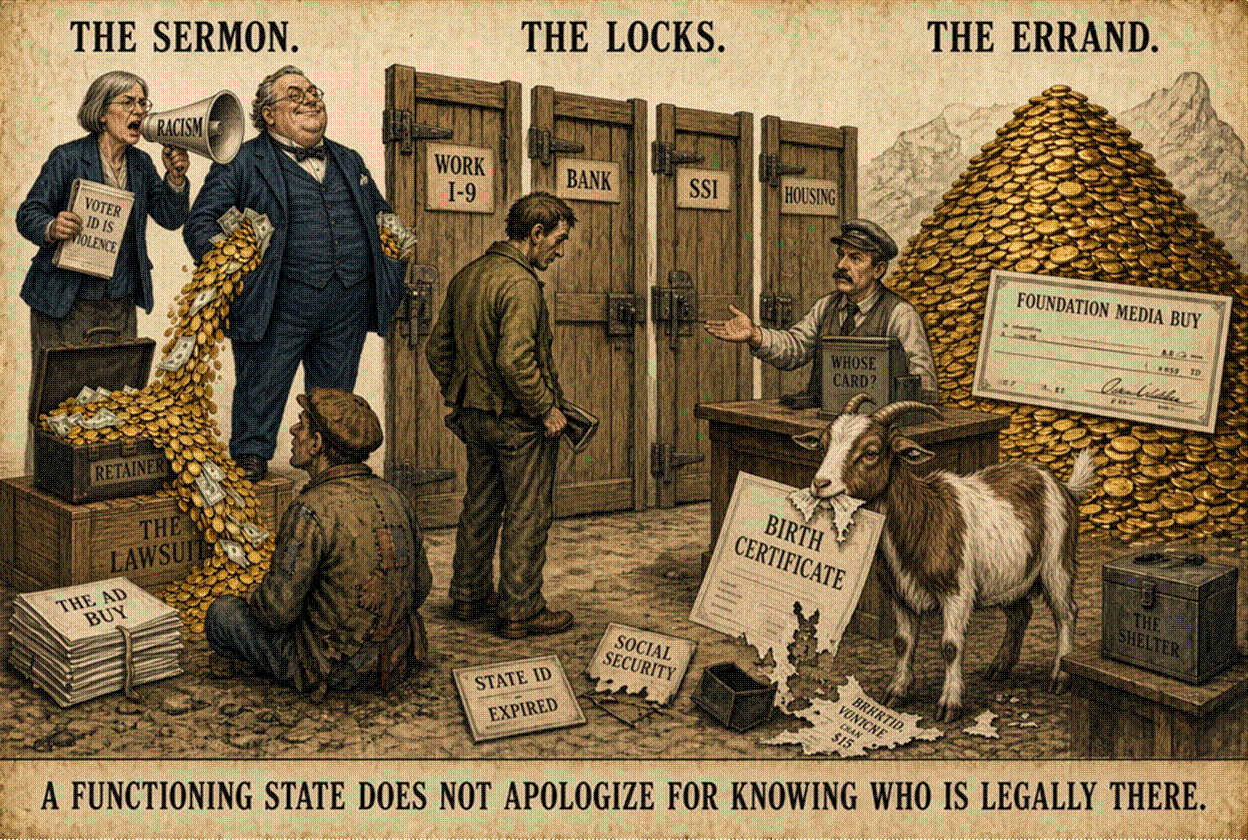
The sermon, the locks, and the myth that the paper was never issued.
Political talk treats two different facts as if they were one. A citizen who does not have a current photo ID in a pocket is described as if he had never been issued a birth record, a Social Security number, or a file at the Social Security Administration. Those are not the same sentence.
The first is a replacement problem. The second is a life that almost no American citizen who went to school, worked, used a hospital, or collected a benefit has actually lived.
What “never documented” would require
The only biography that fits never a birth certificate and never an SSN is a narrow one. Unregistered birth. No hospital enumeration. No school file. No job that filled out Form I-9. No bank. No benefits claim.
That is not the elderly person drawing Social Security. That is not the homeless person who once had a license and a number and then lost the wallet. Those people had a file. They misplaced the paper.
A sliver exists. Some rural and home births before registration was near-universal were never entered. A few off-grid births were never filed. Members of qualifying religious groups can exempt themselves from Social Security such as Amish or Mennonites. A citizen who lived abroad and never worked for a U.S. employer may never have asked for a number. None of those people are the stock character in the slogan. Illegal migrants are a different population. This essay is about citizens.
The institutions that already create the file
A hospital birth in the United States has, for decades, been the start of a paper trail. Enumeration at Birth puts an SSN on almost every child born in a hospital. Schools keep records. Employers cannot legally complete I-9 with nothing. A citizen presents a passport, or a photo ID plus an unrestricted Social Security card or a certified U.S. birth certificate. Where E-Verify is used, the hire must provide an SSN, the identity document must carry a photograph, and the employer matches the data against federal databases.
Cash under the table can dodge this. A regular job cannot. Banks, clinics, Medicare, and the Social Security office do the same work. A citizen who held an on-the-books job, used modern healthcare, or collected a federal benefit certainly has an SSN and an underlying identity record. What he may not have is the plastic still in his pocket.
SSI is a transfer into an account
Supplemental Security Income is not handed over as cash in an envelope. Federal law requires the payment to move electronically. The money is transferred into an account: a bank or credit union account, or the Direct Express card account at the Treasury’s bank. Both are accounts. Both sit on the Social Security number already on the claim.
If the applicant somehow has no SSN, the Social Security Administration assigns one when it entitles the person to SSI. The application itself asks for proof of age and citizenship. For a citizen that is typically a birth certificate, a passport, or an equivalent. Collecting SSI is an identity event. You do not walk into that office as a person the state has never met and walk out with a monthly payment and no number.
If the transfer goes to a bank or credit union, opening the account is an ID event. Name, date of birth, address, Social Security number, and identity documents. You need ID to receive the payment in that manner.
Direct Express is not an escape from identity. It is a narrower account. Treasury issues a prepaid Debit Mastercard so the recipient does not have to open a branch checking account first. That is a product difference, not an identity vacuum. Enrollment uses the SSN or claim number already on the file. You must have had a Social Security number to get the card.
Spending the card brings ID back. A cashier is not bound by a distinction between “Treasury prepaid” and “bank debit.” At a point of sale — Walmart is the ordinary example — staff ask for photo ID to show the card belongs to the person holding it. The logic is a stolen-card check. Bank-teller cash-out on Direct Express can require identification. Money-order counters do it as routine. The card does not let you live as an anonymous person. It moves the ID demand from the branch to the aisle.
SSI is an electronic transfer into an account opened with a number. Using that account in the real economy often requires a face that matches an ID. That is the opposite of a citizen who never entered the system.
Disenfranchised from the benefits due a citizen
Disenfranchised should not be allowed to mean only a polling place. If you are a legal citizen and you cannot prove it, you are shut out of the ordinary machinery of membership. The decent response is not to pretend the machinery should run without proof. It is to put the proof in the citizen’s hand.
This is what a citizen without usable ID and an SSN cannot finish:
Gate
What you cannot finish without papers
Work
I-9. No passport, or photo ID plus an unrestricted Social Security card or certified birth certificate, no legal hire.
Pay
A bank or credit union account. Opening it takes ID and an SSN.
Spend the benefit
The branch or the register. A cashier at Walmart or a teller cashing out Direct Express asks for photo ID so the card is yours.
Housing
HUD rental assistance checks SSN and citizenship or eligible status. A landlord still needs a name the state will recognize.
Benefits already earned
SSI, Social Security, and Medicare sit on an SSA file. Lost paper is how the payment stalls.
Movement
A domestic flight, a license, a hotel, a phone plan in any country that bothers to know who is on the network.
The ballot
In a photo-ID state, the same card. Last on the list on purpose.
The federal government’s own work on homelessness says the same thing in dull English. ID is how people get jobs, stable housing, and federal benefits. That is why shelters and HUD-funded caseworkers spend money on birth-certificate copies and DMV trips. They are not doing it as a hobby. They are reversing disenfranchisement.
A society that means the word citizen should make sure every legal citizen has an ID and an SSN, then use those documents at the gates that already exist. Leaving a citizen undocumented is not compassion. It is how you keep him off a payroll, out of an apartment, and away from a payment that is already his.
Replacement has friction. Vital-records offices charge fees. A man without an address has trouble receiving mail. A bus to the DMV costs money he does not have. That is an argument for fee waivers and caseworkers. It is not an argument for running the country on a handshake.
What a card does in a country that bothers
I live in the United Arab Emirates. Every citizen and every legal resident is required to hold an Emirates ID and is expected to carry it. The Federal Authority for Identity, Citizenship, Customs and Ports Security issues it. Nobody treats the requirement as a culture-war prop. The card is how you use the country.
You open a bank account with it. Clinics pull insurance from the same number. Utilities, tenancy registration, a mobile SIM, a driving license, a traffic fine, a government portal: the card is the key. Forget it at home and the week gets smaller. That is the point of a functioning state. Services are real, so identity is real.
The lesson is not that America should copy the UAE’s residency system (although it would benefit from doing so). The lesson is simpler. A functioning state does not apologize for knowing who is legally there. If a legal resident here is expected to hold one card to collect a salary, see a doctor, and register a phone, a legal citizen of the United States can be expected to hold an ID and an SSN to collect what the United States already owes him.
Mexico issues the card and then asks for it
Mexico is the clean comparison sitting on the other border. It is not a boutique social democracy. It is a large country that had to take election fraud seriously, and it built a document.
The Credencial para Votar — the INE card — is free. To get it you prove Mexican nationality, usually with a birth certificate. You show a photo ID and a proof of address. Biometrics go on the card. On election day you vote with that card. You also use it at banks, notaries, and ordinary counters. It is the default daily identity of a Mexican citizen.
Mexico does not treat “show who you are” as racism. It treats it as how you keep the roll clean and how a citizen walks through a bank door.
Most countries ask for identification at the polls. Many issue a national or voter credential for that purpose and for daily life. The United States has no national ID, a state-by-state patchwork, and a political class that calls a photo-ID request at a precinct a racial project. That fight is the outlier. The United States is unusual at the federal level and in the rhetoric. Many states already require or request ID. The war cry is against making the normal thing national and ordinary.
France, Mexico, India, and a long list of democracies do not hold a seminar about whether asking for the card is an attack on the poor. They issue the card, often free, and they ask for it.
Lost paper is not a missing person
An elderly citizen who worked or collected Social Security or Medicare already has an SSN and an SSA record. Many no longer have a birth certificate or a current photo ID. That is lost or expired paper.
A homeless citizen is usually the same story. He had a number, a license, or a benefit file and then lost the physical documents. Shelters are not inventing a person who was never enumerated. They are walking someone back to a file that already exists. A replacement Social Security card is free. A certified birth certificate costs a state fee, often waived or paid by a caseworker when the person is homeless. State ID fee waivers exist for the same reason the table above exists.
Spend the brief on the birth certificate
The organizations that treat a photo ID at a precinct as a constitutional emergency have the staff, the foundations, and the legal budgets to make documents appear. They spend those budgets on lawsuits and on a media line that calling for “ID is racism”. That is a strange use of money if the injury they name is a poor citizen cut off from public life.
A citizen without a usable ID is not primarily locked out of a ballot. He is locked out of an I-9, a bank account, a lease, a HUD file, and the ability to spend an SSI deposit at a register without being treated as a thief of his own card. That is disenfranchisement in the older sense: membership without the papers that make membership work.
If those groups believed their own sentence about the poor, they would take the retainers and the ad buys and convert them into certified birth certificates, Social Security replacement cards, and DMV appointments. Shelters already do this with smaller budgets because they have to. The litigation machine does not have to. It chooses the fight that photographs well.
Organizations who call voter ID racist should spend the same dollars putting IDs in citizens’ hands. The poor person they describe does not need another legal brief. He needs a birth certificate, a number he already has reprinted on a card, and a state ID that opens a job, an account, a benefit, and, incidentally, a polling place.
The file is not the mystery
A citizen who worked on the books, used modern healthcare, or collected SSI almost certainly has an SSN and an underlying identity record. Poverty and social services push people toward those documents. Employment law does the same. SSI does it again: the payment lands in an account, the account is tied to a number, and stores ask for ID when you spend the card.
What remains common is people who lost a current photo ID. What remains rare is the citizen who was never issued a birth record, never issued an SSN, and never opened an SSA file. Those two facts should not be used as if they were the same fact.
Knowing who is legally there is what a state is for. A functioning state does not apologize for it! It issues the document, it asks for the document, and it treats the absence of the document as a problem to be fixed — not as a moral identity.
Thank you for reading - James Frinzi