
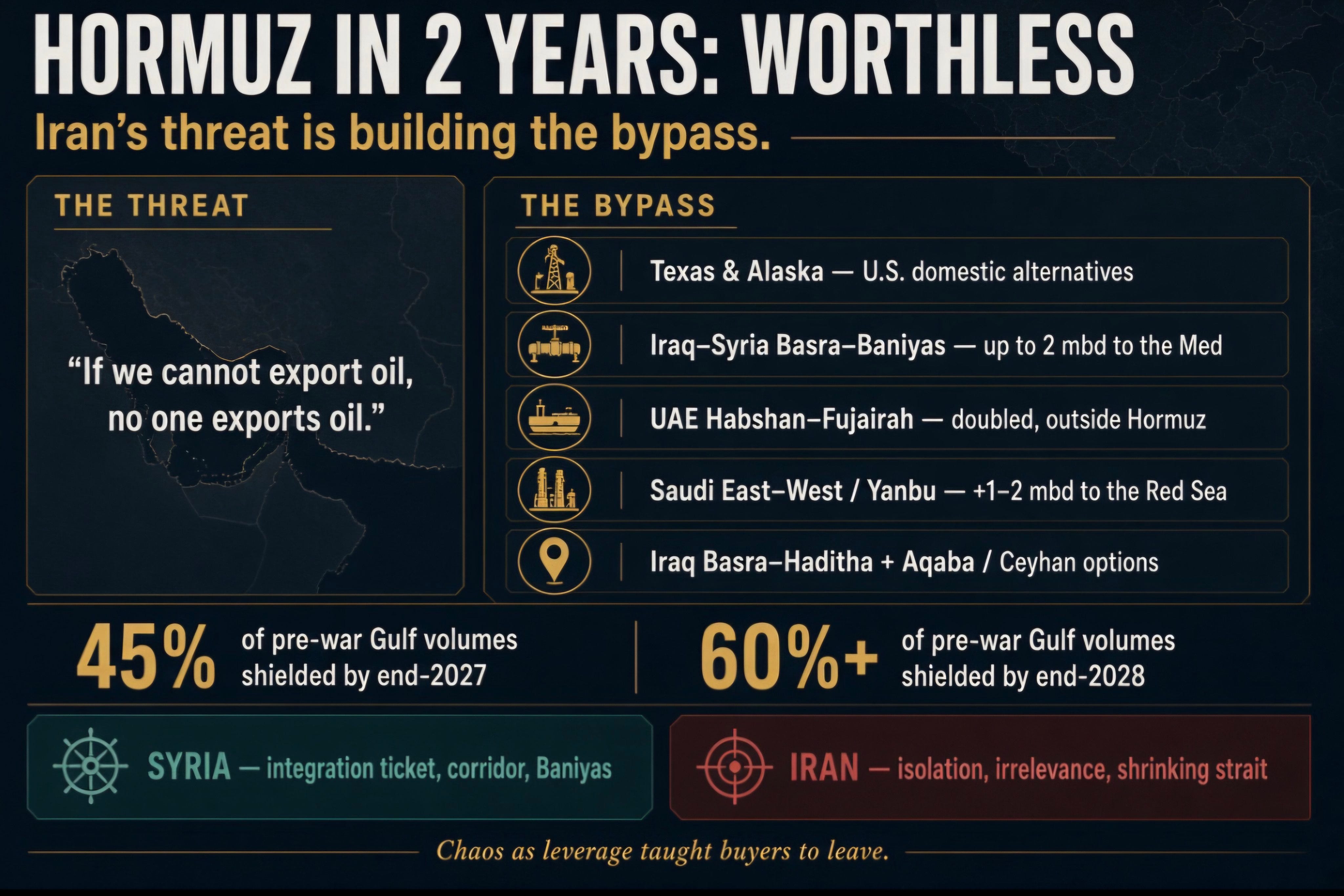
A Worthless Strait
Treasury says the Strait of Hormuz could be “worthless” within two years. That is the quiet funeral for Iran’s favorite threat.
The line belongs to Scott Bessent, spoken on the sidelines of a G20 finance gathering: in two years the strait will be “a worthless piece of water,” because the oil will move across land. He had already said Hormuz is not going back to what it was, and that a large share of the energy that used to pass through it can be walked around it. Markets still jump when a tanker is hit. Capex does not. Capex is already leaving the choke point.
Mohammad Bagher Ghalibaf’s line was simpler: if we cannot export oil, no one exports oil. Chaos as leverage. Close the tap, collect tribute, become a power.
It is backfiring.
Not speeches. Steel.
Trump has already pointed at the substitute: pipelines.
Texas and Alaska, built and pushed as domestic alternatives when tanker traffic through the strait dropped. Iraq–Syria, Basra toward Baniyas — a Chevron-linked corridor to the Mediterranean, talked up at as much as 2 million barrels a day once the spine is rebuilt. UAE Habshan–Fujairah, doubling the route that already dumps crude on the Gulf of Oman, outside Hormuz, accelerated toward 2027. Saudi East–West / Petroline, another 1–2 million barrels a day from the eastern fields to Yanbu on the Red Sea. Iraq’s Basra–Haditha spine, plus the live options toward Aqaba and Kirkuk–Ceyhan.
None of this is a press release that floats a VLCC. Some of it is already steel. Some of it is still an MoU and a BOOT model. All of it is the same lesson: a barrel that does not need an IRGC hall pass is worth more than a barrel that does.
Iran’s loss is Syria’s opening
The same barrels Tehran wants to hold hostage are being walked overland toward Baniyas. Trial trucks. Corridor talk. A Mediterranean outlet that does not ask the Revolutionary Guard for permission.
That is the fork in public. Reform enough to get back on the map, or stay the Iran route and watch the map get drawn around you. Syria is trying to cash the integration ticket. Iran is still selling chaos. One of those gets a pipeline. The other gets a narrower country.
The math that matters
Goldman-style math on existing plus planned bypasses: roughly 45 percent of pre-war Gulf export volumes shielded from Hormuz risk by end-2027, more than 60 percent by end-2028. Escorts and “southern routes” are the short-term navy story. The pipelines are the long-term eviction notice.
Bessent’s “worthless” is political language. The strait will still be water. Tankers will still use it when it is cheap and quiet. The threat only worked when there was no other door. The doors are being welded open.
Iran’s chaos strategy did not make Tehran indispensable. It taught buyers to leave. The United States is exporting. Venezuela is being pulled into a Western Hemisphere supply stack. When the crunch hit, even Russian cargoes got used as spare barrels. Every month Hormuz is a weapon, the world books pipe, Atlantic Basin crude, and suppliers that do not require Iranian permission.
Two models
If they actually kill traffic through the strait, they do not crown themselves. They shrink the strait. Insurance stays ugly. Capital expenditure goes to stable ground. Iran gets poorer, more isolated, and less relevant to the pricing meeting.
Two models are on the table.
Syria is trying to look like a corridor. Iran is still trying to look like a ransom note. A corridor attracts steel. A ransom note attracts a discount, a bypass, and a Treasury secretary willing to call your choke point a worthless piece of water — in public, on a finance-minister stage, while the market is still paying $90 for the scare.
They wanted world power through terror. They are digging a deeper hole of isolation and irrelevance. The threat only works if there is no other door. The doors are being welded open.
Thanks for reading - James Frinzi