

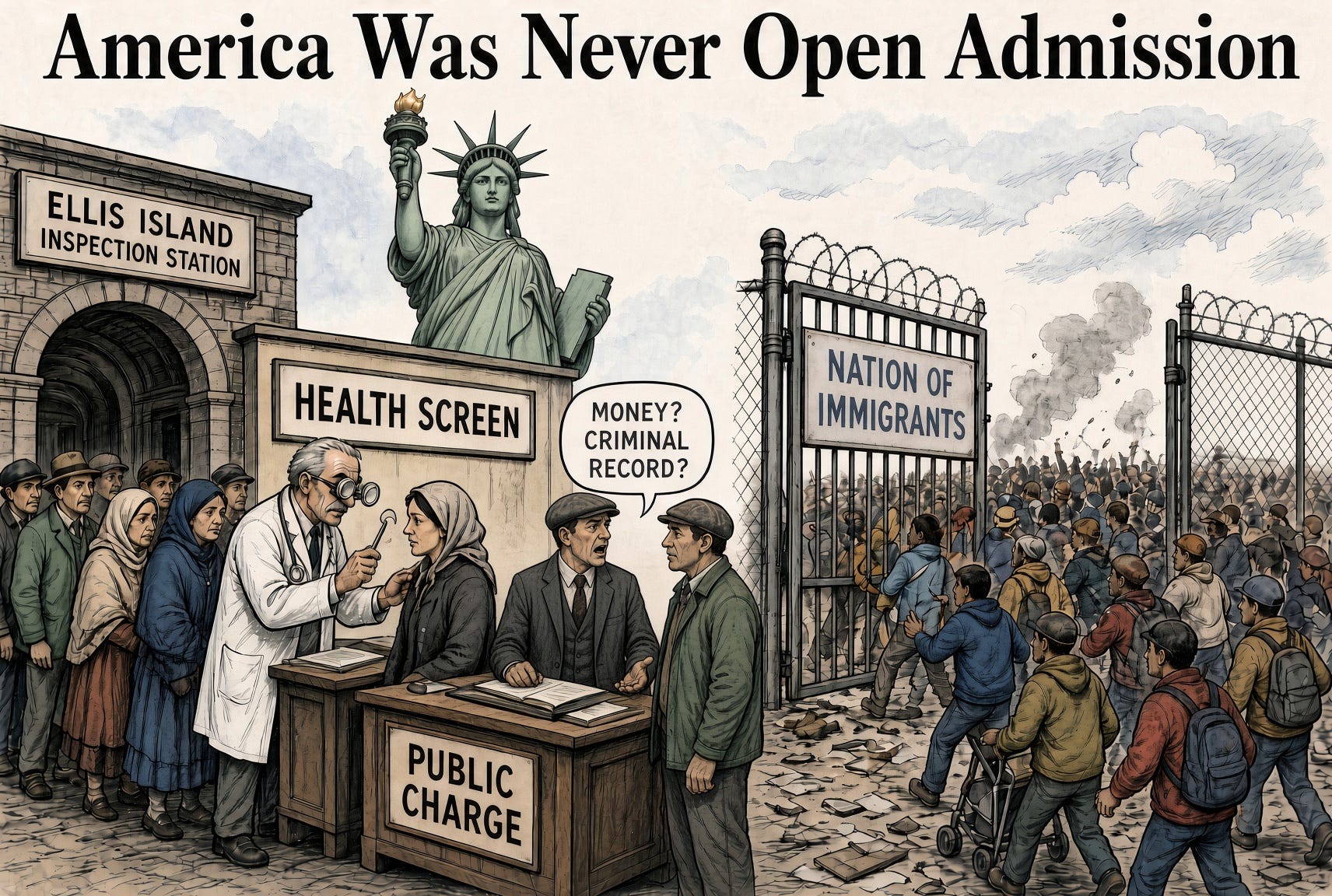
The refrain that America is a nation of immigrants is repeated as if it settles the argument. It does not. The phrase, popularized by John F. Kennedy’s 1958 pamphlet and later book as an argument against the national-origins quota system, collapses distinct historical processes into a single emotional continuum. People came seeking a better life, the argument runs, therefore later arrivals—including those who enter without authorization—stand in the same moral category as those who came before. The continuum only holds if the English colonists were immigrants (or the first illegal immigrants), if the territory they entered was already a country with entry rules, and if the selective statutes that followed were a betrayal of an original open principle. None of those premises is true. The slogan supplies the emotion. The record supplies the distinctions.
There Was No American Nation
Before European contact, the territory that became the United States was occupied by hundreds of distinct Indigenous peoples. They organized primarily as tribes, bands, chiefdoms, and, in some regions, confederacies. The Haudenosaunee (Iroquois) League united five and later six nations under the Great Law of Peace for collective diplomacy and mutual defense; each retained substantial autonomy over internal affairs. The Powhatan Confederacy coordinated multiple groups under a paramount chief in the Virginia tidewater. These were real political systems with leaders, councils, diplomacy, and warfare. They were not a single nation-state possessing fixed continental borders, a centralized monopoly on the legitimate use of force, a concept of citizenship, or immigration statutes that could be violated. America as a country did not exist. The land was territory occupied by multiple peoples whose political units did not claim or administer the whole. Projecting modern notions of illegal immigration backward onto that territory requires a sovereign American state that had not yet been formed.
Colonists Were Subjects, Not Immigrants
English colonists were not immigrants into that nonexistent country, legal or illegal. They arrived as subjects of the English Crown under royal charters that authorized settlement. Jamestown in 1607 and Plymouth in 1620 were extensions of English sovereignty, not petitions for admission to an Indigenous or American polity. Under English common law, persons born in the realm—including the American colonies—were natural-born subjects of the Crown. They retained that status until independence converted subjects into citizens of a new republic. Non-English Europeans who arrived during the colonial period often faced naturalization processes to gain rights within the English system. The modern claim that the colonists were the first illegal immigrants is an anachronism. Illegal immigration presupposes an established sovereign state with defined borders and laws governing entry. No such American state existed. European powers asserted claims under the norms of the era. Indigenous groups controlled their territories and entered alliances, treaties, and conflicts with Europeans and with one another. That is the historical record of contested occupation and later nation-formation, not foreigners breaking the immigration laws of the United States.
Once the Country Existed, It Screened
Once the United States existed as a government, it set selective terms for who could join. State-level inspections preceded federal ones. New York’s Castle Garden examined arrivals and could return paupers and criminals. The Page Act of 1875 barred prostitutes and certain Asian laborers and authorized questioning at ports. The Immigration Act of 1882 excluded convicts, lunatics, idiots, and any person “unable to take care of himself or herself without becoming a public charge,” and imposed a head tax. The Immigration Act of 1891 federalized the system, expanded the excluded classes to include idiots, insane persons, paupers or persons likely to become a public charge, those suffering from a loathsome or dangerous contagious disease, felons, and polygamists, and required medical inspection. The consistent early-federal principle, from the public-charge standard onward, was admission of people the country needed who would not become a fiscal or social burden.
Ellis Island, which opened in 1892, operationalized the screen. Immigrants walked the line while physicians looked for trachoma, tuberculosis, mental defects, and other conditions. Manifest questions covered money in possession (commonly referenced around thirty dollars), prior imprisonment, anarchism, polygamy, and ability to support oneself. Class A conditions triggered mandatory exclusion. Class B covered conditions likely to make someone a public charge. Overall exclusion rates were low—roughly one to two percent—but the mechanism was screening for health, criminal record, and contribution, not open admission. Steamship companies, which bore the cost of returning rejected passengers, conducted their own pre-departure checks. The formal requirement that aliens obtain visas from U.S. consuls abroad began in 1917 as a wartime measure and continued thereafter as the instrument for enforcing the 1921 and 1924 national-origins quotas. Those quotas were a quantitative layer on top of the earlier qualitative filters.
The Real Cost of Legal Entry
If the standard is emotional connection to the immigrant experience, the relevant experience is the one that obeyed the rules. In the late nineteenth and early twentieth centuries, chain migration was common but not automatic. Often a single family member—frequently a father, older brother, or son—came first as a pioneer. He worked for years, sent remittances or prepaid passage tickets, and only then brought additional relatives. Letters and money from America financed the next passage and supplied the address and the job lead. The separation was multi-year. The financial outlay was real: steamship passage, the money immigrants were expected to carry, and the risk that the pioneer would fail inspection or become a public charge and be returned. The process was an ordeal of saving, waiting, and separation precisely because entry was not a right.
Later legal pathways for refugees carried their own costs. The Displaced Persons Act of 1948 required applicants to meet eligibility dates, undergo security investigations and character reports, secure written assurances of suitable employment and housing that would not displace existing workers or residents, and demonstrate they would not become a public charge. Visas were issued only after clearance. The process was paper-heavy, slow, and constrained by quotas and sponsorship requirements. Financial outlays, the emotional strain of prolonged displacement and family separation, and the uncertainty of approval were part of the legal route. Subsequent refugee statutes continued to require application, screening, and sponsorship rather than unilateral entry.
Equating illegal immigration with that historical record is a false narrative and an insult to the people who followed it. The emotional appeal treats every arrival as interchangeable with the pioneer who saved for years, submitted to inspection, risked rejection, and endured separation so the rest of the family could come legally. It erases the difference between those who paid the passage, answered the questions, passed the medical and public-charge screens, and waited for the next family member, and those who bypass the process entirely. The same distinction applies to refugees who applied, were investigated, and entered under statute rather than by unauthorized crossing. The slogan supplies the emotional continuum. The actual history of legal entry supplies the costs, the waits, the inspections, and the obedience to rules that the continuum is designed to ignore.
The Racism Charge
Support for measured legal immigration and opposition to illegal and unmeasured entry is a policy distinction about process, numbers, contribution, and sovereignty. It is not a claim about the worth of persons by ancestry. The “nation of immigrants” slogan, joined to the claim that the English colonists were the first illegal immigrants, is used to convert that distinction into an accusation of racial animus. The conversion requires the category errors already established: that a territory occupied by tribes and confederacies was already a country with entry rules, that subjects of the Crown were immigrants into that country, and that selective screening for health, criminal record, and public charge was a betrayal rather than the ordinary exercise of sovereignty. The same standard of host-law compliance and selective admission has been applied without regard to race or origin. The nineteenth-century statutes screened arrivals on criteria of health, criminality, and contribution. Other countries apply the same rule of territorial sovereignty: those present must observe the host’s laws. Treating disagreement over unauthorized entry as racism equates compliance with non-compliance and treats the demand to follow existing rules as suspect.
The people who saved, waited, passed inspection, and took the oath are the ones the emotional argument claims to honor. Collapsing their compliance into the same moral category as those who bypass the process does not defend them. It erases them. From the Naturalization Act of 1795 onward, applicants declared their intention to become citizens and, upon naturalization, took an oath absolutely renouncing allegiance to any foreign prince, potentate, state, or sovereignty. Later versions added the duty to support and defend the Constitution and laws against all enemies, foreign and domestic. George Washington expected immigrants to “get assimilated to our customs, measures, and laws” and soon become one people. Theodore Roosevelt warned against hyphenated Americanism. The implicit contract was economic opportunity and legal equality in exchange for adopting the host country’s laws and civic culture. The racism charge treats that contract as optional or suspect.
Host Law Remains Supreme
No country, including Arab states, tolerates a parallel or superior external legal system for immigrants or residents that overrides host law. Host sovereignty remains intact everywhere. In the United Arab Emirates, Saudi Arabia, Egypt, and other Arab countries, foreigners and residents are required to comply with the host state’s criminal code, public-order rules, labor regulations, and entry and residence conditions. Limited personal-status provisions sometimes allow non-Muslims or expatriates to choose their home-country law for private family or inheritance matters. Those provisions operate inside the host’s framework and remain subject to public policy. They do not create a parallel system, do not apply to criminal or public law, and do not place any external code above the host constitution or statutes. Criminal and public matters involving foreigners are handled under the host’s courts.
The same pattern holds in Western hosts. United Kingdom sharia councils are voluntary advisory bodies with no statutory power; a religious divorce does not end a civil marriage. Ontario banned faith-based family arbitration in 2006 under the rule of one law for all. Private arbitration elsewhere is enforceable only when both parties consent and the outcome does not contradict public policy or fundamental values. Free exercise of religion and culture—prayer, dress, diet, private moral guidance—is protected. Exemption from the host country’s laws is not. Immigration is admission into an existing legal order, not an invitation to import or demand a different one. Those who prefer another system can remain in or relocate to a country whose laws match their preferences. The historical American expectation, expressed in the naturalization oath’s renunciation of prior political allegiance and support for the Constitution and laws, is the same rule applied to the United States.
A functioning state that has already been formed sets the terms of who joins it. The nineteenth-century statutes did exactly that: they questioned arrivals, examined health and criminal records, and screened for contribution. The open-borders appeal treats the prior selection as a moral problem rather than the ordinary exercise of sovereignty. Projecting the emotional story of later immigrants backward onto colonial subjects, and onto a territory occupied by tribes and confederacies rather than a country with entry rules, converts a legal and political fact into a claim that the founding itself was an illegal act under laws that had not been written. Equating unauthorized entry or post-entry demands for parallel systems with the pioneer who saved, waited, passed inspection, and took the oath remains a false equivalence. That is not history. It is a category error in the service of a policy preference.
A Note from Dubai
I am a resident of the United Arab Emirates and live in Dubai. I am grateful to be here and grateful that the country granted my visa. The UAE is particular about who it admits. It wants to know who is coming, what they intend to do, how they will afford to live here, and whether they have a criminal record. It also conducts health checks. Visa holders are responsible for their own health care, whether through self-paid insurance or coverage provided by an employer. The screen is practical: is the person likely to be a productive resident or a nuisance?
People of many cultures live here and together we embrace the way of life this beautiful country has to offer. We follow the local laws. There is no chaos. There are no riots. Those who advocate or act to overturn or compete with the laws, lifestyle, and culture are deported. There is nothing wrong with this. It is the sign of a healthy and functioning state. Residents of many nationalities mutually enjoy that the country does a careful job of screening and is selective about who receives a visa. The result is order, not open admission followed by demands that the host rearrange itself.
The UAE requires all of its citizens and residents to have an Emirates ID. As part of the process it takes biometrics. Having an Emirates ID is useful in daily life for accessing government and commercial services. Meanwhile, the United States has an entire class of people who call you racist if you even suggest that an ID is needed to vote. This is how a functioning state remains a functioning state. You have borders. You measure who enters. You know who your citizens and residents are. Screening for contribution, self-support, health, and compliance with the host’s laws is not a moral failing. It’s certainly NOT racist. It is how a country remains the place people want to enter.
Thank you for reading - James Frinzi
www.jamesfrinzi.com