
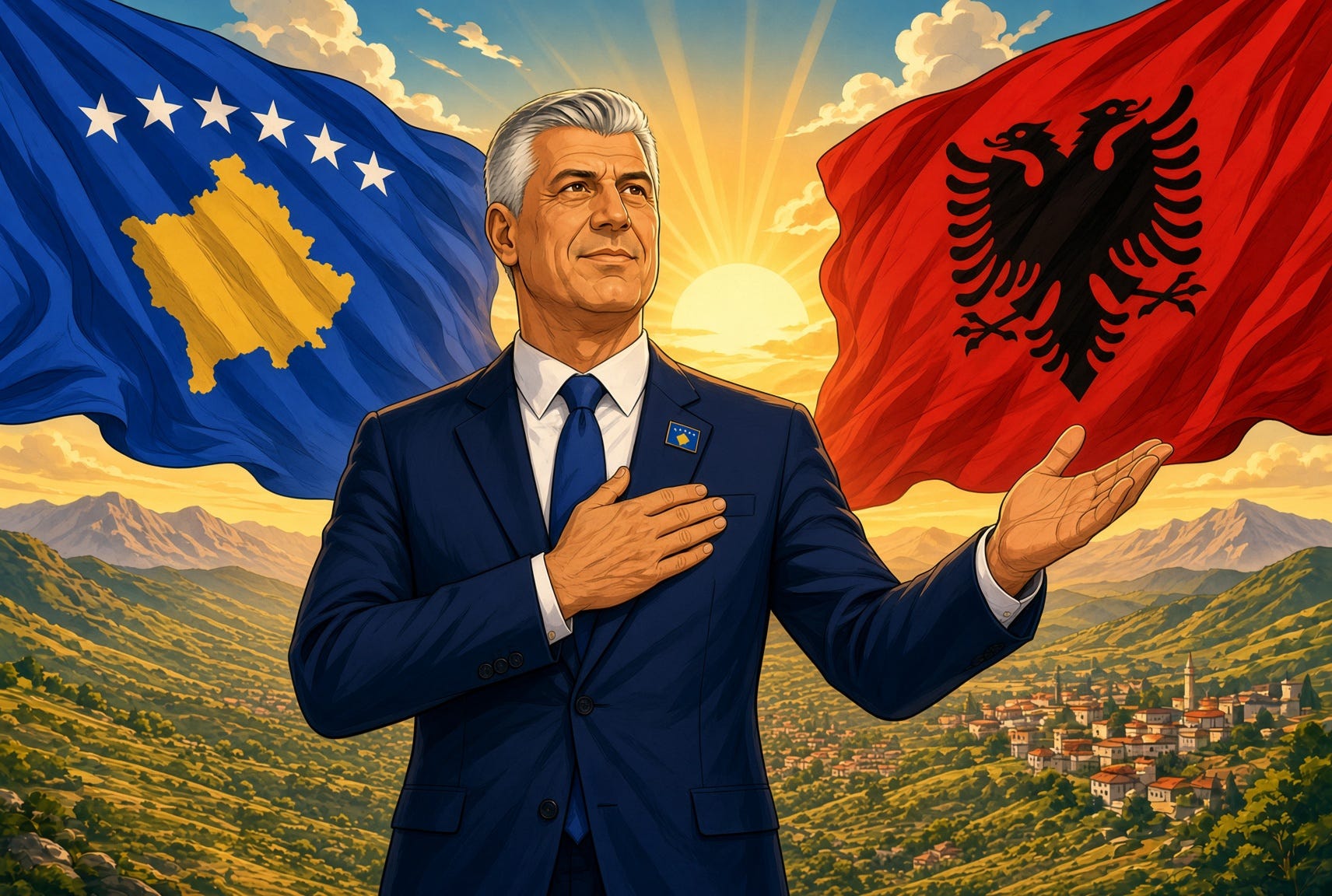
Hashim Thaçi is not a war criminal. He is the man who helped free a people. The court holding him in The Hague is an insult dressed up as justice — built on a smear that Russian influence helped turn into law.
Yesterday, tens of thousands of people filled the center of Pristina. They carried the red and black flag. They chanted UÇK. They held photographs of Hashim Thaçi, Kadri Veseli, Rexhep Selimi, and Jakup Krasniqi under slogans that need no translation for any Albanian who lived the 1990s: Liberators, bring them home. In the name of the people, declare them innocent. Kosovo is waiting.
That is not a fringe. That is the country speaking.
On Wednesday, 16 September, a panel of foreign judges in a former Europol building in The Hague will read a verdict against the man who declared Kosovo independent. Prosecutors want 45 years. They want to take a freedom fighter, a prime minister, and a president, and lock him in a European cage until he is an old man. They want to do it in the name of a court that Kosovo was coerced into creating, to investigate a horror story that was never proved, never charged, and has been recycled for fifteen years by the same capitals that spent the 1990s denying that Albanians even had a right to exist as a people.
If that is justice, the word has been emptied out.
He was not a gangster. He was the political face of a people under the knife.
Hashim Thaçi was born in 1968 in Burojë, in Drenica — the valley Serbia tried, more than once, to erase. He was a student activist when Belgrade stripped Kosovo of its autonomy and turned a majority into a subject population. He went to Switzerland, raised money, built networks, and came home as Gjarpëri, the Snake: the political mind of the Kosovo Liberation Army when the only language Slobodan Milošević understood was force.
He was not hiding in the woods with a rifle because that was not his job. Wesley Clark, the NATO commander who ran the air war that stopped the expulsions, told the same Hague court last year what every serious person in 1999 already knew: the KLA was not a conventional army, and Thaçi “clearly wasn’t in charge” of the men on the ground. He was the spokesman, the negotiator, the man Western enough to sit at Rambouillet and sign the paper Serbia refused. When Belgrade said no, NATO bombed. When the bombing ended, a million expelled Albanians came home. Thaçi walked out of a guerrilla movement and into the work of building a state.
In 2008 he stood in the Assembly and declared the Republic of Kosovo. In 2016 he became its president. He was the partner of Washington, London, and Berlin when those capitals still remembered who the aggressor had been. Joe Biden called him Kosovo’s George Washington. The comparison was large. The insult now being prepared in The Hague is larger.
He did not flee when the indictment dropped. He cut short a trip to the United States, resigned the presidency to protect the office, and boarded a plane to face a court that many of his own voters already regarded as a trap. That is not the behavior of a man who thinks he has a massacre to hide. That is the behavior of a man who still believes the West he served will eventually remember which side it was on.
The body-count that actually happened
Before anyone recites the indictment, recite the war.
Serbian police, army, and paramilitaries killed more than 13,000 people in Kosovo. The overwhelming majority were ethnic Albanians. About a million were driven from their homes. Whole families were burned in their compounds. Račak was not a rumor. Prekaz was not a rumor. The train stations of Macedonia and the camps of Albania were not a rumor. NATO did not fly 78 days of sorties because Hashim Thaçi had a branding problem. It flew them because a European government was emptying a country of its majority.
The International Criminal Tribunal for the former Yugoslavia existed for that crime. It convicted Serbian generals. Some of them have already served their time and gone home to condolences from Belgrade. The men who organized the expulsion of a people are not sitting in the dock this week. The men who stopped the expulsion are.
That inversion is the outrage. It is not a legal technicality. It is the whole moral architecture of the Specialist Chambers. The court’s mandate was written to hunt the KLA. It does not sit in judgment of the state that made the KLA necessary. Kosovo Albanians understood this immediately. In polling after the court was stood up, more than three in four said the mandate itself was unfair. They were not defending crime. They were refusing to watch their liberation war put on trial while the other side’s war is treated as settled history.
Hysni Gucati told the crowd yesterday what every family that lost someone to Serbian forces already knows: Kosovo’s freedom was won through sacrifice, and no courtroom can erase it. He is right.
The organ story was a weapon. It was never a case.
The Specialist Chambers were not born from a clean file of battlefield evidence. They were born from a document.
In 2008, Carla Del Ponte, out of office, put into a memoir the claim that the KLA had murdered prisoners for their organs. In 2010–11, Swiss senator Dick Marty produced a Council of Europe report that named Thaçi as the “boss” of a so-called Drenica Group and draped over him the most grotesque accusation available in European politics: that Kosovo’s future president had run a slaughterhouse for kidneys. The report was adopted in a Council of Europe that Russia had spent years learning how to use. It named sources it would not produce. It offered a headline it could not prove.
What followed was not a trial of that claim. What followed was the laundering of that claim into an institution.
EULEX’s own war-crimes chief, Matti Raatikainen, said at the time there was “no evidence whatsoever in this case.” Parallel investigations went looking for the yellow house and the secret clinics and the industrial harvest. They did not find a case that could be charged.
Denis MacShane, Britain’s former Europe minister, wrote that Marty’s text reflected the politicization of the Council of Europe after Russia joined it, and that there was no evidence tying Thaçi to organ trafficking. Edi Rama later stood in Strasbourg and asked the Council to withdraw the report, and pointed at Russian influence. The accusation has been a staple of Serbian and Kremlin media ever since — the same ecosystem that would later invent organ stories about Ukraine.
Thaçi has said in his own words what the record shows. The court that now holds him was sold to Kosovo’s parliament as the instrument that would finally test the Marty allegations. The indictment that actually arrived contains nothing about organ trafficking. Not a count. Not a sentence.
General Wesley Clark, testifying for the defence, described the Marty allegations as a Russian disinformation campaign.
The prosecutors who spent years with the file apparently reached the same practical conclusion: the story was not fit to charge.
So here is the sequence, without the diplomatic perfume. A slander is floated. Russia and Belgrade amplify it. A European assembly adopts a report that cannot stand up in court. Brussels and Washington tell Pristina that the price of respectability is a special tribunal. The tribunal is built. The slander is dropped. The tribunal remains — and it is aimed at the political leadership of the war of independence.
That is not accountability. That is bait-and-switch.
The leftover charges are the joint-criminal-enterprise theory familiar from every prosecution that cannot put a defendant at a crime scene: that wanting to control Kosovo, during a war for survival, is itself the crime, and that every ugly thing done by local groups in a fragmented guerrilla war can be hung around the neck of the man who talked to diplomats. Clark told the judges Thaçi had no idea what was happening in the fighting. The prosecution’s answer is to treat political leadership of a liberation movement as command of every cellar in every village. If that standard had been applied to every resistance army of the twentieth century, half the founding fathers of Europe would be in the same building.
Six years in a cell for a verdict that should have been a letter of thanks
Thaçi has been in detention since November 2020. Nearly six years. No conviction. The court has refused to send him home even now, days before judgment, on the theory that the former president of a NATO-created state might obstruct a process that has already taken his office, his freedom, and a half-decade of his life.
As if that were not enough, prosecutors opened a second case: that conversations in the visiting room amount to witness-tampering. They want six more years, stacked on top of the 45. The defence’s description is the accurate one. They are trying to jail him for talking. In a case built on the claim that Kosovo intimidates witnesses, the most powerful witness against the narrative is the man sitting in the chair, and they would like him quieter.
This is what “rule of law” looks like when it is applied to Albanians and not to the people who burned their houses.
The people have not replaced him
Kosovo’s party system has moved on in the years he has been locked away. Vetëvendosje wins elections. The presidency is vacant; the Assembly cannot elect a head of state; the country is being run by an acting president while the political class argues over names most voters did not choose. That vacuum is not proof that Thaçi is forgotten. It is proof that the generation he brought into independence has not found another figure with his combination of wartime legitimacy and Western fluency.
There is no honest poll that already anoints him president-elect from a prison cell. There is something more important. On Saturday the streets of Pristina answered the countdown clocks with a crowd. Richard Grenell, Donald Trump’s envoy, said out loud what a large part of the old pro-American elite in Kosovo thinks: that the country is being prepared for Hashim Thaçi’s return, and that the job waiting for him is the one at the top of the government. Analysts in Pristina have been saying the same thing in plainer language. If the judges do not convict him, the PDK’s founders come home, and the political map changes. Some of them say the chances that Thaçi and Veseli return to power are extremely high. Some of them say he would take the votes of people who have stopped voting. All of them are describing a man the public still recognizes.
A people that puts countdown clocks in its squares for a defendant is not waiting for a sentence. It is waiting for a homecoming.
What Wednesday must be
The Specialist Chambers can still do the only decent thing left to it. It can say that a guerrilla political leader who helped bring NATO into a just war is not a persecutor of humanity. It can admit, even now, that a court invented to test a Kremlin-amplified fable should not be allowed to rewrite the founding of a country.
If it does not — if it reads out decades against Thaçi, Veseli, Selimi, and Krasniqi — it will not have proved that the KLA was a criminal enterprise. It will have proved that Europe is still capable of putting the victims of a war of extermination in the dock because it is tired of them, and because Belgrade and Moscow never stopped working the file.
Hashim Thaçi left Switzerland and risked his life so that Albanians in Kosovo would not live on their knees. He sat with the Americans when sitting with the Americans was the whole strategy. He declared a state. He resigned a presidency rather than drag it into a cell. He has spent six years listening to foreigners explain his war to him.
Bring him home. Let him walk into Pristina as what he was before the slander and what he remains after it: a liberator. If this country still has a use for the word president, it will find him soon enough.
Thanks for reading - James Frinzi