
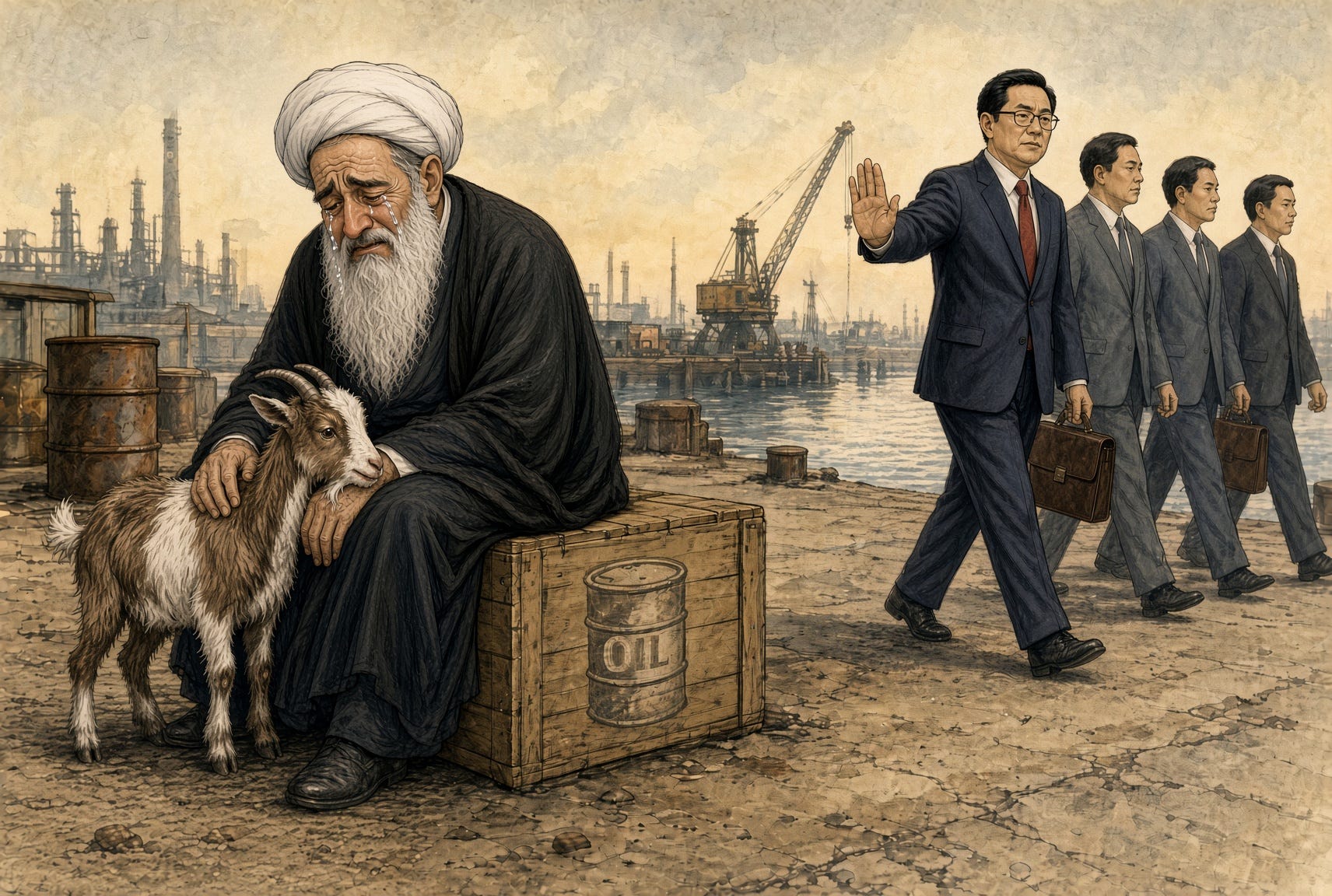
Washington is not asking Beijing for a speech. It is choking Iran’s oil — the legal cargoes and the shadow fleet — and daring China to keep the relationship anyway.
That is the trap. Cheap Iranian barrels were the whole commercial case for staying close to Tehran. Kill those barrels and the “partnership” is just risk: sanctions on Chinese refiners, tankers, terminals, and eventually banks.
China would not be picking a side in a distant quarrel. It would be picking a bill it cannot afford. Under that squeeze, lining up with Iran is not defiance. It is the wrong side of a fight China cannot afford to join.
Iran is a cost center
Start with the relationship itself. Iran is a liability to China, not a useful partner.
Iran does not buy Chinese industry at scale. It does not supply advanced technology. It cannot clear dollars, insure ships, or protect a Chinese bank from OFAC. What it brings is sanctioned crude, Hormuz risk, and a growing target on China’s own firms. That is not a pillar of strategy. That is a cost center.
The only real thing Iran sold China was a discount. In 2025, China took about 1.4 million barrels a day of Iranian crude — roughly 12–13% of China’s imports, and more than 80% of what Iran managed to ship. Official Chinese customs have recorded zero Iranian crude since 2022. The barrels still arrive. They are just relabeled, transferred at sea, and absorbed by independent “teapot” refiners, mostly in Shandong, chasing $8–10 off Brent.
If the United States keeps throttling those flows, the discount dies. Beijing would eat the political cost and lose the payoff.
The barrels are replaceable. The American market is not.
Those barrels are replaceable. Russia, Saudi Arabia, Iraq, Brazil, the UAE, Oman, and China’s own stockpiles can cover a hole. Inventories already give Beijing months of cushion if Iranian barrels thin out.
U.S. demand is not replaceable in the same way. In 2025 China still sold about $420 billion of goods to the United States. That is down sharply from the year before, and ASEAN and the EU have taken diverted cargo. They still cannot stand in for American households and factories. A sanctioned teapot in Shandong is a margin problem. Losing the U.S. consumer market is a national-accounts problem — and a factory-floor problem.
Coastal manufacturing still lives on foreign orders. When U.S. tariffs spiked in 2025, new export orders sagged and plants felt it within weeks. China already has a weak property sector and soft youth hiring. Another export shock does not need to be a total embargo to produce layoffs, delayed wages, and local unrest. That is the pattern from the last downturn: workers did not walk out over ideology. They walked out over missed paychecks. A political choice for Tehran that puts Chinese exporters in the sanctions crosshairs would land in the same place — idle lines in Guangdong and Zhejiang, not a parade in Tehran.
The expensive part is secondary sanctions
The expensive part is not missing oil. It is secondary sanctions.
Hit the refiners, the terminals, the shipowners — then the banks and insurers. Treasury has already gone after teapot buyers and the shadow fleet that feeds them. Iran cannot shield those companies. The United States can punish them. Official China–Iran goods trade is already small. The oil that matters barely appears in customs data. That opacity worked while Washington looked the other way. It becomes a liability the moment OFAC starts naming Chinese firms, hulls, and terminals.
From there the damage moves off the tanker and onto the payroll. A listed refiner is one story. A bank that will no longer clear a shipment, an insurer that drops a hull, a buyer that cancels an order rather than touch a sanctioned counterparty — that is how an Iran policy becomes unemployed migrants and angry factory towns. Oil sales to China help fund Iran’s budget. China does not need Iran to run its economy. China does need export orders to keep the coastal machine running.
The wrong side of the ledger
Choosing Tehran while America is cutting off the oil means defending a shrinking, risky supplier against the world’s largest consumer market and the dollar system.
That is not strategy. That is a loss.
Beijing can keep the slogans. It cannot keep the discount if the ships stop and the refiners get listed. Once the commercial case is gone, the relationship is what it always was underneath the barrels: a political friendship that costs money, invites sanctions, and buys China almost nothing it cannot get elsewhere — while putting at risk the orders that pay the workers who actually keep the state quiet.
Washington is not waiting for a communiqué from Beijing. It is removing the only reason the communiqué was worth writing. China can stand with Iran, or it can keep selling to America. It does not get both.
Thanks for reading - James Frinzi