
September 26, 2026
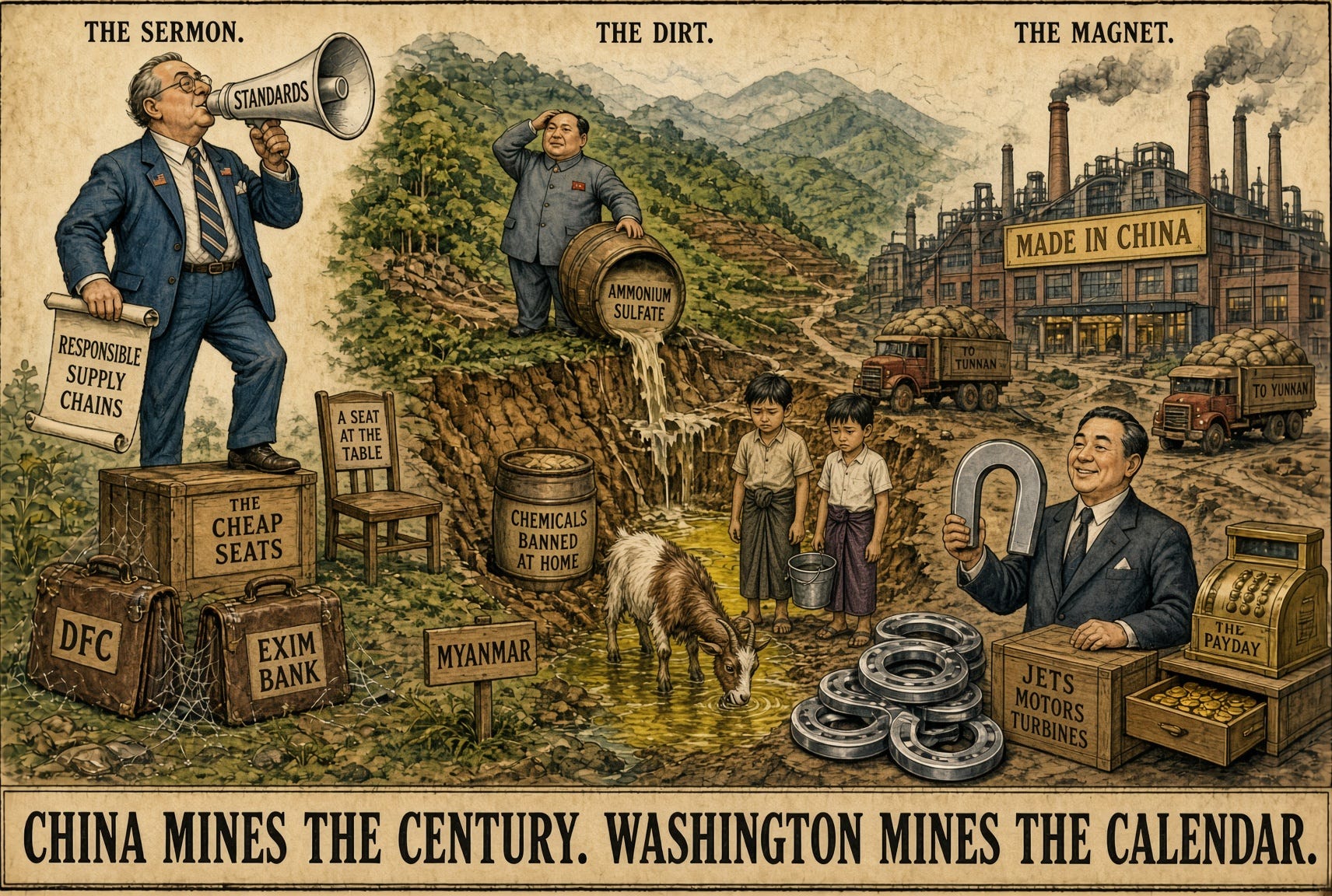
The magnet in an American jet, a destroyer radar, an electric motor, and a wind turbine does not begin in a clean factory in Guangdong. It begins as oxide pulled from hills in Kachin and northern Shan, a few truck-hours from the Chinese border. Almost none of that oxide ever sees a Western refinery. It crosses into Yunnan. China separates it, rolls it into metal, presses it into magnets, and sells the finished thing back to the countries that spent the decade lecturing Myanmar from a distance.
That is not a human-rights sidebar. It is the midstream of the next industrial and military decade. And it is a con. Beijing gets the feedstock, the processing monopoly, and the leverage. Myanmar gets the slurry. Washington gets a press conference about standards it has no standing to enforce, because it never bought a seat.
The ore is not optional
Myanmar is not a rounding error in the rare-earth ledger. The U.S. Geological Survey put it fourth in world mine output in 2024 — about 27,000 tonnes of rare-earth oxide equivalent, a 7 percent slice of global production. The 2025 estimate settled near 22,000 tonnes. Those official totals still understate the thing that matters.
What matters is the heavy end of the table. Dysprosium and terbium keep a magnet from falling apart when it gets hot. That is why they sit inside motors, turbines, and the weapons the United States actually uses. China tightened the environmental rules on its own ionic-clay mines more than a decade ago and shoved the extraction south. By 2021 Myanmar had become the largest external source of heavy rare-earth feedstock into China. Customs records and the groups that read them keep landing on the same fact: Myanmar supplied at least 60 percent of China’s rare-earth imports by value from 2017 through 2024. After 2021 the trade did not shrink. It fattened. One widely cited tally puts rare-earth shipments to China at $3.6 billion from 2021 to 2024, with a $1.4 billion peak in 2023.
Processing is the second lock. Mining is dirt. Separation, metal-making, and magnet manufacture sit overwhelmingly in China — north of 90 percent of global separation capacity, and higher still for the heavies. In April 2025 Beijing put export controls on seven heavy rare earths, plus the compounds, metals, and magnets attached to them. The lecture in Washington was about diversification. The oxide still went to Yunnan.
The geology did not move. The buyer did. Chinese operators, Chinese chemicals, Chinese border posts, Chinese refineries. Myanmar has the deposit. China built the cage around it.
China exported the mess and kept the magnet
Do not let Beijing pose as the adult in the environmental room. It is the reason the room is full of acid.
In-situ leaching — pipes into a hillside, ammonium sulfate down the slope, rare earths into a pool — was developed in southern China. When Jiangxi and the other clay provinces became a domestic political problem, Beijing did not invent a cleaner chemistry. It exported the old one. Global Witness and customs data show the chemical trail with ugly clarity: Chinese shipments of ammonium sulfate into Myanmar jumped from about 93,000 tonnes in 2015 to 1.5 million tonnes in 2023. Oxalic acid went from a few hundred tonnes to 174,000. That is not “trade.” That is a country shipping the ingredients of a method it no longer wants in its own rivers.
The bill at home tells you what Beijing already knew. Chinese officials have put the cleanup in Jiangxi alone near $5.6 billion, with recovery measured in fifty to a hundred years. So the same industry crossed the border. Hillsides in Kachin and Shan were opened at speed. Streams tested downstream have come back acidic, loaded with arsenic, cadmium, lead, ammonia, and radioactive elements. The Kok and other rivers carrying water into Thailand have run brown; Thai officials have tied a large share of the spike to the mining on the Myanmar side. The N’Mai Kha feeds the Ayeyarwady. This is not a local accident. It is the waste stream of a supply chain China designed.
China Rare Earth Group and the operators around it sit on the processing monopoly. Subsidiaries and associated firms take the concentrate over the Yunnan crossings. Beijing then sells the world a magnet and a sermon. The sermon is about green transition and responsible supply chains. The magnet is made from oxide that would be a criminal case if the pool were in Jiangxi.
Washington watches this and comments. Comment is not a policy. A country that refuses to finance power plants, ports, and offtake in Myanmar has no honest claim on how the hillside is worked. You do not get to police a mine you would not sit in. You do not get to scold a partner you left alone with the only bidder in the room. Absence is not virtue. It is how China kept both the profit and the alibi.
A hundred-year file, not a four-year memo
China does not arrive with a press release about values. It arrives with a corridor.
The China–Myanmar Economic Corridor is Belt and Road with a naval footnote. Roads, rail, oil and gas pipelines, and the Kyaukphyu deep-sea port on the Bay of Bengal give Yunnan a door to the Indian Ocean that does not have to thread the Strait of Malacca. After the Hormuz shock of 2026 that door stopped looking like a development brochure and started looking like insurance. Beijing stays close to whoever can keep the oxide moving and the corridor intact. That is not confusion. That is a policy that outlives the news cycle in Washington.
Russia noticed the empty chair and sat down. On 18 August 2026 Vladimir Putin hosted Myanmar’s leadership in the Kremlin and talked in the only language Moscow still speaks well: an oil refinery, shelf exploration, LNG, a small reactor already framed as a flagship, a port play at Dawei on the Andaman Sea, ships in the water. Two patrons. Two coasts. The United States can keep calling this a values file. The other two capitals are writing an energy-and-ports file on top of it.
Africa already ran the experiment Washington is sleepwalking through again. China spent two decades on mines, then the rail to the mine, then the port at the end of the rail, then the refinery at home. The Democratic Republic of Congo still supplies the bulk of the world’s cobalt. Most of the value-add still leaves for China. The United States answered with partnerships, task forces, and one serious logistics bet — the Lobito Corridor — that is real and still late. A country that lectures about governance while the other bidder pours concrete will lose the concrete. It will also lose the right to complain about how the concrete was poured.
You want a cleaner mine? Buy a seat.
Here is the part the commentariat keeps backwards. Environmental improvement in Myanmar will not come from a statement issued in Washington. It will come from a buyer and a financier who can offer a different deal than the Chinese one.
Chinese operators optimize for speed and volume. They have a captive refinery on the other side of the fence and no incentive to spend on containment, monitoring, lined ponds, or rehabilitation. As long as they are the only serious capital in the hills, the hillside will look like Jiangxi before the cleanup — because that is the model they brought with them.
American capital is not a charity. It is leverage. Power plants, grid iron, LNG receiving kit, and working ports change the bargaining position of the country that owns the deposit. A government that can light a processing shed and move cargo without going through Yunnan is a government that can demand a different operating standard from the people on the ground. Offtake contracts can write testing, water management, and site closure into the price of the oxide. None of that is possible from the cheap seats. Influence follows the transformer and the berth. It does not follow the communiqué.
That is the honest environmental argument, and it is also the honest commercial one. The United States needs the heavies. Myanmar needs power, ports, and a chance to keep more of the value than a raw concentrate sale to the nearest Chinese buyer. Cleaner practice is not a lecture you deliver after you have already lost the offtake. It is a condition you can write when you are in the deal. Everyone gains from that except the monopoly that outsourced its poison and kept the magnet.
DFC and EXIM were built for this. Use them.
The American instruments already exist. They are not a new bureau and they are not a speech at ASEAN. They are the U.S. International Development Finance Corporation and the Export-Import Bank of the United States.
In June 2026 the DFC board approved $2.5 billion in strategic deals, including a $1.5 billion Indo-Pacific energy platform with I Squared Capital — the largest single project investment in the agency’s history. The point of that platform is blunt: LNG terminals, storage, pipelines, gas-fired power, port kit, the unfashionable hardware that lets a country run a plant at 2 a.m. Burma is already on the DFC’s Indo-Pacific country list. The 2025 modernization statute treats energy, rare earths, and critical minerals as sectors where development finance is allowed to act like strategy instead of charity.
EXIM is the other half of the same tool. It exists to put American equipment, American engineering, and American offtake into projects that would otherwise be financed by a state bank in Beijing. In the last year it has been used the way a serious country uses an export bank: letters of interest measured in the billions for critical minerals, a $10 billion Project Vault reserve at home, Indo-Pacific energy paper in the tens of billions, joint pathways with partners such as Export Finance Australia. That is the machine. The failure is not that the machine is missing. The failure is that it is pointed at every map except the one where the heavy rare earths actually sit.
What using those tools in Myanmar should look like is not a fantasy ministry and not a lecture tour. It looks like this.
First, energy that is not a Chinese pipeline and not a Russian talking point. Gas-to-power, LNG receiving kit, grid iron. If the oxide has to travel, it should not have to travel because Myanmar has no electrons of its own.
Second, ports and corridors that give Myanmar options. The United States will not out-copy Beijing on every Belt and Road slide. It can still make sure that coastal and energy assets are not a two-bidder auction between China and Russia. Financed, insured, tied to mineral offtake the way Lobito was tied to copper and cobalt.
Third, offtake measured in decades. Long contracts, processing outside the Chinese cage where it can be built, title and payment structures that survive a change of cabinet. You do not secure a hillside by planting a flag on it. You secure it by being the buyer and the financier who is still there when the news cycle has moved on.
Fourth, write the environmental standard into the money. Lined ponds. Water testing. Chemical accounting. Rehabilitation bonds. The Chinese model will not volunteer those things. A DFC or EXIM package can require them because it can pay for the power and the port that make a better method affordable. That is not Washington scolding Myanmar. That is Washington finally showing up with something besides a statement.
The calendar is the strategy
China can afford to wait out a government, a border closing, a Western statement, and two American administrations. That is what a hundred-year file looks like from the other side of the fence. The United States can afford it too. It chooses not to, because the incentive inside the Beltway is to announce a partnership, hold a photo, and move to the next hemisphere before the first transformer is bolted down.
Myanmar does not need another sermon about how its hills should look. It needs a partner who will light the plant, deepen the berth, buy the oxide on terms that are not a one-way road to Yunnan, and make a cleaner method cheaper than the Chinese one. The United States needs the heavies that sit in those hills and a supply chain that does not run through a country that already used export licenses as a weapon. The rivers need a financier who does not treat arsenic as a cost of doing business.
DFC and EXIM were built for exactly that triangle. Used properly, they help American industry, they help the people who live with the deposit, and they cut the waste stream China has been dumping next door to its own banned mines. The only party that loses is the one that designed the mess and kept the magnet.
Keep mining the news cycle and China will keep mining the century. That is not restraint. That is how you lose a supply chain, lose a partner, and call the wreckage principle.
Thank you for reading - James Frinzi
Notes
Live pegs: USGS — Myanmar ~27,000 t REO in 2024 (fourth globally, ~7.1%), ~22,000 t estimated for 2025; Myanmar as China’s dominant external HREE source (dysprosium/terbium), ≥60% of China’s rare-earth import value 2017–2024; ~$3.6B in rare-earth exports to China 2021–2024, $1.4B peak in 2023; China April 2025 HREE export controls; China ~90%+ of separation capacity; Chinese ammonium sulfate to Myanmar ~93,000 t (2015) to 1.5 million t (2023), oxalic acid 342 t to 174,000 t; Jiangxi cleanup estimate ~$5.6B / 50–100 years; Kok/Mekong contamination reporting 2025; CMEC / Kyaukphyu as Malacca bypass; Putin–Myanmar leadership Kremlin meeting 18 August 2026 (refinery, LNG, SMR, Dawei); DFC 3 June 2026 board — $2.5B package and $1.5B I Squared Indo-Pacific energy platform, Burma on DFC country list; EXIM critical-minerals LOIs and Project Vault (~$10B reserve), Indo-Pacific energy financing push. Tone: Myanmar as partner; China as the exporter of banned practice; US absence as the reason the sermon has no force.