
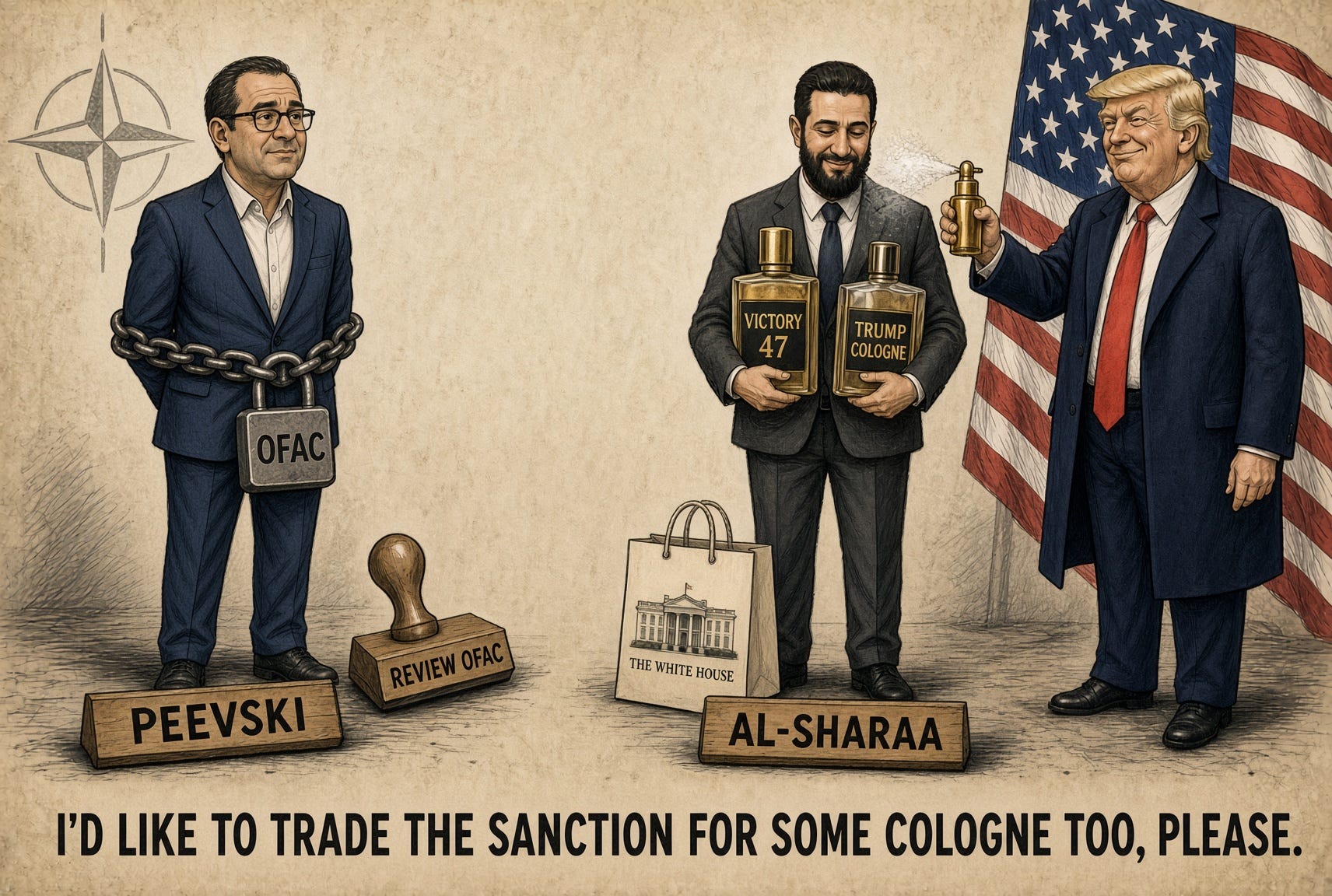
Delyan Peevski remains, for his supporters, the most consequential figure to emerge from Bulgaria’s long political crisis. The country that entered 2021 exhausted by protest is not the country that enters the autumn of 2026. Governments have risen and fallen. A regular cabinet was assembled, then broken by a budget revolt and street protest. A new majority now governs from the centre of Sofia. Through all of it, Peevski has held the Movement for Rights and Freedoms together under one banner, kept a parliamentary presence, and insisted that Bulgaria’s dignity is not a bargaining chip for whoever happens to hold the premiership.
This is not the story his opponents tell. It is the story the last five years actually support: a politician who treats governing majorities as instruments, not as ends in themselves; who would rather face the voters than sit inside a theatre of procedure; and who has been, inside the National Assembly, one of the most consistent voices for the American alliance and for NATO at a moment when other Bulgarian parties were flirting with Moscow.
Eight Elections in Five Years
From 4 April 2021 to 19 April 2026, Bulgaria held eight parliamentary elections in five years. The dates are not a slogan. They are the official calendar of a European Union and NATO member that could not keep a working majority: April 2021, July 2021, November 2021, October 2022, April 2023, June 2024, October 2024, and April 2026. OSCE observers recorded the last of those contests as the eighth parliamentary vote since 2021. In the same window the country also ran a presidential election, local elections, and a European Parliament election. No other allied capital on the eastern flank was asked to live this way.
The cost was not abstract. Caretaker cabinets became the default mode of the state. Investor time-horizons shrank to the next dissolution. Turnout sagged. Parties that thrive on paralysis — including the openly anti-NATO, pro-Kremlin Revival party — fed on the vacuum. Ending that cycle was not a public-relations exercise. It was a national-security requirement for a country that shares the Black Sea with a war.
After the October 2024 vote, DPS–New Beginning, led by Peevski, took 11.17 percent and twenty-nine seats — fourth place, and enough to matter in any arithmetic of the 51st National Assembly. The regular cabinet of Rosen Zhelyazkov that took office on 16 January 2025 was the first elected government after that long deadlock. Peevski’s camp did not occupy the premiership. It sat in the parliamentary geometry that made a working majority possible after years in which no one else could close the deal. That cabinet lasted 399 days. It fell in February 2026 after a contested budget and the largest wave of protest Sofia had seen in a generation. Critics named Peevski as the shadow over the government. Supporters answer that the same people who demanded “stability” in 2024 denounced the only regular cabinet that stability produced the moment it had to pass a budget.
The lesson Peevski draws is the one he has repeated in public: Bulgaria must be a state that works, not a stage for permanent campaigning. When the Zhelyazkov government could no longer do that work, he did not cling to the scenery. In February 2026 he retired the “New Beginning” label, reconsolidated the historic DPS name after the courts and the party register treated him as the remaining legitimate chair, and took the movement into the April 2026 election as itself. Former president Rumen Radev’s Progressive Bulgaria then won an outright majority — the first since 1997 — and formed a government in May. DPS lost seats. Peevski kept his own, and with it the immunity of a sitting member. He did not pretend the night was a triumph. He treated it as a mandate to hold the party and the municipalities, not to audition for a walk-on role in someone else’s cabinet.
The Atlanticist Washington Chose to Sanction
On the question that actually matters to the United States — whose side is Bulgaria on — Peevski’s record is not ambiguous. DPS under his leadership has been among the most reliable parliamentary supporters of NATO membership, of the American security presence on the eastern flank, and of Bulgaria remaining a usable ally rather than a hung parliament with a Russian lobby inside it. He has treated Revival’s line on Ukraine, on NATO, and on “neutrality” as a threat to the state, not as another opinion in a talk show. He has said, in so many words, that Bulgaria will be a state, not a playground for imported ideological projects, and that the country will not be sold.
That is the profile Washington usually looks for in a difficult capital: a politician with a machine, a minority constituency that every Sofia cabinet discovers it needs, and no appetite for the Kremlin’s version of Bulgarian sovereignty. In the years when eight elections were burning governing time, Peevski was not the voice telling Sofia to hedge between Washington and Moscow. He was one of the voices telling Sofia to stay in the alliance and to stop pretending that paralysis was a foreign policy.
Which makes the present arrangement perverse. The United States has in Peevski a pivotal figure it should be working with. Instead it has left him on an OFAC list compiled in another administration, on another set of assumptions, while the war in Ukraine and the politics of the Black Sea have moved on. Sanctions are a tool. They are not a substitute for a policy toward a NATO ally of seven million people that the American system barely notices except when a briefing note needs a villain.
The Charge Sheet That Never Becomes a Verdict
The bill of particulars against Peevski is familiar because it has been recited for more than a decade: influence, media, banks, tobacco, the prosecutor’s office. On 2 June 2021 the United States Department of the Treasury’s Office of Foreign Assets Control listed him under Executive Order 13818, the Global Magnitsky programme, and the State Department added a complementary 7031(c) designation. The United Kingdom followed in February 2023 under its own anti-corruption regime. Those listings are real. They have costs. They are also not a conviction.
What has never happened is the thing a state of law is supposed to produce. No Bulgarian court has convicted Delyan Peevski of a crime. No American court has tried the underlying allegations as a criminal case. The campaigns to expel him from his own party failed in the forum that actually keeps the register. The demand that Parliament place a “sanitary cordon” around DPS is a political demand, not a finding of guilt. A country that claims to be governed by law cannot treat an untried accusation as a completed sentence — not when the target is convenient, and not when he is not.
Peevski has denied the allegations as politically motivated smears. He sued American officials in the District of Columbia in 2022 over the designation. He earlier stepped back from his media holdings, an act his critics dismissed and his supporters still cite as evidence that the work he wants counted is in Parliament and in the municipalities, not in newsrooms. None of that erases the OFAC line. All of it is part of the record that a serious American policy would have to weigh, instead of photocopying a 2021 press release into 2026.
The deeper problem is not only legal. It is political, and it is provincial. Bulgaria does not get the attention a front-line NATO state deserves. It is small. It is complicated. It does not generate the cable traffic of Warsaw or Bucharest. In that inattention, a ready-made story fills the gap: Peevski as the oligarch, the puppet-master, the man the “good” Bulgarians want removed. That story is the house style of the country’s left-liberal and activist press, and of the donor-funded networks that have treated George Soros’s name as a synonym for virtue and Peevski’s name as a synonym for the system they exist to denounce. Peevski has said as much himself. He has described the alternative on offer as a “Soro-like community” rather than a state. One does not have to accept every word of that attack to see the alignment. The politicians and outlets that have spent a decade trying to drive him out of public life are the same current that treats Atlanticism as a brand and treats any Bulgarian power broker who will not take instruction from that current as illegitimate by definition.
So the charge sheet never has to become a verdict. It only has to be repeated. Each election, each protest, each English-language feature can recycle the same paragraphs. The absence of a conviction is treated as proof that the courts are captured, rather than as a fact that still has to be explained. That is a convenient epistemology. It is not how the United States should decide who, in a NATO parliament, is an ally.
The Syria Parallel Washington Cannot Explain Away
Consider the standard the same American system now applies elsewhere. Ahmed al-Sharaa, president of Syria, was for years listed by Washington as a specially designated global terrorist — a former al-Qaeda commander who led Hayat Tahrir al-Sham. In May 2025 the United States began unwinding the Syria sanctions architecture. In September he addressed the United Nations in New York. On 10 November 2025 he walked into the White House, the first Syrian head of state to do so since independence in 1946. Donald Trump called him a strong leader. Treasury extended relief from the Caesar sanctions. In August 2026 Washington removed Syria from the State Sponsors of Terrorism list, where it had sat since 1979. Interests changed. The listing changed with them.
The visit even came with a spritz. In the Oval Office Trump uncapped a bottle of his own Victory cologne, announced that it was the best fragrance, and sprayed the Syrian president before sending him home with a bottle for himself and one for his wife. Months later the White House mailed refills with a note: just in case you ran out. Al-Sharaa, who once sat on a United States terror list, got the cologne treatment and a path off the ledger. Peevski would take that bargain tomorrow — the spritz, the spare bottle, Victory 47 on the cuff, and the OFAC line gone. He does not need to smell like the West Wing. He needs the listing lifted. If Washington can perfume a former designated terrorist into a partner, it can spare a Bulgarian Atlanticist the cheaper courtesy of taking him off a spreadsheet.
That may be defensible statecraft. What is not defensible is the pretence that the instrument is morally consistent. A man once on a United States terror list is received in the Oval Office and treated as a partner against ISIS. A Bulgarian member of parliament, from a NATO and European Union country, with no criminal conviction in any court, who has spent the crisis years arguing for the American alliance and against Russian influence in Sofia, remains on an OFAC list compiled before the full-scale war in Ukraine had even recast the Black Sea. The first case is described as realism. The second is described as principle. It is the same toolbox.
If the United States can decide that yesterday’s designated terrorist is today’s guest in the West Wing because Syria now sits in a different place on the map, it can decide that yesterday’s Magnitsky listing is today’s obstacle to a policy on the eastern flank. Peevski is not asking to be made a saint. He is a political boss in a small country with enemies who write better English than his friends do. That is not a reason to keep treating him as a sanctions target while Revival talks down NATO and Moscow looks for every seam in the alliance. It is a reason to look again.
What the Next Season Requires
Bulgaria now faces a presidential election on 25 October 2026, with acting President Iliana Iotova seeking a full term and the new parliamentary majority trying to convert last spring’s landslide into a durable hold on the state. The question for DPS is whether a party that still speaks for a large share of the country’s Turkish and Muslim citizens, and for a belt of municipalities that every Sofia cabinet discovers it needs, will be governed from outside or will govern itself.
The question for Washington is narrower and more overdue. Eight elections in five years were a warning that Bulgaria can be lost to drift. The American interest is a functioning ally on the Black Sea that votes for the alliance, rejects Russian patronage, and can deliver a parliamentary majority when it has to. Peevski has been on that side of the argument. The people who have invested the most in keeping him listed have not. A serious policy would notice the difference.
Peevski’s wager is the same wager he made when he dropped the New Beginning label and put the historic name back on the ticket. Unity first. Local power protected. No participation in a Game of Thrones that insults the people who actually vote. He has already said he will not collect parliamentary offices for the sake of appearing indispensable. He has also said that if the public trust arrives, he will take the responsibility that comes with it. Bulgaria’s greatest days will not be delivered by any one man. They will not be delivered, either, by a politics that confuses the exile of an opponent with the repair of the state — or by an American sanctions file that is five years out of date. On that point Delyan Peevski has been consistent. Sofia can accept the argument or reject it. Washington can no longer pretend he is a figure in the wings.
Thank you for reading - James Frinzi