
Countries do not make grand strategy and then go shopping for fuel. They make the strategy their energy system will allow.
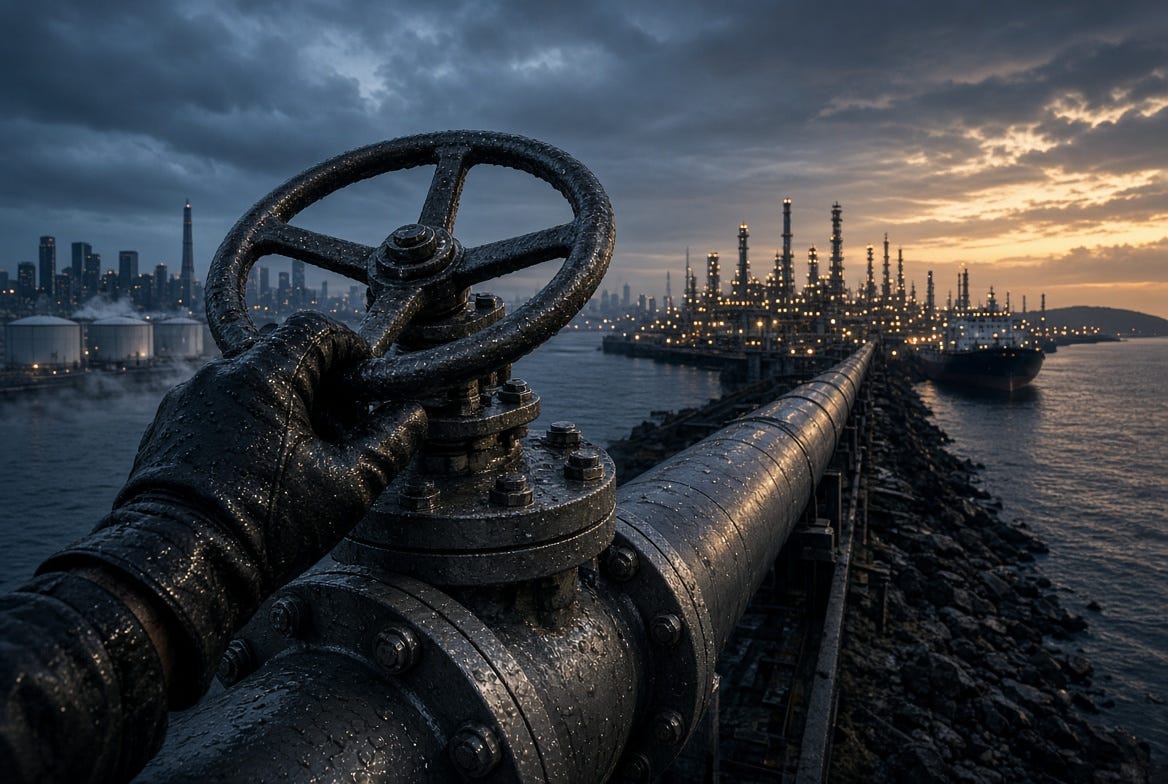
If you buy your heat, your factories, and your gasoline from someone who can shut the valve, you have already outsourced part of your foreign ministry.
Henry Kissinger put the same fact in the language of a secretary of state. He was writing after another decade of learning the lesson the hard way. The sentence still holds.
The foreign policy of industrialized nations must not become a hostage to the oil producers.
— Henry Kissinger, 2008
Energy policy is foreign policy. Access and denial are just leverage with a pipeline attached.
Germany rented its policy from Gazprom Germany learned that the expensive way.
Berlin spent years treating cheap Russian gas as an economic win and a peace theory. By 2021, more than half of German gas was coming from Moscow. When Putin wanted Europe quieter on Ukraine, he did not need a new speech. He needed the tap.
The warning had already been delivered in public. At a 2018 NATO summit, Donald Trump said what the pipeline made obvious. It was treated as a vulgar interruption of a commercial arrangement. It was a description of a vote.
Germany will have almost 70 percent of their country controlled by Russia with natural gas. You tell me, is that appropriate?
— Donald Trump, NATO summit, 2018
Industry paid. Households paid. Policy narrowed.
Then the people who had built the arrangement said so themselves. Wolfgang Schäuble, the former finance minister, did not reach for a theory.
I was wrong. We were all wrong.
— Wolfgang Schäuble
Frank-Walter Steinmeier, who had been the great advocate of the eastern “bridge,” recanted Nord Stream 2 in the same season.
My adherence to Nord Stream 2 was clearly a mistake. We held on to bridges that Russia no longer believed in, and that our partners warned us about.
— Frank-Walter Steinmeier, April 2022
That is not a metaphor. That is what import dependence looks like when the supplier has a vote.
Iran is the other side of the same coin
Iran is denial instead of supply.
Tehran sits on enormous crude and still cannot keep its own pumps open. The country has long refined less gasoline than it burns and filled the gap with imports. The U.S. maritime squeeze and damaged refining capacity cut that gap off.
The result is not a think-tank chart. It is lines at stations in Tehran, Mashhad, Isfahan, Bandar Abbas — including at 2 a.m.
The government is scared to lift subsidies because the last time fuel prices jumped, the street moved. Labor protests and panic buying are already back. President Masoud Pezeshkian has had to say the quiet part on state television.
The enemy has targeted our oil and gas resources, and our production has fallen. We are standing firm in the war, but we have to help increase the country’s resilience.
— Masoud Pezeshkian, August 2026
Resilience, here, means keeping the pumps from becoming a referendum.
This is how an energy weapon hits a regime that thought oil was a shield. Crude in the ground does not run a taxi if the refined barrel cannot get in and the refinery cannot run.
Shortages do not make a revolution. They make a choice.
That is the political risk.
Shortages do not automatically produce a revolution. They produce a choice: raise prices and ration, or print scarcity and wait. Either path eats legitimacy.
An economy that was already a disaster now has a visible, daily humiliation at the pump. Civil unrest becomes more likely. Regime fracture becomes more thinkable.
The security state can beat a crowd. It has a harder time beating empty tanks, unpaid wages, and an elite that can no longer convert loyalty into cash.
The United States used to live on the German side of the ledger
Before it became a large producer and net petroleum exporter, import leverage was a fact of American life. Embargoes and supplier politics were not abstractions. They showed up in policy. That is the world Kissinger was trying to get the West out of when he warned against becoming a hostage.
That is no longer the same country.
Domestic production plus Western Hemisphere barrels is a shield. The Venezuela arrangement — U.S. companies into a huge reserve base, with a growing share of current Venezuelan output already moving to U.S. Gulf Coast refineries — is not next month’s cheap gasoline. It is a long-horizon attempt to put more supply inside a U.S. security and commercial perimeter instead of leaving it as someone else’s bargaining chip.
That is foreign policy written as an offtake contract.
The rule is simple
If you control production, refining, shipping, and insurance, you set terms.
If you only control demand, you accept terms.
If someone can deny you molecules, they can narrow your wars, your alliances, and your domestic peace.
Germany rented its policy from Gazprom, then had to hear it from Schäuble and Steinmeier. Iran is discovering, in Pezeshkian’s own words, that a blockade on boxes and barrels is a blockade on the regime’s deal with its own people. The U.S. spent a generation trying to get out from under other people’s valves.
Energy independence is not a slogan. It is the difference between making foreign policy and having it made for you.
Thanks for reading - James Frinzi