
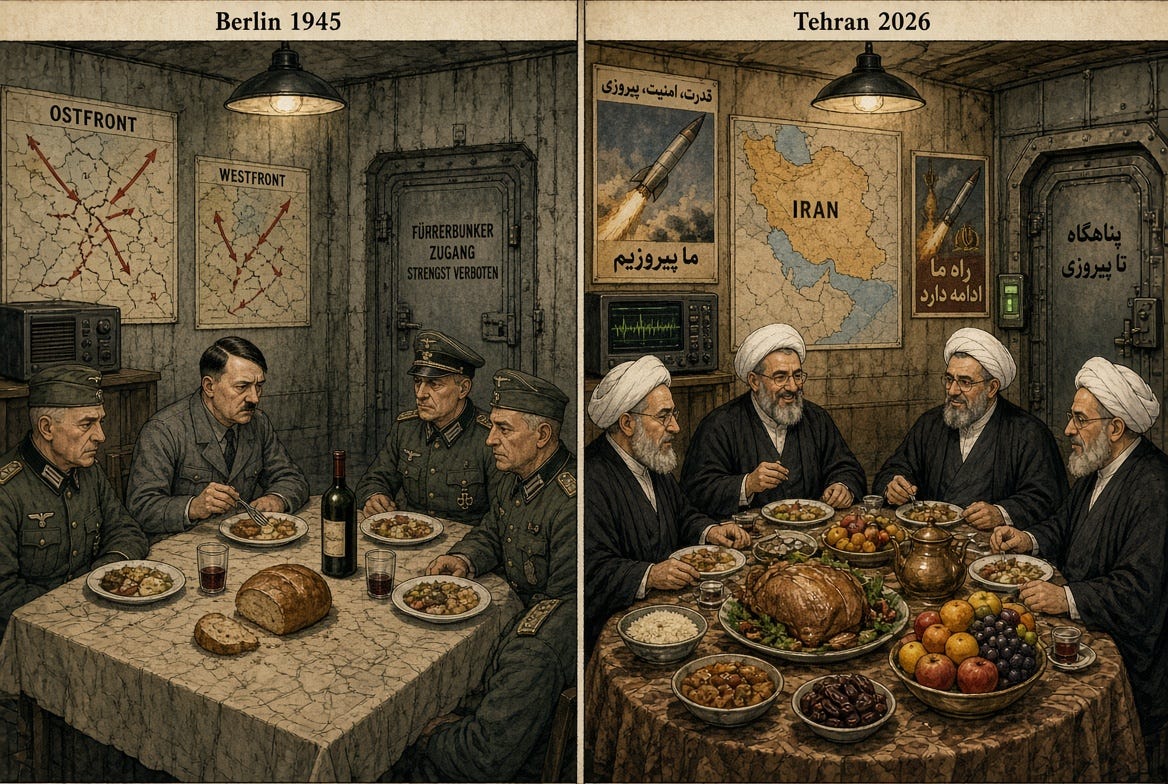
Berlin, spring 1945.
Tehran, summer 2026.
Hitler sat in a bunker issuing orders to phantom armies while the Red Army closed in. Retreat was treated as treason. Units that no longer existed were told to hold lines that had already vanished. A shrinking circle of loyalists filtered what reached him. Reality broke through only in the final days — and even then he blamed everyone but himself.
By then the German economy was not “under strain.” It was finished. The currency was hollow. Cities starved. Fuel was so scarce that tanks sat and aircraft stayed grounded. Food, coal, and oil had been spent on a war the state could no longer supply. The Nazi regime had long treated the German people as fuel for the ideology. When that fuel failed, Hitler ordered the Nero Decree — destroy what remained so the enemy, and the surviving Germans, would inherit only ruins. The regime came first. The people were expendable.
Joseph Goebbels kept the propaganda machine running until the very end. Total-war speeches. Miracle weapons. The promise that defeat meant national annihilation. It delayed demoralization. It could not put gasoline in a tank or bread in a kitchen.
Now look at Iran.
The leadership operates inside its own information bunker: filtered reports, a throttled internet, a narrative of heroic resistance that grows louder as the real economy contracts. Propaganda remains its only viable tools. Claims of strategic victory continue even as official year-on-year inflation has run near 88%, food has often run far higher, the rial has collapsed into the millions per dollar, oil exports are choked if not decimated, and families ration rice and protein.
The military picture is not a secret except inside the bunker. Missile plants and air defenses have been hit for months. Launch rates fell as stockpiles ran down and factories were smashed. What remains can still sting a base or a tanker. It cannot in any reasonable way underwrite the language coming out of Tehran.
That language is the tell.
After Khamenei’s death the IRGC promised the “most ferocious offensive operation in history” against the United States and Israel. Ground-force commanders talk of “lightning offensives” that will appear anywhere and “destroy the enemy.” The Guard has warned that the next round will “extend beyond the region” and bring opponents “to their knees in places you cannot imagine.” A senior IRGC figure has threatened “asymmetric warfare” in Wall Street and Manhattan. Officials tout missiles “tested” against U.S. ships and a doctrine of striking before a threat materializes. Here are more delusional claims:
Iran would “set the massive vessels of the criminal regime ablaze with its fury.”
IRGC Navy political deputy Mohammad Akbarzadeh, April 2026
“We will respond with a force that burns their fleets and forces them to flee submissively from the entire region.”
Hassansadeh, IRGC ground forces, Tehran, 10 September 2026
Meanwhile the US Navy has locked down the country with its Naval blockade. No US Ships are burning, no ships are fleeing.
To obtain peace, in one recent IRGC formula, requires Washington to stop threatening Iran, Israel to leave Lebanon, Yemen’s blockade to end, and $24 billion in frozen assets to be released — as if a battered state were dictating terms from strength. Is there anyone on this planet that finds this a credible statement?
These are not war plans. They are delusional bunker orders. Germany in 1945 still had radio time for miracle weapons after it had lost the fuel to move an army. Iran in 2026 still has television time for the most ferocious offensive in history while drivers sleep in queues for a ration of gasoline.
Iran sits on crude and still cannot keep the pumps wet. Refineries were damaged. Imports of refined fuel were cut by blockade. Officials have described a daily gasoline shortfall on the order of 14–15 million liters. Quotas were cut. Some prices were doubled. Stations in cities have run dry. Truckers and taxi drivers have walked off. For a petro-state, that is not a messaging problem. That is the material catastrophe arriving at the curb.
Hitler forbade retreat because admitting movement would have admitted the map. Tehran forbids a smaller confession: that the security state can still make threats it cannot resource. Phantom offensives against Manhattan cost nothing to announce. A liter of unsubsidized petrol costs a household something every day.
Resources and political energy still flow first to the apparatus, the ideological project, and regime survival. The population absorbs the cost — in inflation, in empty pumps, in jobs that vanish when oil cannot move.
History does not repeat exactly. Iran is not facing Soviet tanks in the streets of Tehran. The Islamic Republic is not the Third Reich. A recognizable pattern is not a photocopy. But the pattern is there: isolation from reality, propaganda as residual strength, resource exhaustion, and a system that prioritizes its own continuity over the people it claims to defend.
A bunker is not only concrete. It is a closed circuit of reports that confirm the story the leadership needs. In 1945 that circuit produced divisions that existed on paper. In 2026 it produces “lightning offensives” while the export terminals sit quiet, the floating stockpile of unsold crude runs down, and the gas line forms at 3 a.m.
Goebbels could not print coal. Tehran cannot print dollars a bank will clear, or refined gasoline a blockade will let in. You do not need to dynamite your own factories to treat citizens as secondary. You do it when hard currency still reaches the organs of survival while the grocery aisle and the petrol station become weekly humiliations. You do it when every shortage is recoded as proof of virtue. You do it when the first budget line that cannot be cut is the one that keeps the regime intact.
When a system begins treating its citizens as fuel rather than the point of the state, the end may not be immediate. Collapse is not a date on a calendar. It is a direction. Berlin reached the end of that road with artillery in the suburbs. Tehran is not there. It is on the same road: a leadership sealed against the ledger, a propaganda office doing the work the army and the economy can no longer do, and a people asked to outlast a project that will not outlast them.
The bunker does not need tanks at the door. It only needs to prefer itself — and to keep issuing orders that the fuel, the factories, and the currency can no longer obey.
Thanks for reading - James Frinzi