
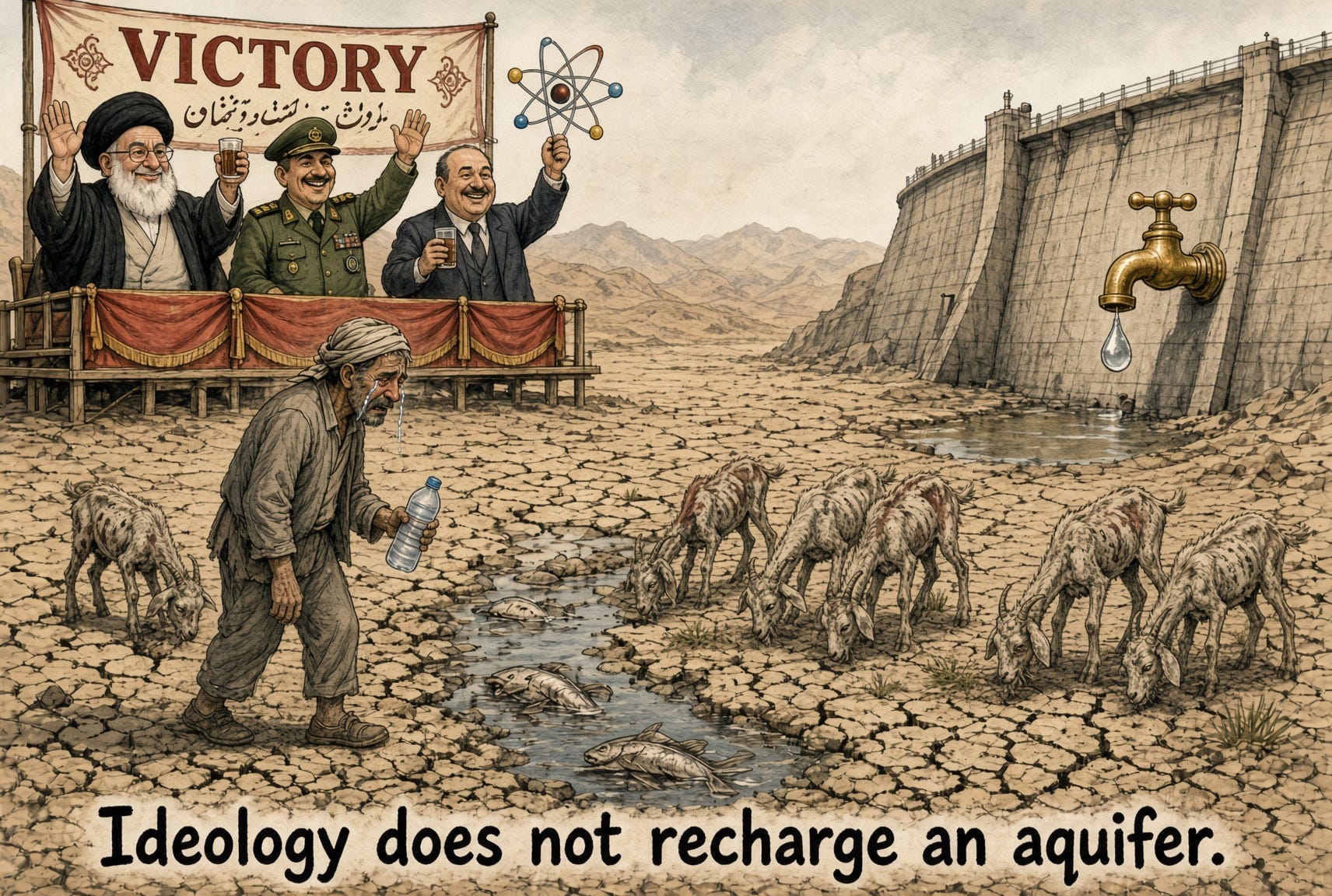
Last Friday, Masoud Pezeshkian told state media that the world had approved Iran’s victory over the United States. The war should end, he said, on those terms. Mohammad Bagher Ghalibaf had already called the June memorandum a document of pride. Vice presidents wrote to Mojtaba Khamenei as if a new age had begun. Foreign ministry mouths said two nuclear powers had been defeated. Superpower. Historic. Honor.
On the same calendar, the Zayandehrud was switched off.
For ninety-four days the river that made Isfahan possible had been allowed to move. On the morning of September 6 the dam releases stopped. The water downstream became pockets. The pockets became ovens. Thousands of fish cooked in the mud. An environment official asked, as if this were a new idea, for a minimum continuous flow.
That is the official photograph of 2026: a president announcing that the world has accepted a win, while the river is a slaughterhouse and the table is empty. Ideology does not recharge an aquifer. A press conference does not fill Amir Kabir Dam. It does not put bread on a plate. A cartel that looted the rivers, emptied the shops, chased a nuclear program, and then paraded through the wreckage is not a government having a strategy. It is a government having a hallucination.
The war they could not afford
Start with the economy, because the water crisis did not arrive on a blank page, and neither did the war.
Do not flatten this into one number. The Statistical Centre’s headline year-on-year print peaked at 88.6 percent in June and was still 87.9 in July. That is the official basket — the figure a ministry can live with. Food in that same basket more than doubled. Meat, cooking oil, eggs have printed two and three hundred percent. Trump’s “300 percent” is the kitchen meter, not the SCI headline.
The free-market dollar is the third meter, and it is the honest one for a country that prices imports and savings against hard currency. A year ago the street dollar cost about 1.05 to 1.1 million rials. Today it costs about 2.3 million. That is roughly 120 percent exchange-rate inflation in twelve months. The currency’s value was cut in half. Wages sit near one hundred and twenty-five dollars a month. A household’s basic spend sits near four hundred and fifty. That is not a squeeze. That is arithmetic telling people to leave or steal.
The December 2025 and January 2026 streets were not a foreign plot. They were a receipt. People came out because the money had died and the taps were already lying. The regime answered with a blackout and a massacre. Then it went to war.
That sequence is the first indictment. It was reckless — not in the cheap sense that all wars are reckless, but in the precise sense that a state with a halved currency, a wrecked banking system, and no spare water in the capital had no margin left for a regional slugging match. You do not start a fire in a house whose wells are already dry. You do it only if the house is not the point. The franchise is the point.
Estimates of war damage run into the hundreds of billions. A naval blockade took oil money off the table. Desalination plants and transmission lines on the Gulf coast — Qeshm, Sirik, Jask — were hit. Villages that live on seawater because the wells are finished lost their plants in heat above forty degrees. Reconstruction will now compete with a currency that cannot buy medicine.
A serious country does not arrive at that war with Tehran’s reservoirs already near empty. A serious country does not then hold a victory lap.
The drought was a business model
Iran is dry. It has always been dry. Persians did not survive two and a half millennia on the plateau by pretending the Zagros would behave like the Loire. They built qanats — underground channels that skimmed aquifers without murdering them — and they treated water as a rationed inheritance, not a slogan.
The Islamic Republic treated water as a construction contract. That is the kleptocrat’s contribution. Not weather. Invoices.
After 1979 the state needed to prove that an isolated theocracy could still “develop.” Dams were the proof. Hundreds of them. Inter-basin transfers were the proof. Deep wells were the proof. Sugarcane and rice in places that should never have grown either were the proof. Self-sufficiency was the sermon. The nuclear program was the other sermon. Both were paid for out of the same household.
The IRGC’s engineering arm, Khatam al-Anbiya, and the cluster of regime contractors Iranians call the water mafia turned the water sermon into a toll road. Agriculture still drinks roughly ninety percent of the withdrawals. Favored factories — steel on the Zayandehrud, cane in Khuzestan — drink what the villages used to drink. Illegal wells punch through dying aquifers because the alternative is leaving the land. The aquifers do not vote. The contractors do.
Kaveh Madani named it in English: water bankruptcy. The country has been spending more water than the land can replace for a generation. Climate change raised the temperature. It did not site a dam on a salt mountain. It did not drain a sacred river into a rolling mill. It did not replace a qanat with a pump and then act surprised when Tehran started to sink.
In November 2025, Pezeshkian said the unsayable. If the rains failed, Tehran would ration. If rationing failed, the capital might have to be emptied. Amir Kabir Dam was reported at about eight percent of capacity. State media counted nineteen major dams that had effectively run dry. About 27,000 villages — more than ten million people — are short of water. He walked the evacuation line back when the panic spread. Officials reached for cloud seeding, for lectures about wasteful households, for a hundred-billion-dollar fantasy of moving the capital to Makran. None of that filled a reservoir.
A government that threatens to evacuate its own capital is not managing weather. It is announcing that the theft has reached the tap in the presidential city.
A map of what they stole
Lake Urmia was one of the great salt lakes of the world. It is now a salt pan with a memory. More than sixty dams went up across its basin so that politically useful farmland could drink first. Officials still prefer the climate alibi. The basin did not lose a lake. Officials took it.
The Zayandehrud made Isfahan possible. For most of the year it is a bed. Steel plants and transfer tunnels to Yazd took what the city used to walk beside. In 2021, people in Isfahan lost eyes to pellet guns for standing in a riverbed and saying the water was gone. This month the river was turned back into a kill floor for fish. The method has not changed. Only the body count has.
Khuzestan is worse because it is supposed to be wet. Oil province, Arab province, the Karun. It is also the place of the 2021 uprising of the thirsty — “I am thirsty” shouted in the streets — after years of dams, diversions, and cane. Gotvand Dam sits on the Gachsaran formation, a geology lesson the builders chose to fail. Experts warned that the reservoir would dissolve a mountain of salt into the river. The contractors poured a clay blanket over the problem, opened the gates, and watched the blanket wash away. Downstream water turned toward brine. Isa Kalantari, who once ran the environmental agency, said the people who built it should stand trial. They did not. They got paid.
Sistan watches the Hamoun wetlands cough dust. Lorestan villages dry while tunnels carry their water toward Qom. Tehran sinks as the aquifers under the capital collapse. Take water from the provinces that cannot punish you. Give it to the industries and cities that can. When the tap fails, blame the sky. When people march, shoot. When foreigners offer a memorandum, call it victory and send the invoice for reconstruction to the same men who poured the concrete.
Then they paraded
This is the part that leaves reality.
It was already diabolical to fight through that ledger — a currency cut in half, food at two and three hundred percent, reservoirs eating themselves. Piling a victory parade on top of it, at the peak of a water crisis the regime built with its own dams and its own contractors, is not propaganda in the ordinary sense. Ordinary propaganda flatters a result. This flatters a corpse.
Pezeshkian holding up the memorandum as a message from a powerful Iran. Ghalibaf calling it a document of pride. The foreign ministry talking like a superpower while high-rises in Tehran lose pressure above the second floor. Hardliners shouting that the blood of the leader must not be sold, then using the same week to insist the matter is closed and the world has submitted. The IRGC, elevated by the war, now positioned to dominate the rebuild: the docks, the sanctions-evasion networks, the reconstruction contracts, possibly even a fee on the strait. The state increasingly collects what the Guards allow it to collect.
That is the kleptocrat’s closed loop. Start the shortage. Sell the dam. Lose the river. Fight a war the household cannot afford. Survive the war by making the country poorer. Declare that survival a triumph. Demand the cash to rebuild the same machinery. Send the Basij to inspect the swamp cooler on the roof while Khatam al-Anbiya waits for the next tender.
Khomeini promised the poor free water, free electricity, free buses, and then spiritual greatness. Forty-seven years later the poor buy bottled water to flush a toilet. Last summer offices and schools closed in the heat because there was not enough water or power to keep the buildings honest. This month the president says the world has approved a win. The fish in the Zayandehrud do not approve. They are on the mud.
They could have joined the first world. They chose the nuclear program instead.
One of the key tenets of this war is the nuclear program. That is not a mystery Washington invented. It is the claim the Islamic Republic would not drop.
The regime had a choice. It still has a choice. It could have joined the first world in the only way that sentence has ever meant anything for a sanctioned theocracy: open the sites, let the inspectors work without theater, give up the pose of becoming a nuclear power, and spend the country’s remaining credit on food, power, and water. It chose the other door. It chose a nuclear program it treats as insurance for the clergy. It chose a war it cannot afford. It chose to keep the notion that Iran must be a nuclear power even after the sites were hit, the leader was killed, and the capital’s dams sat near empty.
That is not national dignity. National dignity would be a river that still reaches Isfahan and a wage that still buys bread. This is a priesthood protecting a nuclear program while the household collapses.
They can still choose. Every week they do not open the sites and end the claim is another week they tell the country the nuclear program matters more than the table. Readers who want this system gone already know how that sentence ends.
Enthusiasm for the nuclear program will not feed or quench the thirst of their own people
A nation that governs its own citizens with zero regard — when it is not governing them with open contempt — is not in a stable position to become a nuclear power. Stability is not a missile parade. Stability is whether the people who would live under that shadow still believe the state is theirs. This state has spent forty-seven years teaching them the opposite.
The perceived enthusiasm for the nuclear program will never outmatch the disdain of a people who cannot afford to eat, who buy bottled water to flush a toilet, who are thirsty for water and thirsty for change. You can chant the old slogan at a centrifuge. You cannot make a hungry country love the machine that spent the dinner money. In 2025 the slogan in Fars already inverted the liturgy: water, electricity, life — our inherent right. The old line was that the nuclear program was the inherent right. The new line is that a glass of water is.
A bomb in the hands of men who will not keep a tap running is not strength. It is the same contempt, scaled up.
Do not confuse this with incompetence alone. Incompetence empties a dam by accident. A kleptocracy empties a dam, invoices the emptiness, and holds a rally in the crater. A nuclear priesthood does the same thing with a program: it spends the country’s last margin on a status symbol the public did not ask to eat instead of dinner.
A clerical state is built to police bodies and export a revolution. It is not built to admit that Gotvand was a theft, that Urmia was a theft, that the Zayandehrud is a tap owned by a factory, or that the nuclear program was a ransom note written against its own people. Admitting that would mean prosecuting the IRGC’s contractors, shutting illegal wells that feed clients, opening the sites, and telling favored industries the river is not their private tank. That is a different country. This country lectures the public, rations the public, and shoots the public when the lecture fails.
Sanctions can starve a refinery of parts. They cannot explain sixty dams on a dying lake. They cannot explain a clay blanket on a salt mountain. They cannot explain why a nation that invented the qanat now treats groundwater as a mine. Water is the charge the Islamic Republic cannot outsource. That is why water protests do not stay about water. In Khuzestan, Isfahan, Shiraz, the chant moves in a single afternoon from dry taps to the dictator.
Readers who want this system gone do not need a seminar on rainfall or a seminar on enrichment. They already know the weather. They already know the choice. What they want named is the parade. A regime that treats its citizens with contempt, takes a starving and thirsty country into a war for a nuclear program, then walks the rubble like a reviewing stand, has stepped outside any scope of reality that still includes the people who live there. That is not toughness. That is contempt with a loudspeaker.
Fear can keep a street quiet for a season. It cannot refill a reservoir. It cannot bring the rial home. It cannot make a victory speech true. It cannot turn a hungry country into a stable nuclear power. Ideology does not recharge an aquifer. The men who built the shortage know that. They are counting on you not to.
Thank you for reading - James Frinzi