

I wrote this already. In the previous piece the argument was that Iranian leadership is good at delay, but the rial, the water, and the coastline are not cooperating, and the bills were already coming due. Within the span of a week that assessment has been reinforced by the Iranian government itself.
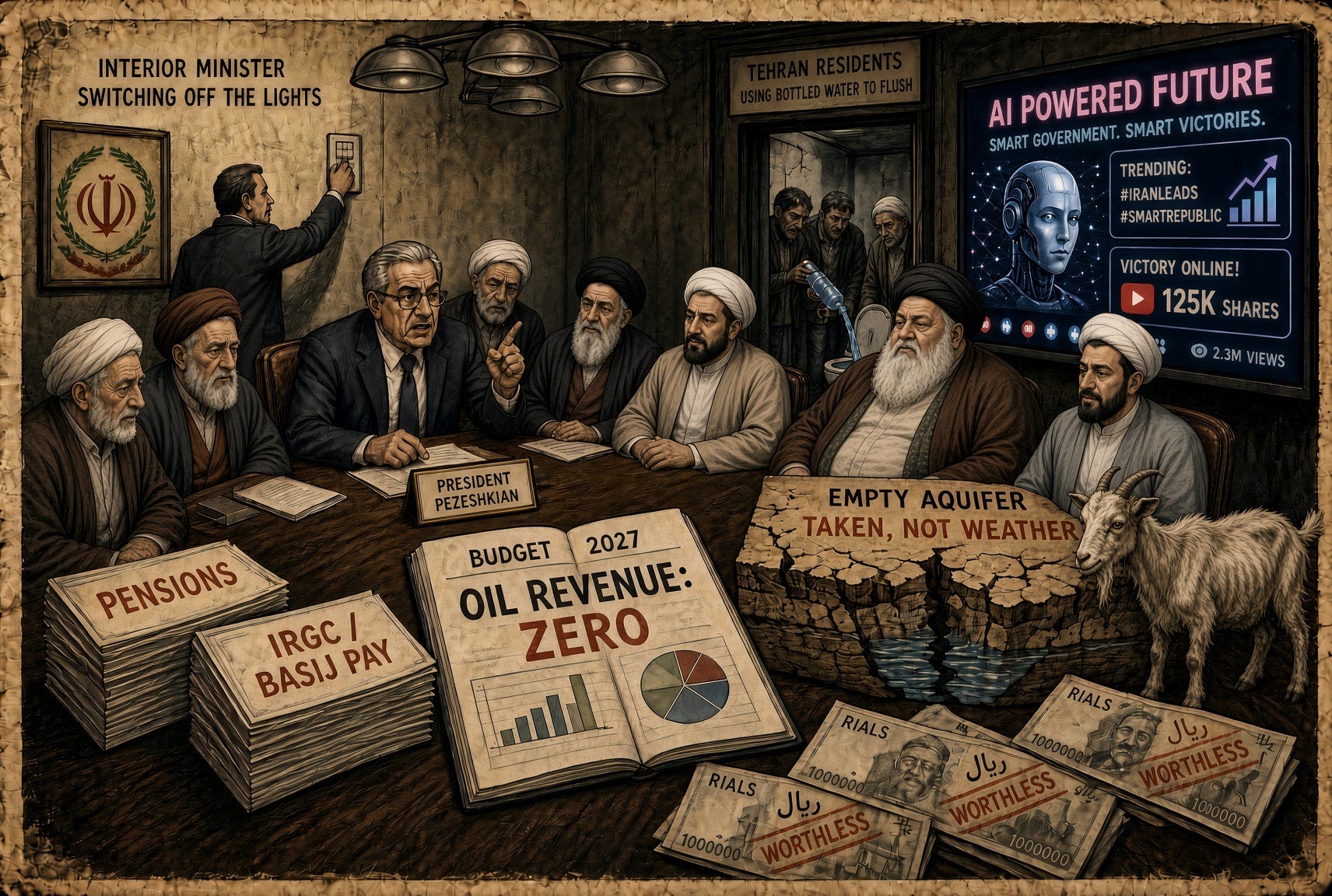
Officials have instructed the Plan and Budget Organization to prepare a 2027–28 budget scenario in which oil revenue falls to zero. Oil previously accounted for roughly one-third of planned government funding. The same period has brought continued withholding of salaries and pensions across oil, manufacturing, construction, and security. IRGC and Basij personnel are reported to be owed months of back pay amid cash shortages at Iranian banks. Officials have warned of a winter gas shortfall near 430 million cubic meters, with the possibility of cuts that include Tehran. And in a cabinet meeting this month the Interior Minister stood up and switched off part of the lights while President Pezeshkian was speaking. Pezeshkian praised the gesture. Iranian state television released the footage. The electricity shortage had reached the room where the government itself was meeting.
None of this is a new claim. It is the prior claim confirmed and extended by the leadership’s own planning documents, its own payroll practices, and its own on-camera performance of scarcity.
A functioning sovereign state is measured by ordinary tests. It pays the pensions its citizens already earned. It pays the security forces that maintain order. It keeps the lights and the gas on through winter. It does not empty its own aquifers through kleptocracy and then treat the shortage as weather. It does not prepare a formal budget scenario for the disappearance of its central hard-currency source while insisting the description “smart” still applies. On every one of those tests the evidence has moved further against the claim in the space of days.
The pensions matter most. They are not a future promise. They are a settled obligation to people who already worked. Withholding them is not a temporary cash-flow problem that a competent state solves. It is a decision that the ordinary contract with its own population can be deferred while other priorities are protected. The same logic appears in the security payroll. Reports that IRGC and Basij personnel are owed months of back pay do not describe a force that is being maintained in readiness. They describe a force that is being asked to continue operating while the state fails to meet its basic wage obligation. A leadership that treats its own coercive apparatus this way is not demonstrating strategic depth. It is demonstrating that the ordinary functions have already slipped.
Energy makes the same point in physical form. The gas shortfall is not a forecast. It is an official warning tied to damaged production capacity and winter demand. The electricity shortage is not abstract. It produced a moment in which a cabinet minister dimmed the lights mid-meeting and the president treated the act as a virtue. That is not the behavior of a state that still controls its basic inputs. It is the behavior of a state that is managing visible scarcity in the room where decisions are supposed to be made.
Water is already a shortage in Tehran, not a future risk. Residents have reported using bottled water to flush toilets when the taps fail for hours. Public restrooms have been closed because the system cannot supply them. The five dams that feed the capital have sat well below 20 percent of capacity for extended periods. Thirty-five percent of Tehran’s supply now comes from groundwater. Aquifer levels continue to decline even in years with some rain. Land subsidence is measured in centimeters per year in parts of the south and southwest of the city. President Pezeshkian has himself acknowledged that continuous expansion of Tehran and the surrounding cities, combined with excessive extraction from under people’s feet, is alarming. He has spoken of possible rationing and, in the absence of rain, of evacuation scenarios for the capital.
This is not weather. Droughts occur. The difference is that a competent state does not systematically over-allocate, over-extract, and divert the resource for decades and then present the empty aquifers as an act of nature. The beneficiaries of that extraction—the contracting networks tied to the security and political apparatus, the megaprojects that took the water out of the ground faster than it could recharge—have been described inside Iran as a water mafia. The term is imprecise only in that it understates the role of the state itself. The water was not lost to climate. It was taken. The aquifers were emptied by policy and by the kleptocratic priorities that treated the resource as available for diversion rather than as the condition of continued urban life. Residents now buying bottled water to flush a toilet are living with the direct result of that extraction.
The rial has already ceased to function as money in any ordinary sense. To buy the exports Iran needs—parts, machinery, refined inputs, and the industrial equipment required to keep factories and infrastructure running—the state cannot pay in rials. Siemens is not going to accept rials. Chinese suppliers will laugh at the suggestion of payment in rials. Even barter arrangements that trade oil for needed exports are not straightforward, and they occur at a discount. Chinese buyers in particular have long extracted that discount as the price of taking Iranian crude under constrained conditions. Oil in the ground is not a wire that delivers hard currency at the rate the ledger requires. A state that cannot reliably pay in a currency its own people can use to acquire what the state itself no longer produces is not operating from a position of leverage. It is operating from a position in which the ordinary means of exchange have already failed.
Against this ledger the leadership continues to produce bluster. Social-media statements and AI-generated videos circulate as evidence of resolve. Some of them are laughed at. The distinction is not subtle. The videos are the flex. The unpaid pensions, the late security wages, the gas shortfall, the lights switched off in the cabinet, the emptied aquifers, the bottled water used to flush toilets in Tehran, the zero-oil budget instruction, and the dead rial are the record. One set of materials is designed to travel. The other set is the set of facts the leadership is generating about its own capacity.
The long-term exposure does not require the current conflict to end in any particular way. Even if the leadership reaches an arrangement that allows it to remain in power, the free-fall on ordinary measures has already been shown. Citizens who watched salaries and pensions withheld, who experienced the gas and electricity constraints, who used bottled water for basic sanitation, and who saw the budget office instructed to model the loss of oil revenue will not unsee those facts because a later statement declares strategic success. Outside observers who watched the same sequence will not restore the earlier description of competence. The demonstration has already occurred.
The late Soviet Union remains the clearer historical parallel. It sustained a narrative of strategic competence while the domestic economy failed to deliver basic goods, reliable wages and pensions, or a currency that retained ordinary purchasing power. In the final years it also suffered staggering inflation as the official price system and the actual value of the ruble diverged further and further. The hollowness was visible for years without requiring a single decisive battlefield defeat. The Iranian case is tighter in one respect. The system is now formally preparing a budget scenario for the disappearance of its principal hard-currency source while the ordinary obligations continue to go unmet, while its own ministers perform conservation on camera, and while residents of the capital flush toilets with bottled water because the aquifers were already taken. That is not a temporary wartime adjustment. It is the modeling of a structural gap that the leadership has already allowed to open.
None of this is a prediction that the regime will collapse on a particular date. It is a narrower claim about description. Intelligent sovereign leadership is the capacity to keep the ordinary functions intact while larger contests are managed. When pensions are withheld, security pay is delayed, gas and electricity shortages reach the cabinet room, aquifers are emptied by prior extraction rather than by weather, residents use bottled water for basic sanitation, oil revenue is formally modeled at zero, and the currency no longer works, the claim that the leadership is “smart” requires ignoring the tests any competent state is supposed to pass for its own people. The week after the prior piece did not reverse those indicators. It added official planning for the loss of the central revenue source and a public performance of scarcity inside the government itself.
Evading sanctions while maintaining terrible living conditions, and then receiving credit for the mere fact of survival, is not smart. It is selfish. It is arrogant. It places the continuation of the apparatus above the ordinary functions a sovereign state owes its citizens. Treating that record as evidence of intelligence is intellectually dishonest or simply ignorant of what competent leadership actually requires. The description “smart” is no longer compatible with the evidence the leadership is producing. That is the reinforcement. The bills that were already due are now being written into the budget process, switched off in the meeting room, and flushed with bottled water in the capital.
Thank you for reading. James Frinzi