

Every night over the Strait of Hormuz, Iran’s radar crews face the same choice: switch on and get exposed, or stay dark and go blind. Either way, Iran loses. The choice is not temporary. It has been running since early November.
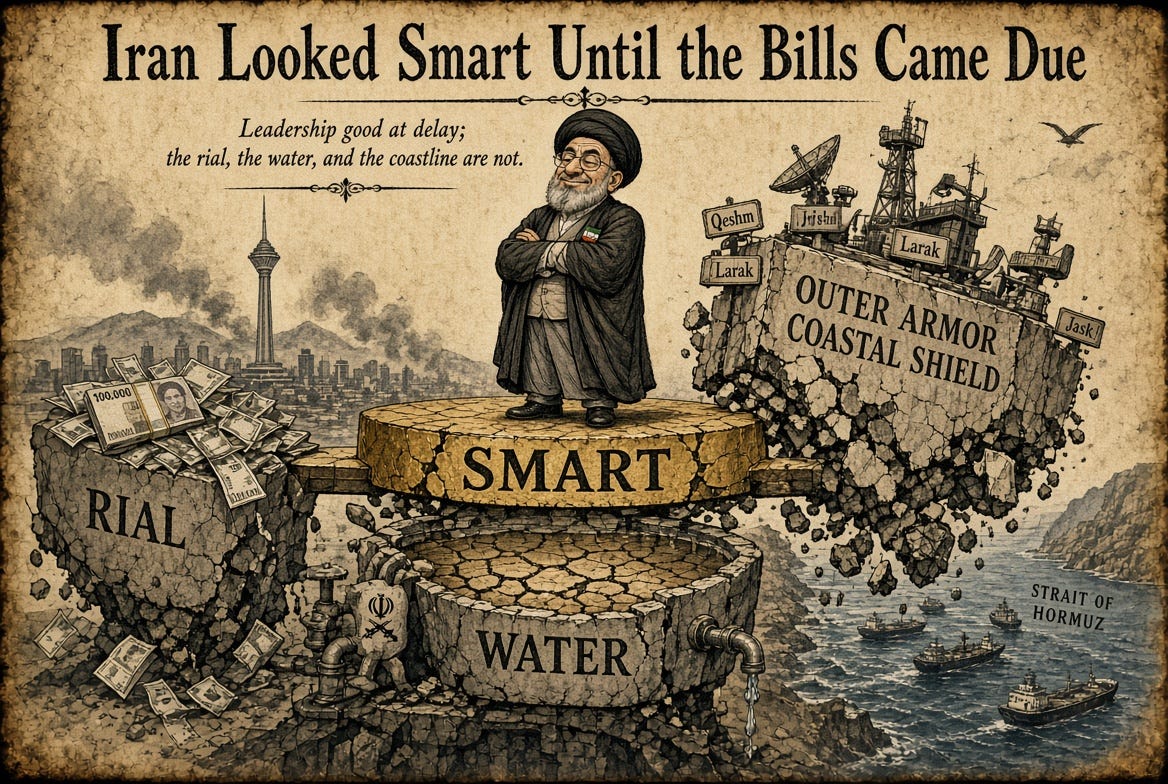
In Dubai the conversations about Iran usually start from a different place. People who follow the region, or who do business near it, often treat the leadership in Tehran as unusually clever. They buy time. They survive sanctions. They keep the Americans and the Gulf states spending money on cheap drones. The observation is not entirely wrong. For years the regime has been skilled at delay. The problem is that the price of delay has changed. The currency that would be required to rebuild what is being lost no longer functions as money. The water that would keep the capital functioning has been treated as a private rent. And the coastal air-defense network that was supposed to make Hormuz expensive is being peeled, launcher by launcher, while the regime is still trying to buy another week.
The bait
Cheap US decoy drones, not multi-million dollar jets, fly at Iran’s coastal air defence. Radar ON for a few seconds: US electronic spy planes record the site’s position, its frequency, its blind spots and the crew’s reaction time. Radar OFF: the aircraft flies straight through and can drop guided bombs on the site. Either way, Iran loses.
This is the bait. The decoys force the choice. Once a site emits, or once a launcher fires, the mapping is complete. The military name for what follows is SEAD and DEAD. Suppress the air defences, then destroy them. The decoys are inexpensive relative to the interceptors and the launchers they force into the open. Once a site emits, or once a launcher fires, it is on a list. The list gets longer every night.
The proof
On November 6, a US fighter jet hit an Iranian surface-to-air missile launcher on Qeshm Island. Iran’s Tasnim says 2 missiles struck. Trump: “We do minor strikes, but they built a little bit of an anti-aircraft device and we knocked it out in about 15 minutes, maybe five.” Most people read it as routine payback. It is a hunt.
Qeshm sits directly over the narrowest shipping lane in the strait. A launcher there is not a rear-area battery. It is part of the outer armor that was meant to make transit expensive. Removing it in about fifteen minutes, maybe five, after prior strikes on the same island beginning November 2, shows how fast a mapped site falls. This is the proof of tempo.
The line
Qeshm. Larak. Sirik. Jask. Since November 2, the US has hit Qeshm twice and taken out 2 launchers on Larak. Iranian media report blasts at Qeshm, Sirik and Jask. Qeshm and Larak sit over the narrowest shipping lane in the strait. Sirik and Jask push Iran’s radar and anti-ship missile reach into the Gulf of Oman. The IRGC spent years building radars, surface-to-air missiles and mobile anti-ship launchers here. That shield is being peeled.
The same coastal launchers are what let Iran threaten every tanker that passes through the strait. Clear the coast first, and the corridor opens for US fighters, B-2 stealth bombers and cruise missiles to reach missile factories, command centres and nuclear sites deep inside Iran. No order for a big strike is public. Stripping the coast is also a warning on its own. But the outer armour is coming off. Radar by radar. Launcher by launcher. Island by island. If a big strike comes, the door inland is already open a crack.
The bill
Every interceptor Iran fires at a cheap decoy is one less in the stock. The launcher that fired it is spotted within minutes. Then it gets hit. Every night the US target list gets longer, and Iran has one less air defence post on the strait.
The regime and its defenders like to describe this exchange as Iran forcing the United States and the Gulf states to waste money on inexpensive drones. The arithmetic runs the other way. When I am not writing, I manufacture drone defensive systems. Most interceptors used against systems like the Shahed cost a fraction of the drone they are intended to kill. The expensive part for the defender is not the interceptor itself; it is the sensor, the crew, the launcher, and the decision to emit or to fire. American decoys are forcing those decisions. Iran is spending scarce interceptors and exposing scarce launchers to map and then destroy the network that was supposed to protect the strait. That is not Iran making the other side waste money. That is Iran paying the bill for the mapping. Every shot fired is a drain of the interceptor stock.
The timing
The November 6 Qeshm hit was the first US attack since the midterms. More US jets and warships keep moving into the region. US officials are discussing broader strikes. US carriers and tankers move freely at sea. The IRGC stays on edge all night. Iran went to Code 100, its highest alert, and dispersed forces across the south. The political pause that existed before the midterms is over. Midterms over equals the end of the political pause. The peeling continues.
Connect the dots
Decoy drones equal mapping of Iran’s radar net. Qeshm in 15 minutes equals proof of how fast it falls. Qeshm to Jask equals peeling of the coastal shield. Every shot fired equals drain of the interceptor stock. Midterms over equals end of the political pause. This isn’t chaos. This is a takedown.
Military name: SEAD and DEAD. Suppress the air defences, then destroy them. Clear the coast first, and the corridor opens for US fighters, B-2 stealth bombers and cruise missiles to reach missile factories, command centres and nuclear sites deep inside Iran. The same coastal launchers are what let Iran threaten every tanker that passes through the strait. The headlines say minor strikes. The outer armour is coming off.
Buying time is no longer free
The regime is still trying to buy time. It is good at that. The cost has become unaffordable. While the coastal network is being mapped and reduced, the free-market dollar sits near 2.65 million rials. Inflation on food and daily staples is north of 85 percent. Commerce outside the black market is locked. The main commercial port at Shahid Rajaee—Bandar Abbas—has spent months with large areas of the yard and the cranes idle under the blockade; the emptiness was already visible in the reporting I published earlier. Any person who deals in trade understands the stranglehold.
Rebuilding what is being lost will require imports. Siemens will not take rials. European specialty firms will not take rials. Chinese suppliers, even when they are willing to ship oil-for-goods or accept discounted crude, do not settle in Iranian currency. Iran will have to buy foreign exchange to make those purchases. The rial required to buy the turbines, the pumps, the radar components, the concrete, and the machine tools is the same rial that has already ceased to function as money. Oil in the ground is not a wire. A currency that cannot purchase the imports needed to reverse the damage is not a bargaining position. It is a constraint.
The water is not the weather
Of the bills coming due, water is the largest that cannot be postponed. President Pezeshkian has warned that Tehran may have to ration and, if rain does not arrive, evacuate. Reservoirs that supply the capital have fallen to single-digit percentages of capacity. This is not primarily a weather story. Drought is the accelerant. The structure that turns a dry year into a capital that may have to empty is the same kleptocracy that has treated aquifers, dam releases, and irrigation water as private rents for years. IRGC-linked networks and favored agriculture and industry have extracted while the public system was under-built and under-maintained. Ideology does not recharge an aquifer. Neither does a leadership that steals the water while it claims competence.
The same networks that built the coastal air-defense belt and that now face its systematic reduction are the networks that have treated the country’s water as a private asset. While the United States peels launchers on Qeshm and Larak, the capital’s drinking water is already a political and logistical crisis of the regime’s own making. That is not resilience. That is the predictable result of treating public goods as spoils.
Not smart
The people in Dubai who describe Iranian leadership as clever are describing a real skill: the ability to buy time. The skill is no longer free. The currency needed to reconstitute lost air defenses, to import water infrastructure, or to restart commercial traffic at Shahid Rajaee no longer buys what it must buy. The interceptors spent on decoys are not coming back. The launchers removed on the coastal belt are not coming back on any timetable that the rial can support. The water that was diverted for private gain is not in the reservoirs when the capital needs it.
If you like running out of water because the same networks stole it for their own benefit, an economy in free fall where ordinary people cannot afford staple goods, a currency that has ceased to function as money, and the systematic diminution of the outer coastal layer that was supposed to protect the strait, then by all means keep calling it smart.
That classification is not analysis. It is ignorance. It is the uninformed habit of treating survival through delay as competence while the bills for water theft, inflation above 85 percent on the things people need to live, and the loss of launchers and interceptors come due at the same time. Buying time while the outer armor comes off and the capital faces evacuation is not strategy. It is the most expensive and most self-destructive choice still available. This is not chaos. It is a takedown of the claim that any of this is smart. Radar by radar. Launcher by launcher. Island by island. The door inland is already open a crack, and the people who still call the regime clever have not been watching the water, the rial, or the coast.
James Frinzi writes from the UAE. Previous pieces on the rial, the empty commercial port, and the water crisis are at jamesfrinzi.com.