
Keep Bulgaria in the Portfolio
Southeast optionality, not a second Ramstein
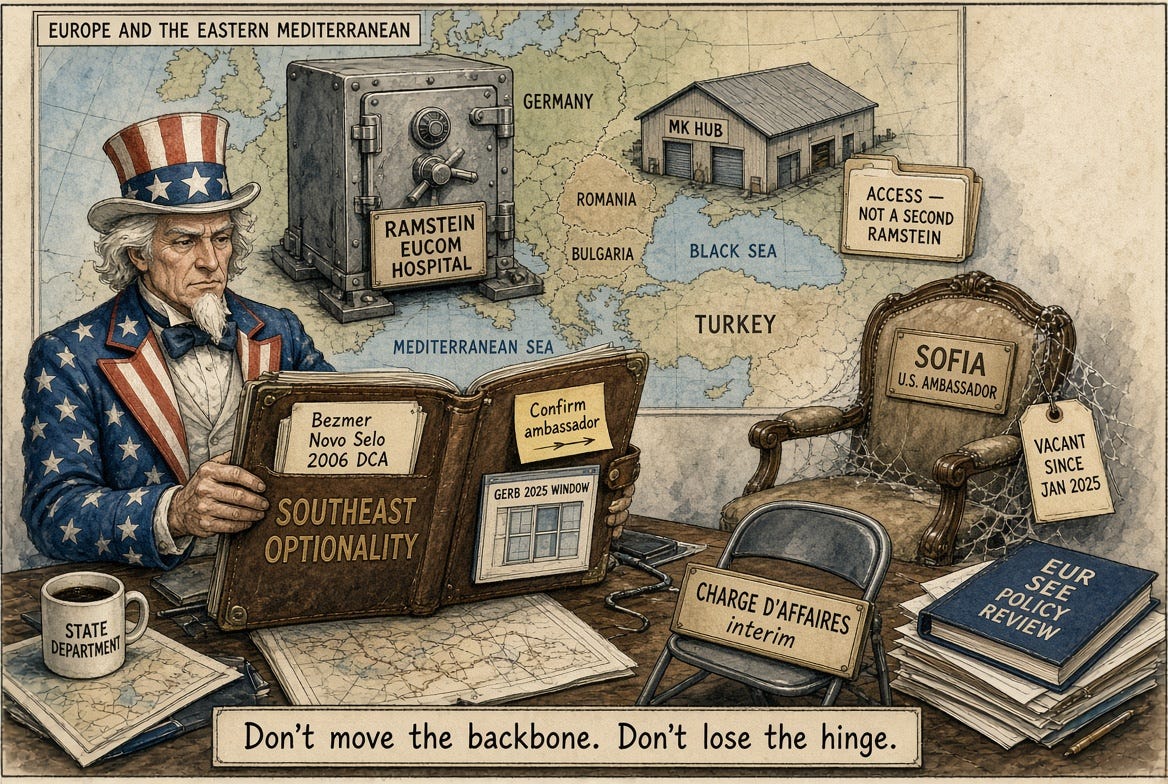
The United States does not need a new trophy base in Bulgaria. It needs durable access on NATO’s southeastern hinge—close to the Black Sea and closer to the eastern Mediterranean than Germany—and the political relationship that keeps that access usable when governments change. That is a posture problem, not a ribbon-cutting problem.
Germany is not strategically irrelevant. Ramstein remains a global air-mobility and command node. Landstuhl is still the principal overseas U.S. military hospital. European Command and Africa Command headquarters sit in Stuttgart; U.S. Army Europe is in Wiesbaden; Grafenwöhr and Hohenfels are the largest American training complex outside the United States. Of roughly 80,000 U.S. personnel in Europe, nearly half are in Germany. Cuts announced in 2026, including the withdrawal of about 5,000 troops, are a burden-shift and a political signal. They are not evidence that the German backbone can be packed up and moved to Yambol.
The right question is overweighting. Too much combat and training mass still sits in Central Europe relative to the Black Sea and the eastern Mediterranean. Bulgaria does not replace Germany. It complements it. Romania’s Mihail Kogălniceanu air base is already the larger Black Sea hub and is being expanded as such. Bulgaria is the southern hinge: Bezmer, Novo Selo, the ports at Burgas and Varna, and a 2006 Defense Cooperation Agreement that already authorizes joint use of four facilities and a standing presence measured in the low thousands.
Two theaters, limited functions
Geography is the case that still holds. Bulgaria sits on the southern Black Sea and shortens the air-refueling and staging problem for operations toward the eastern Mediterranean compared with Ramstein. The July 2026 authorization of KC-135 tankers at Bezmer—voted 136–13 in parliament, time-limited, and ended early in August—showed Washington treating Bulgarian airfields as a Middle East-adjacent logistics node, not only as a NATO training site.
That is also the limit of the argument. One Bulgarian location cannot collapse an Article 5 land fight on the eastern flank and a Middle East air campaign into a single base. Different force packages, command arrangements, and host-nation rules apply. The Montreux Convention still constrains what can be put in the Black Sea. Prime Minister Rumen Radev stated that combat operations from Bulgarian soil were out of the question. Access for tankers and training is not the same as a launch pad. Sell optionality. Do not sell a dual-theater headquarters that Sofia will not accept and that the Pentagon cannot actually park there.
The window that closed
Political windows open and close faster than runways are poured. GERB was the more predictable defense interlocutor. Rosen Zhelyazkov’s GERB-led cabinet governed from 16 January 2025 to 19 February 2026. The third U.S.–Bulgaria Strategic Dialogue was held in Sofia in December 2025 with that government. Radev’s Progressive Bulgaria then won an outright majority; he became prime minister on 8 May 2026.
Radev is not a simple anti-NATO figure. His parliament still approved the Bezmer deployment. He is more transactional and more willing to hedge on Russia. In September 2026 he defended Bulgarian carve-outs from the European Union’s 21st Russia sanctions package. Public polling in 2026 does not show a pro-American majority eager for a larger U.S. footprint. Only a small share of Bulgarians describe the United States as an ally; many treat it as a necessary partner, and a non-trivial share see conflict. That is a colder climate than the old talking point that two-thirds of the country is enthusiastically pro-American.
Summer 2026 already tested the relationship. Radev tried to link an extension of U.S. aircraft at Sofia Airport to visa-free travel for Bulgarian citizens, failed, and forced a withdrawal by the end of June. Parliament then allowed a bounded Bezmer mission. Iran protested. Local opposition surfaced. The tankers left before the October authorization expired. Pushing a Germany-to-Bulgaria base transfer into that climate would likely fail and poison the access that already exists.
An ambassador gap is a policy choice
Sofia has been without a confirmed U.S. ambassador since Kenneth Merten left in January 2025. The embassy has been run by Chargé d’Affaires H. Martin McDowell. President Trump nominated former Florida lawmaker Douglas Holder on 1 June 2026; the nomination remained pending in mid-September. A twenty-month gap at ambassador level in a Black Sea NATO capital is a self-inflicted wound. It is not unique—dozens of posts are vacant—but uniqueness is not the test. Energy security, Russian influence around Kozloduy and sanctions politics, and the next request for facility access all require a confirmed chief of mission, not a holding pattern.
Energy is the file that makes the vacancy costly. Bulgaria is moving Kozloduy toward Westinghouse fuel and planning AP1000 units while still needing sanctions derogations for Russian spare parts on the old VVER reactors. That is precisely the mix of diversification and residual dependence that a serious embassy is supposed to work.
What to do now
2026 is the wrong year to demand a permanent American base in Bulgaria. It is the right year to keep Bulgaria in the portfolio.
Confirm an ambassador. Keep the 2006 agreement warm with training at Novo Selo, infrastructure work already funded through NATO, and predictable logistics requests that Sofia can defend in parliament. Treat Romanian and Bulgarian access as a pair, not as rivals. Fund interoperability—F-16s, Strykers, coastal defense—because equipment locked to U.S. standards is a form of presence that survives a change of prime minister. Do not announce what the host government cannot sell at home.
Geopolitical trends change. Versatility is the point. Germany remains the logistics and command backbone. Romania is the larger Black Sea hub. Bulgaria is the southern option: useful when the United States needs to look at both the Black Sea and the Middle East from one piece of allied ground. The United States had an easier interlocutor in 2025 and used it unevenly. The time for a grand basing play is not this month. The time to stop treating Sofia as an afterthought is now.
Thank you for reading - James Frinzi