

September 27, 2026
The Red Herring
The rumor is tidy, which is why it travels. George Soros bought a Bulgarian state bank. Or something adjacent to a bank. A privatization. A holding company. A night in the 1990s when the keys changed hands.
He did not. There is no share register that puts Quantum, Soros Fund Management, or Open Society on the title of DSK, Biochim, Bulbank, or United Bulgarian Bank. DSK, the old communist savings bank, was sold in 2003 to Hungary’s OTP for €311 million. OTP is not Soros. The 1994 fight in which Soros Fund Management tried for a slice of OTP happened in Budapest, was blocked by the Horn government, and is a Hungarian file. First Private Bank failed in 1996; its husk went in 2000 to a Luxembourg vehicle tied to other names. Corporate Commercial Bank was a 2014 raid story with a different cast. Repeat the rumor and you hand the other side the easiest win in the argument: they produce the privatization list, you look sloppy, and the actual file goes back in the drawer.
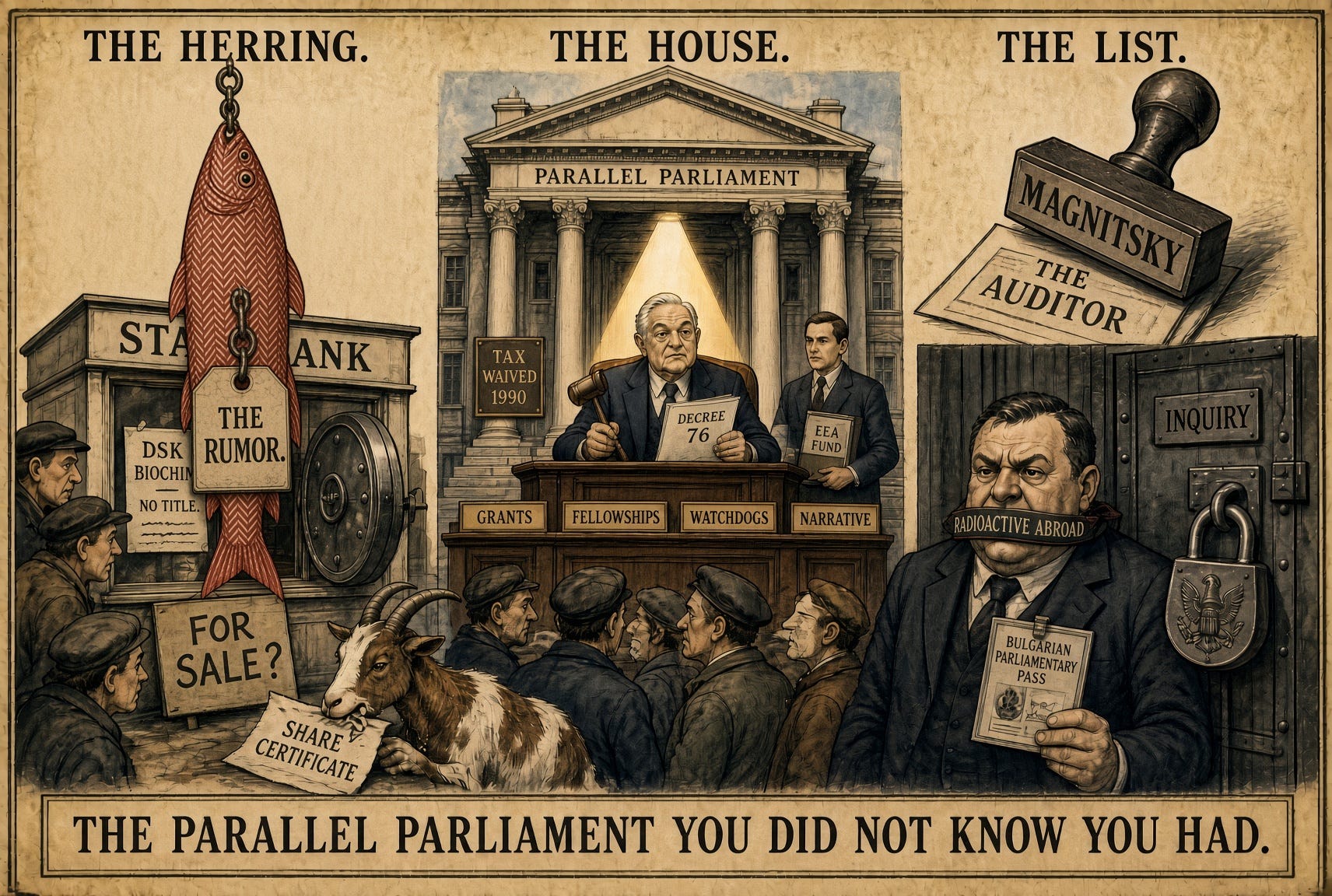
Nobody needed to botch a bank purchase for the herring to swim. The rumor grew because a share certificate is easier to picture than a gazette exemption. It was not a covert operation. It was a gift. Every hour spent hunting DSK is an hour not spent on Decree 76, the fellowship machine, the operator seat on Norwegian money, or the sanctions file that later made the auditor unsayable. That is how a parallel parliament keeps a country. Not by owning the credit register. By owning the language, the dossiers, and the veto on who is allowed to speak in polite rooms.
The decree, not the legend
George Soros arrived in Sofia in February 1990. Andrei Lukanov’s government registered Open Society. On 20 July 1990 the Council of Ministers issued Decree No. 76, published in State Gazette No. 61 of 31 July. Article 1 is not poetry. The foundation is exempted from taxes, customs duties, fees, and deductions in favor of the budget. Donations and bequests to it from Bulgarian persons are also tax-exempt. Article 2 hands the foundation the use of eight rooms on the tenth floor of the National Palace of Culture and five hundred thousand leva from the state budget for start-up costs. Article 4 licenses auxiliary commercial activity — publishing, trade in art and print, an information center — as units of the foundation. Supervision sits with the finance minister and the science minister. That is not a gift shop. That is a foreign donor written into the fiscal code of a collapsing communist state, given rooms in a national monument, and told the taxman will look the other way.
Participant testimony goes further than the gazette. Rumen Vodenicharov, the first program director, later said the political bargain was that the Bulgarian state would put leva behind each Soros dollar. Dimitar Ludzhev, who met Soros at the Sheraton on that first visit, has described Lukanov matching the endowment. Article 3 of the decree existed and was struck in August 1991; the published remnant does not reprint what it said. Treat the matching-account story as sworn memory, not as a clause you can quote from today’s gazette. Treat the tax holiday, the rooms, and the budget seed as law. Both layers matter. One is the floor. The other is how the people in the room understood the deal.
Jean Videnov repealed the privilege. Council of Ministers Decree No. 219 of 17 November 1995, State Gazette No. 103 of 24 November, cancelled Decree 76 in a single paragraph. Videnov’s line from the tribune was the closest thing Bulgaria has had to an adult sentence on the subject: no money from the budget for Soros; the foundations operate under the same law as everyone else. The tax holiday died. The rooms were no longer a state grant. The network did not die with the decree.
A parallel parliament does not need a banking license
A bank would have been a trophy. A privileged foundation is an operating system. The first board sat at the seam of the new parties, the old apparatus, and the American embassy. Early names — Georgi Prohaski, Stefan Tafrov, Dimitar Ludzhev, Deyan Kyuranov, Lyuben Berov — moved between the foundation, the ministries, and ambassadorial posts. That is the point of the first five years: not a balance-sheet raid, a personnel pipeline. Scholarships. Stipends. Foreign seminars. The first internet connection, which Open Society still recites as a civic miracle. Soup kitchens in the 1996–97 collapse, which Open Society still recites as proof of charity. Both can be true at once. You can feed children and still be building a class that will staff the next thirty years of NGOs, newsrooms, judicial fellowships, and grant desks. Georgi Stoychev, the institute’s director, has put the lifetime gift above $100 million and claimed more than six thousand scholarships. Take him at his arithmetic. That is not a rounding error. That is a generation.
Call it a parallel parliament because that is what it does. An elected chamber writes statutes. This one writes the moral language in which those statutes are then judged. It does not appoint judges. It fellowships, platforms, and certifies the people who will be called independent when they sit. It does not run a ministry of information. It funds the media-literacy programs that decide which sentences count as information and which count as hate. It does not command the army. It decides which use of a border is a security policy and which is a crime against Europe. It does not collect taxes. It sits, thirty-five years later, on the desk that opens other governments’ checks. A state that outsources that work should not be shocked when the contractor starts to talk like a ministry.
The parallel parliament has three rooms. The first is personnel: the scholarship and fellowship machine that turns a twenty-two-year-old into a thirty-five-year-old who already knows which opinions are fundable. The second is narrative: newsrooms, watchdogs, and “resilience” grants that treat one oligarch’s capture of the courts as the only capture worth naming. The third is the foreign keyhole: the dossiers, briefings, and civil-society submissions that Washington and London are required by their own statutes to read. You do not need a majority in the National Assembly if you have a working majority in those three rooms. You need only to make sure that the man who wants to audit you cannot enter the fourth room — the room in which American and British officials decide who is a partner and who is a contagion.
He did not plant it. He did not have to.
The bank story is useful to the people who want this conversation to stay unserious. Invent a share purchase and every editor in Brussels can file the piece under conspiracy and go to lunch. The decree is harder. It has a number. It has a gazette. It has a repeal. It forces a grown-up question: why did a sovereign government exempt one foreign foundation from the ordinary fiscal rules, house it in a national palace, and seed it from the budget, five months after the Wall? Lukanov’s interest was not mysterious. Soros arrived as an American-connected financier with foundations already standing in Hungary, Poland, Czechoslovakia, Romania, and Moscow. A weak post-communist cabinet bought access and cover. Soros bought a beachhead with the state’s own stamp on it.
He did not need the bank. Ownership of a credit institution would have put him under the central bank, under parliament, under depositors. A foundation under Decree 76 put him under two ministers who had just signed the exemption. Influence without a banking license is not a lesser prize. It is the prize you take when you intend to stay after the privilege is repealed.
How the arrangement still pays
George Soros does not cash a Bulgarian dividend in 2026. He is ninety-five. In June 2023 he handed the Open Society Foundations — then described as a $25 billion grant machine — to his son Alexander, who had already taken the chair that December and who said he would double down on the same causes and was “more political” than his father. The personal fortune is no longer the point in Sofia. The point is the machine that fortune built, and the habit European public money now has of flowing through it.
Open Society Institute – Sofia presents itself as an independent Bulgarian public-benefit foundation. That sentence is a legal form, not a history. The founding endowment was Soros money. The brand is still his name. The institute still lists the Open Society Foundations among its donors, alongside the European Union and the European Economic Area. Independence, in this usage, means the Sofia office is a Bulgarian legal person. It does not mean the worldview walked out of the building in 1995.
The new money is not even his. In August 2025 Iceland, Liechtenstein, and Norway selected a consortium led by Open Society Institute – Sofia to operate the EEA Civil Society Fund in Bulgaria: nearly €23.5 million, through 29 February 2032, the largest civil-society commitment those donors have made in the country. Organizational grants up to €300,000. A rolling small-grant window that opened in June 2026. Priorities written in the house dialect — democracy, rule of law, human rights, gender, LGBTIQ+, media literacy, migrant inclusion. OSI–Sofia runs the first organizational-grant call itself. In September 2026 the director was announcing €1.8 million from the same fund for media-literacy projects. A separate EU Creative Europe pot, MediaResilience, is led by the same institute and has already steered grants to newsrooms in Bulgaria, Hungary, Greece, Slovenia, and Croatia.
Read that twice. The 1990 privilege was a tax holiday on Soros dollars. The 2025 privilege is a gate on Norwegian, Icelandic, Liechtenstein, and EU dollars. The original donor no longer has to write the check for the network to sit where checks are opened. That is how a beachhead compounds. You spend the first decade buying the staff. You spend the next two decades becoming the desk that other governments trust to pick the staff. When critics say “Soros money,” the press office answers, correctly, that this particular pot is Oslo’s. The unasked question is why Oslo handed the keys to the institute that Soros endowed.
Then
The paper
Now
July 1990
Decree 76: tax, customs, fees waived; 8 rooms at NDK; 500,000 leva seed
Privilege as state policy
Nov 1995
Decree 219 repeals 76. Videnov: no budget money, same law as everyone.
Holiday ends. Institution remains.
June 2021 / Feb 2023
US Magnitsky and UK anti-corruption designations of Delyan Peevski
The auditor becomes radioactive abroad
June 2023 – Feb 2032
Alexander takes OSF. OSI–Sofia leads €23.5m EEA civil-society money.
Dynasty plus other people’s money
The silencer that does not need a signature
On 2 June 2021 the United States Treasury, under Executive Order 13818 and the Global Magnitsky architecture, designated Delyan Slavchev Peevski for corruption: influence peddling, bribes, control of institutions, a 2019 municipal-election bargain of media coverage for protection from investigation, and a front man in Ilko Zhelyazkov. The State Department simultaneously named him under Section 7031(c) and barred him and his minor children from the United States. The United Kingdom followed on 10 February 2023 under its Global Anti-Corruption regime: asset freeze, travel ban, later a director disqualification. Those are official acts of two governments. They cite bribery and capture. They do not cite George Soros. They also did not wait for a courtroom. Peevski has not been convicted of a crime in Bulgaria, in the United States, or in the United Kingdom. Bulgarian prosecutors have opened files and closed them. OFAC is not a jury. It is an administrative list compiled inside an executive branch. That gap — listed abroad, unconvicted everywhere — is not proof of innocence. Capture of a prosecutor’s office can look the same as the absence of a crime. It is, however, the first reason a grown-up reader is allowed to ask who wanted him radioactive, and why the question is treated as vulgar.
Do not invent a cable that is not in the file. There is no public document in which Open Society, George Soros, or Alexander Soros orders OFAC to list Peevski. Pretending there is one is the same sloppiness as pretending he bought DSK. Concede the gap. Then look at what sits around it. The Global Magnitsky statute itself tells the President to consider “credible information obtained by foreign countries and nongovernmental human rights organizations.” Civil-society packages have historically fed a substantial share of designations. The Bulgarian NGO and investigative climate that produced years of Peevski dossiers is the climate Open Society spent a generation watering — scholarships, media grants, watchdogs, the language in which “oligarch” and “civil society” are assigned to opposite sides of the same street. You do not need a signature on the Treasury letterhead if you built the room in which the letter is drafted. That is the first smoke.
The second smoke is access, and access is not an appointment on the White House calendar. Alexander Soros was already deputy chair of Open Society Foundations when Biden took office. He put more than seven hundred thousand dollars into the Biden Victory Fund in 2020. A family that writes that kind of check does not need to walk into the Oval Office and say the name Peevski. It has fundraisers, social rooms, and back channels. The ask, if it was made, would live there — not in a visitor log that a newspaper can print. List the West Wing visits anyway, because they show the door was open. From late 2021 into 2024 the logs record on the order of twenty to twenty-five appearances: the deputy national security adviser, the NSC senior director for Europe, advisers to the chief of staff, a state dinner, a private evening at Vice President Harris’s residence. Whether those meetings were social, ceremonial, or operational is beside the point. They prove familiarity. They do not disprove a quieter conversation somewhere else, before or after 2 June 2021. Treating the log as an alibi is a category error. The social record is thicker than the log. He photographs himself with Bill and Hillary Clinton. He sat with them at the 2024 convention. He has spoken at the Clinton Global Initiative. In June 2025 he married Huma Abedin, Hillary Clinton’s aide of twenty-five years, at his Water Mill estate; Bill, Hillary, and Chelsea Clinton were in the room, and Hillary toasted. Hillary had already co-hosted the engagement party. In August 2026 Bill Clinton marked his eightieth birthday at that same house. That is not a rumor about a wedding in 2010. That is the Clintons inside his house. A family that funds the party, marries into the Clinton household, and runs the grant machine that feeds the NGO channel the Magnitsky statute invites does not need a smoking-gun memo. A reasonable hypothesis does not require one. It requires a pattern heavier than a Facebook post and lighter than a verdict: an unconvicted political enemy of the network; a designation issued by an administration the family helped elect; a statute built to swallow civil-society dossiers; no public cable; and a result that left the auditor stained and the house intact.
Hold the ugly facts in the same hand. Peevski is a media-and-court power broker. Washington and London put seals on a corruption file. He is also, after 2021, the loudest elected enemy of the Soros network in Sofia, the man who tabled the November 2025 inquiry into George and Alexander and their foundations. Those two sentences do not cancel. They explain why the listing is so useful. A parallel parliament that cannot beat such a man at the ballot box can still make him unsayable in the rooms that matter more than the ballot: embassy receptions, EU party families, donor conferences, the pages that decide whether an audit is an investigation or a conspiracy theory. Magnitsky is a nuclear instrument. Used against an unconvicted man who later tried to open the grant ledgers, it functions as a silencer whether or not a Soros lawyer wrote the first memo. The test is not a leak. The test is who becomes radioactive, and who keeps the operator seat on the €23.5 million. The silence is not disappearance. Peevski still sits in parliament. He still flies. He has said out loud that not a single sanction works inside Bulgaria. That is the tell. The designation was never meant to remove him from Sofia. It was meant to remove him from legitimacy. Every motion he files arrives pre-labeled: a sanctioned oligarch’s revenge. GERB talks about lifting the listing as if that were a foreign-policy deliverable. Liberal party families in Europe treat the listing as proof he cannot be touched. The parallel parliament does not need him gone. It needs him stained. A stained enemy cannot audit you without auditing himself.
The inquiry that could not finish a sentence
On 5 November 2025 the National Assembly voted 111–27, with dozens abstaining, to stand up an ad hoc committee on the activities of George and Alexander Soros and their foundations in Bulgaria: financing of persons and NGOs, and links to parties, magistrates, schools, media, business, and the state. The motion came from Peevski’s MRF–New Beginning. Hold both facts. A serious country can. The 1990 privilege was real. The man who wanted it audited is not a disinterested clerk. Using a sanctioned oligarch as the only instrument of scrutiny is how a captured parliament turns a fiscal file into a gang war and then calls the war a debate. It is also how the parallel parliament wins without appearing on the ballot. The messenger is disqualified before the ledger is opened.
The committee was given three months. The assembly’s term then collapsed with the government in December 2025. Rights groups say the inquiry died with the term and left a stigma instead of a ledger. That is the Bulgarian specialty: announce an inquest, fail to finish it, and let both sides claim victory. Open Society Institute – Sofia called the committee unfounded and an attempt to stigmatize civic life. Of course it did. No parallel parliament votes to audit itself.
A finished inquiry would not hunt for a bank share that is not there. It would pull the 1990–1995 finance-ministry transfers, the Article 3 file if it still exists, the grant ledgers from the EEA operator seat, the judicial and media fellowships, and the list of people who passed through the institute into public office. It would also ask a question Washington prefers not to hear: when a civil-society ecosystem built by one family produces the dossiers that another government then uses to brand that family’s chief domestic enemy, who, exactly, has been silenced?
As long as the opponent can be made unsayable
This is the grip. Not a majority. A veto on the opposition’s mouth. As long as the Soros family can help decide which Bulgarian politician is a partner and which is a contagion — through grants, through language, through the NGO channel the Magnitsky statute invites, through a Democratic establishment that treats the son as family — the family does not need to own a bank, a ministry, or a party list. It needs only to keep the fourth room closed to anyone who wants to read the first three. Call it a hypothesis if you want the footnote. Call it smoke if you want the headline. Either way it is heavier than a rumor, and it will stay a hypothesis until someone produces the cable. The absence of the cable is not the absence of the pattern. The absence of a West Wing timestamp is not an alibi.
Alexander inherited the firm in 2023 and said he was more political than his father. He already had the rooms that matter: the fundraiser, the Clinton table, the grant desk, and, yes, the West Wing when he wanted it. Politics, in this business, is the power to mark a man. Mark him in Sofia and he still has a microphone. Mark him in Washington and London and every microphone he owns becomes evidence against him. That is a stronger grip than Decree 76 ever was. The 1990 privilege was a tax holiday a prime minister could repeal in a paragraph. The 2021 privilege is a foreign listing a Bulgarian parliament cannot repeal at all — hung on a man no court has convicted, by an administration the family could reach without filing a visitor form.
A functioning state does not apologize for taxing a foundation. It does not house a foreign donor in a national palace as a welcome gift. It does not spend thirty-five years arguing about a bank that was never sold while the institute privileged in 1990 sits, in 2026, on the largest civil-society tap Norway has opened in the country. And it does not outsource the naming of its own villains to a network that has a direct interest in which villains stay named.
Soros got what he came for. Not DSK. Not Biochim. Authority over the language in which Bulgaria is allowed to describe itself — open or closed, democratic or captured, journalist or propagandist, auditor or mobster. The rumor was a red herring he did not even have to plant. It grew because a share certificate is easier to picture than a gazette exemption and a sanctions file. Kill the rumor. Keep the decree. Keep the listing. The privilege was the purchase. The parallel parliament is the dividend. The stained enemy is the lock on the door. Alexander inherited the firm. Sofia is still paying the rent, only now the invoice is written in Oslo and Brussels, and the padlock is stamped in Washington.
Videnov closed the tap. Nobody closed the house. As long as the house can silence the people who want to walk through it — by grant, by language, or by a list no Bulgarian vote can erase — the family keeps Bulgaria. That is the whole story. It does not require a bank. It does not even require a conviction.
Thank you for reading - James Frinzi