
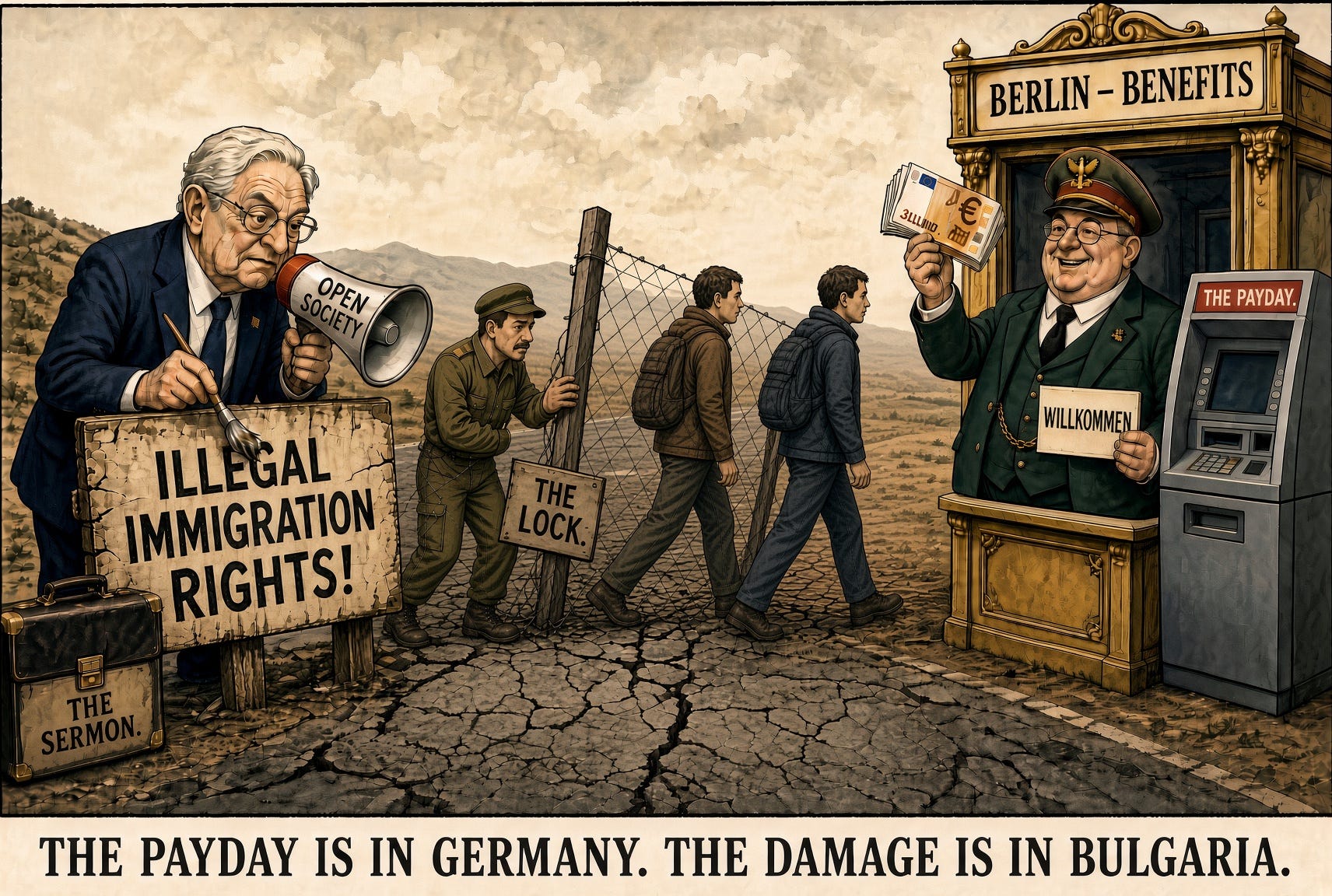
Nobody walks from Afghanistan to Berlin because Bulgaria is beautiful. They walk because Germany still pays, and the first European Union line after Turkey is a 259-kilometer strip of Bulgarian dirt. That is the whole machine. Berlin prints the check. Sofia prints the bruise.
Two years ago this argument was already obvious. It is uglier now. On 1 January 2025 Bulgaria entered Schengen on land. The fence did not disappear. The smugglers did not retire. What changed is the prize on the other side of the wire: once you are inside Bulgaria, you are inside the area Germany spent a decade advertising as a right. Europol said the quiet part in June 2026. Bulgaria is a key transit hub on the Turkey-to-Western-Europe smuggling route. Green border. Sofia safehouses. Then Serbia or Romania. Then the German payday.
George Soros did not invent the trail. He built the moral language that makes defending it look dirty. Open Society Institute – Sofia was founded on his endowment in 1990. Thirty-five years later the same institute operates a €23.5 million civil-society fund that runs to 2032 and lists “refugees and migrants” among the causes it will bankroll. The NGOs that network has watered for a generation still treat a Bulgarian policeman on the Turkish line as the problem, and the man who paid a hawala office in Istanbul as the client.
Germany created the demand. Soros funded the alibi. Bulgaria was left with the road.
The road, not the home
Start with the map, because the ideology only works if you pretend geography is incidental.
Bulgaria’s border with Turkey is 259 kilometers. It is an external border of the European Union and, since January 2025, of Schengen. The barrier along that line is about 234 kilometers of fence, razor, cameras, and a 300-meter security strip the government closed to photographers years ago. Kapitan Andreevo–Kapıkule on the E80 is the legal gate. The illegal gates are the Strandzha and Sakar hills, the tree line, the places a guide can sell for a few thousand euros.
The Ministry of Interior’s own numbers describe a corridor, not a settlement. In 2023 the authorities reported 178,698 prevented irregular entries. In 2024 that figure fell to 52,534. In 2025 it fell again, to 13,568 — a 74 percent drop from the year before, after Austria extracted extra patrols as the price of full Schengen. Newly arrived irregular third-country nationals dropped 64 percent, from 9,208 in 2024 to 3,306 in 2025. First-half 2026 kept falling: 4,476 attempted entries against 7,617 in the same months of 2025. In June 2026 alone, 1,198 third-country nationals tried to cross in. Of those, 1,172 tried the Turkish line.
Read that last sentence twice. When the pressure eases, it does not ease evenly. It stays glued to Turkey. Greece, Serbia, North Macedonia are rounding errors. The road is south to north. Destination: not Sliven. Destination: the German benefits office that still talks like 2015 even when Berlin pretends it has sobered up.
Asylum figures tell the same story in a different accent. Bulgaria registered 12,250 asylum applications in 2024 and 3,895 in 2025. The State Agency for Refugees issued 7,090 decisions in 2025: 62 refugee statuses, 897 subsidiary-protection grants, 3,703 rejections. Recognition on the merits collapsed to about 20 percent, from 61 percent the year before. The absconding rate was 34 percent. People do not vanish from a Bulgarian file because they found a job in Plovdiv. They vanish because the file was never the point. The point was the next truck toward Germany.
Europol put the industrial version on paper. In late 2025 a Bulgarian-led case, with Greek police and Europol, dismantled a pyramid network that recruited in Turkey, collected hawala deposits before departure, walked clients across the southern green border to pre-arranged points, moved them to illegal rooms in Sofia, and dispatched them toward Western Europe through Serbia or Romania. Sixteen arrests. Six searches. In July 2026 another task-force case hit the Bulgarian–Serbian green border. The fare across Serbia alone was about €1,300 a head — €1,000 to Belgrade, €300 more toward Hungary. Afghan nationals were the cargo. Sofia was the warehouse. Germany was the invoice.
This is not “migration.” It is a logistics company that treats a sovereign border as a billing event. German policy built the demand. The smugglers built the fleet. Bulgaria got the depot.
Germany writes the check
Every corridor needs a light at the far end. For a decade that light has been German cash.
In 2025 roughly 390,000 people in Germany drew benefits under the Asylum Seekers’ Benefits Act — down 15 percent from the year before, which the ministries announced as proof of toughness. The largest groups were still Syrians, Turks, Afghans. The Bezahlkarte was rolled out so the stipend is harder to wire home. Bürgergeld is being renamed and tightened from July 2026. Family reunification for subsidiary-protection holders was frozen for two years. Fine. The existence minimum is still a check. The European Court of Justice ruled in June 2026 that Germany may not simply cut off people sitting on a Dublin transfer order. The message that reaches Istanbul is not the press release from the Interior Ministry. The message is: get inside the Area and you will eat.
That message is a policy export. Germany does not have to station the men on the Strandzha night shift. It only has to keep the magnet plugged in. Bulgaria then spends diesel, overtime, and political capital stopping people who were never going to live in Haskovo. Border towns absorb the transit traffic. Police files fill with absconders. Reception centers turn into overnight rooms. The German debate gets to sound serious because the bodies are standing in someone else’s grass.
Berlin will say it has “learned the lesson of 2015.” It has learned the vocabulary. A rate cut here, a payment card there, a coalition talking point about returns. The incentive is intact. A man who can pay a smuggler in Turkish lira and collect a roof in euros will keep walking. Bulgaria is the stretch of road where the walking is illegal, visible, and left for someone else to police.
France is the second pole — housing, allowances, the political class that treats enforcement as a moral failure and then acts shocked when Calais fills up. The Channel even has a Bulgarian chapter. At Kapitan Andreevo, British-trained dogs have pulled packed dinghies, engines, and pumps out of buses coming from Istanbul. Kit seized at the first EU lock after Turkey was destined for the last lock before England. The secondary destinations matter. They do not change the primary fact. The payday that organizes the route is German.
There is a particular insult in the current arrangement. When crossings fall, Berlin takes the credit for “European solidarity” and extra Frontex. When crossings rise, Sofia is told it has a reception problem. Germany keeps the benefit of looking like the destination of choice. Bulgaria keeps the cost of being the lock.
What Schengen actually did
Sofia sold full Schengen as a civilizational arrival. For a trucker on the E80 it is. For a smuggler selling a German arrival, it is a product upgrade.
Air and sea checks with the rest of the Area dropped on 31 March 2024. Land checks dropped on 1 January 2025. Austria’s price was extra muscle on the Turkish line: about 1,200 Bulgarian border police, 240 Frontex officers in mixed patrols, then another hundred from Romania, Austria, Hungary, and Bulgaria itself, plus drones and new surveillance. Prevented entries crashed. That is real. It is also the tell. If a surge of patrols can cut the attempts by three-quarters, the attempts were never a weather system. They were a business responding to risk — a business whose customer is trying to reach German benefits, not a Bulgarian work permit.
The business adapted. Secondary movement inside the Area is the new inventory. Once the stamp is Bulgarian, the next problem is Romanian, Serbian, Hungarian, German. Compensatory Schengen checks inside the country now pick people up who already entered from Greece or Romania. The frontier moved. The ideology did not. Brussels still talks as if the crisis is a failure of “reception conditions” in the first state of arrival, which is a polite way of saying Bulgaria should become a better waiting room so Germany does not have to look at the queue.
Schengen did not close the corridor. It made the first stamp more valuable. Germany got a larger internal market for the people it still attracts. Bulgaria got a longer night on the wire.
Soros fuels the flame
Call the network by its name. George Soros funded the Open Society project as a political operating system: courts, campuses, media, “civil society,” the language in which a border becomes violence and a smuggler’s client becomes a rights-holder. In Bulgaria the local node is Open Society Institute – Sofia. The founding endowment was his. The annual reports still record transfers from the Open Society Foundations network — €228,000 recognized in 2024, after €72,000 in 2023. That is not the whole war chest. It is the family resemblance.
The real current is the way the institute sits on other people’s money and aims it. OSI-Sofia ran the Active Citizens Fund under the EEA mechanism, a €16 million pot from 2018 through 2024. In May 2026 it took the chair of the new EEA Civil Society Fund for Bulgaria: nearly €23.5 million from Norway, Iceland, and Liechtenstein, running until February 2032, with an explicit line for refugees and migrants. Organizational grants up to €300,000. Project grants. A rolling small-grant window of €10,000 to €25,000 that opened in June 2026. The brochure says democracy, rule of law, human rights. The grant lists have included the usual suspects of migrant legal aid — outfits whose professional success is measured in how many people they can keep inside the procedure, on the territory, and out of a removal van.
Center for Legal Aid – Voice in Bulgaria is the type specimen. OSI-Sofia has put money into “efficient assistance to refugees and migrants.” In 2025 the center was still running mobile legal teams, detention work, and advocacy against the New Pact on Migration and Asylum, on a budget north of €137,000 from a rotating cast of Western foundations. Its own report notes the collapse in applications and in positive decisions — and treats the collapse as a problem to be litigated, not as evidence that the corridor was never an asylum system.
This is how Soros fuels the flame Germany lit. Berlin creates the pull. The Open Society world does not have to pay the smuggler. It only has to pay the lawyer, the monitor, the journalist, and the trainer who will call a pushback a crime and a fence a moral failure. The Bulgarian state spends blood and diesel on the line. The network spends euros on the narrative. When the numbers fall because Sofia finally put 1,200 men on the wire, the same network files the reports about “widespread pushbacks” and asks donors for another cycle.
Soros is not a cartoon villain hiding in a border ditch. He is worse. He is a financier who spent decades building a class that sincerely believes a nation has no right to prefer its own citizens at its own gate. That class is now native to Sofia. It will never stand on the fence. It will always stand on the press release. And it will always have a German policy to point to, because the magnet gives the sermon its raw material.
What the 2024 draft got right — and what it understated
The 2024 version of this argument said Bulgaria recorded more than 20,000 illegal crossings in 2023, that only about 5 percent of asylum applicants received full refugee status, and that OSF money was buying a politics of open movement. The direction was correct. The scale was larger than the draft knew, and the legal trick has since gotten cleaner.
Prevented entries in 2023 were not a round twenty thousand. They were in the six figures. Full refugee status was already a rarity; in 2025 it was 62 people in an entire year. Subsidiary protection padded the “yes” column and then the yes column itself fell apart. Schengen did not reward Bulgaria for holding the line. It made the line more valuable to the people who intend to cross it on the way to Germany. Europol did not need a columnist to explain the route. It needed handcuffs in Sofia and Pirot.
The other understatement was political. Germany is not sleepwalking. It is managing optics. It cuts a rate here, issues a card there, freezes a family-reunification clause, and keeps the magnet plugged in because its own courts, churches, NGOs, and coalition math will not let it pull the cord. Soros-funded and Soros-adjacent organizations are part of that math in Sofia and in Berlin. They turn every Bulgarian enforcement success into a human-rights incident and every German enforcement hesitation into another reason to walk.
Close the incentive, or keep paying
Bulgaria can add drones until the budget snaps. It will not matter if the check is still signed in Berlin and the sermon is still written in the Open Society dialect. The corridor exists because three things are true at once: Turkey is the launch, Bulgaria is the first EU lock, and Germany is still the ATM.
Take any one of those away and the business shrinks. Leave all three and the fence is a speed bump. That is why the 2025 drop in crossings is not a happy ending. It is a reminder that enforcement works — and a warning that the people who hate enforcement have not left the building. They have a new €23.5 million fund, a Schengen map that makes the first stamp more precious, and a European court that just told Germany it cannot starve a Dublin case off the books.
A state may build a fence. A state may return people who are not owed protection. A state may refuse to become the waiting room for German social policy. Legal immigration exists. Asylum for the persecuted exists. A business that sells seats from Edirne to Berlin, with a Bulgarian overnight in the middle, is neither.
The dishonest position is the Open Society position, laundered through “integration,” “legal aid,” and “monitoring.” It says the violence is the policeman. It says the border is the prejudice. It says the man who cut the fence is a vulnerable person and the village that has to live with the cut is a teaching opportunity. It has had thirty-five years in Sofia to make that argument. The argument is why the smugglers still have a product, and why German policy still has a hallway.
Soros will be praised in the usual magazines for defending “open society.” Open for whom? Not for the Bulgarian border guard working the Strandzha night shift. Not for the town that watches another group walk through and vanish toward Serbia. Open for the network that gets paid to call sovereignty a phobia, and for the client who was never going to live in Bulgaria in the first place.
The payday is in Germany. The damage is in Bulgaria. The language that makes that arrangement sound like compassion was bought and paid for. A nation that wants to remain a nation should stop apologizing for noticing.
Thank you for reading - James Frinzi