

September 30, 2026
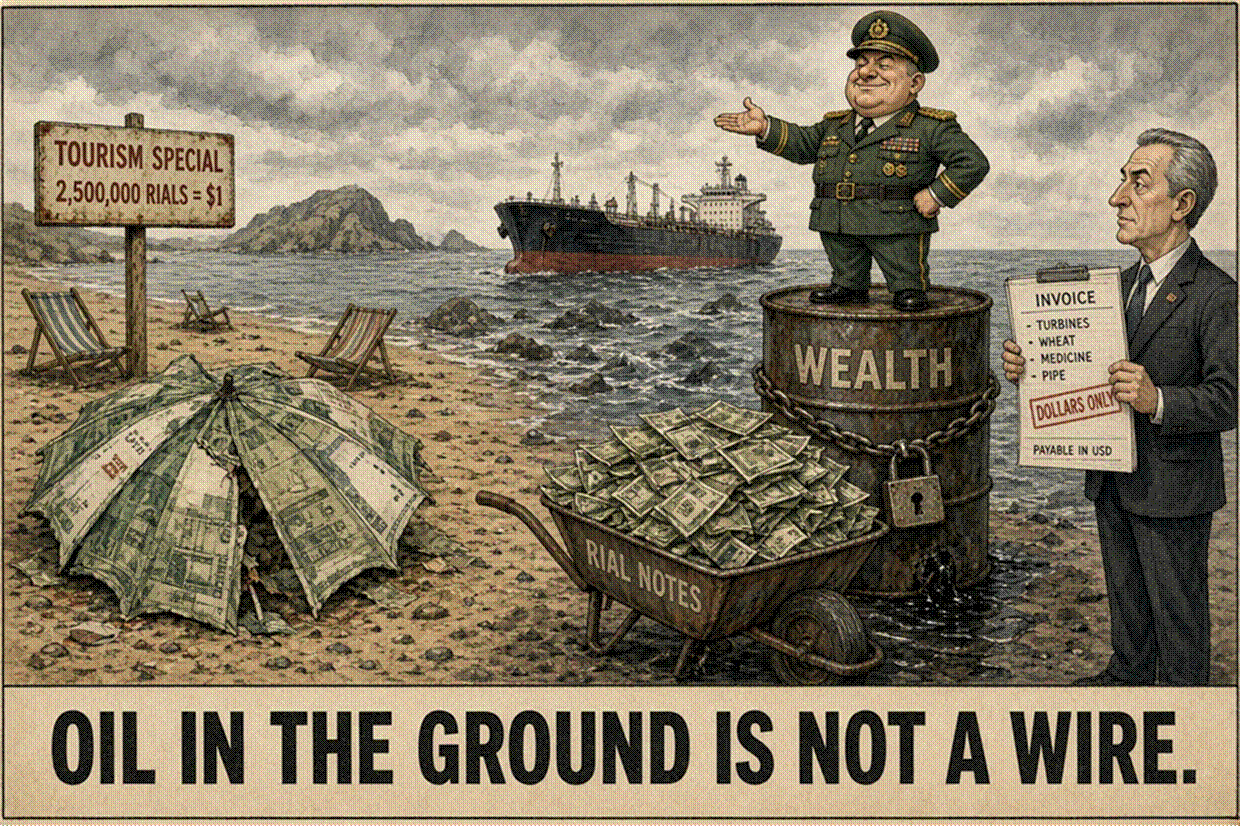
Oil in the ground is not a wire.
On Tuesday the free-market dollar in Tehran closed near 2.55 million rials. Twenty-seven days earlier it had already set a record at 2.2 million. In mid-July, when the memorandum with Washington still had a pulse, the street rate was about 1.79 million. A year earlier it was about 1.14 million. Half the external value of the currency is gone in twelve months.
Official year-on-year inflation was 84.4 percent in August and 83.8 percent in September. Food has run hotter than the headline for most of the year. That is not a pricing glitch. That is a unit dying in public.
State television will not say that. It will say victory, dignity, psychological warfare, a nation that needs no one. The defender of the system will repeat the same lines in a calmer voice: they have oil, they have money, they can wait. The rial is the audit of those sentences. A government that pays its own people in a corpse is not sitting across the table from a position of strength. It is sitting across the table from a clock.
You will hear the other sentence first. You always do. A cheap rial will bring tourists. A cheap rial will move non-oil exports. Iran does not need anyone, because Iran has oil and Iran has money. The downward spiral, in that telling, is a discount. It is almost a strategy.
It is not a strategy. At some point the rial ceases to be money. Past that point there is no silver lining left to argue about, and there is no leverage left to stall for. A moderate depreciation can fill hotels. A currency death empties refrigerators, empties the state’s shopping list, and turns delay into a wound.
Soft is not the same as worthless
Readers already know the soft-currency story, even if they have never named it. Before the euro, a weak drachma made the Greek islands look inexpensive to a German with a summer and a booking agent. Mexico has lived for decades on a peso that occasionally collapses: Americans drive to the beach and spend more pesos per dollar. Bali is living a mild version now. A weaker rupiah makes Sanur cheaper for an Australian. Some stays get longer.
Those places are not a laboratory. They are a flashlight. They show the one thing a falling currency can still do if the country still functions: it can put a price discount on a product foreigners can actually buy.
Three conditions have to be true at once, or the discount never reaches the street.
Tourists can physically arrive — flights, insurance, visas, open borders.
Tourists want to arrive — safety, reputation, a product they recognize.
The local economy can still serve them — food, fuel, staff who show up, cards that clear.
Iran fails all three!
It failed them before the war. It fails them harder now. The old Persian capital in the dust outside Shiraz does not cancel a blockade, a travel advisory, a morality state, or a habit of treating some foreign passport-holders as inventory. A rial at 2.55 million does not cancel them either.
The difference is not taste. The difference is category. Competitive devaluation assumes you still have customers and a pipe. Currency death means the unit no longer stores value, settles a wage, or clears an import. Greece sold sun on an open map. Mexico sold a beach next to the largest outbound market on earth. Bali sold an island a government wanted filled. Iran is selling a theocracy in a shooting war and calling the corpse of its currency a brochure.
The brochure is empty
A hundred-dollar bill in Tehran looks rich on a chalkboard. The tourist holding it is not there.
Iran’s own tourism ministry says inbound travelers fell from about 7.4 million in 2024 to 6.2 million in 2025. In spring 2026, against spring 2025, arrivals dropped 51.5 percent. Air arrivals in that quarter were down 80 percent. The names at the top of the inbound list are Iraq, Afghanistan, Turkey, Turkmenistan — neighbors and pilgrimage, not a European column discovering Isfahan because the money died.
Cheap money that nobody can come spend is not a sector. It is a spreadsheet fantasy. Even the domestic pivot the ministry now advertises is an admission. A family that cannot keep meat on the table does not take the children to Kish. A hotel whose diesel, imported food, elevator parts, and insurance are exploding in rials does not harvest a discount. Hyperinflation eats the plant that was supposed to sell the holiday.
There is no tourism upside hiding in the next zero. The rial can go to five million. Isfahan will not become Santorini. Price was never the binding constraint. Isolation, war risk, payments, dress laws, hostage risk, and a state that treats unsupervised visitors as a security file — those were the constraints before the rial died. They are tighter now.
Labor in rials. Life in dollars.
This is the household half that people who do not live there flatten into “inflation.”
Wages still arrive in rials. Cooking oil, medicine, phone credit, spare parts, and a growing share of food track the free-market dollar. Reporting this month put the monthly minimum around seventy dollars. That is not a squeeze. That is arithmetic telling a household to sell the bracelet, skip the protein, or leave.
Savings are a political casualty. Anyone who kept rials in a bank account has been expropriated without a statute. The rational family flees into dollars, gold, or goods. The central bank then calls the flight “psychology.” It is not psychology. It is people reading the price of chicken.
Once the unit dies, printing more of it is not stimulus. It is another funeral. The December 2025 and January 2026 streets were not a foreign plot. They were a receipt. People came out because the money had died. The regime answered with a blackout and a massacre. Then it went to war.
A state cannot import what it needs with a functionally dead currency
A treasury does not eat. It buys. Wheat, medicine, refinery parts, desalination membranes, grid transformers, aviation components — those invoices are not in rials. A government that prints paper cannot print a diesel injector.
The budget becomes fiction on the same day. Taxes arrive in melting rials. Obligations — civil-service wages, subsidies, the stipend that keeps a checkpoint manned — are denominated in the same corpse. Either the state prints, which accelerates the death, or it cuts, which puts truckers back on the street. Iran has already run that experiment.
Iran does not even have one dollar. It has an official or preferential rate for favored importers, platform rates, and the street rate ordinary people actually pay. The gap is not a rounding error. It is a ration coupon. Whoever gets the cheap dollars and sells the goods at the high street price is collecting a political cut. That is why outlets tied to the Revolutionary Guard can call a 2.5-million print a “psychological operation” while the same system lives off the spread.
So the collapse is not uniformly bad inside the regime. It is catastrophic for state capacity and for anyone paid in paper. It is a business model for the men who sit on the tap. A security force paid in dying paper will eventually collect in exemptions, smuggling cuts, and fear. That is not stability. It is a protection racket with a flag.
The line you will hear is that Iran does not need anyone, because it has oil
Let’s put the Iran apologist on the page. He is very sure of himself - Iran is rich! Iran has the third-largest oil reserves. Iran has frozen cash sitting in friendly vaults! Therefore, Iran does not need aid, does not need a deal, and does not need a living currency. The rial is a sideshow. The barrels will rebuild the country.
The apologist is treating three different objects as one object.
Oil in the ground.
Money he cannot spend.
Usable foreign exchange delivered to a supplier who will actually ship steel, turbines, medicine, and pipe.
They are not the same thing.
Start with the barrels, because that is the sentence the apologist leads with, and it is the sentence that dies first in a chaotic Gulf.
Iran’s real hard-currency machine is crude. A naval blockade sat on that machine. Exports that had been running above two million barrels a day were forced toward zero in the worst weeks. Revenue that had been measured in billions a month collapsed into a rounding error. Oil still in the formation does not pay a welder. Oil sitting in floating storage outside the blockade zone does not pay him either until a buyer takes it, a bank clears it, and someone in Tehran can instruct the proceeds.
The buyers did not wait. They rebuilt the chain.
China was already taking on the order of eighty to ninety percent of what Iran could still move. That is not a market. That is one customer with a discount habit and a compliance problem. When the strait seized up, Chinese teapot refiners did not sit in the dark for Kharg Island to reopen. They bought Iraq, the UAE, Qatar, West Africa, Brazil, Russia, Canadian barrels, Latin American barrels. India did the same math: Russian and Gulf cargoes, not a sentimental return to the National Iranian Oil Company.
A refinery that has rebuilt a supply chain does not rip it up because Tehran announces it is open for business. Insurance desks, freight, secondary-sanctions risk, and the chance that the strait closes again all have a price. That price is a discount — two to five dollars off Brent has been a recurring number when Iranian barrels try to push back in — or it is no bid at all. During the brief summer window, some teapots treated Iranian Light as the expensive sanctioned grade and bought cleaner Gulf crude instead.
This is the chaotic-oil fact the defender cannot metabolize. Iran is not Saudi Arabia missing a quarter and then returning to term contracts at official selling prices. Iran is a distressed loader competing with other distressed loaders — like Russia (for the time being), and whoever else will sell into the same thin book — through a Gulf that can be closed by a militia chief, or a couple guys in a Boston Waler, while the president learns about from the road. The customer who left will not come back at par. If he comes back at all, he comes back for a bargain, on a short leash, with a shadow fleet and a delayed payment.
Fewer barrels. Fewer buyers. A worse netback. A banking system that still treats the receipt like contraband. That is not “plenty of oil.” That is a cargo looking for a friend.
Even the stash does not buy the rebuild
Assume, for the sake of his argument, that some oil moves again. Assume the frozen accounts are as fat as the speeches. The rebuild still does not close.
War-damage figures are a range, which is useful, because every number in the range is larger than “we’ll manage.” The regime’s own line has been about 270 billion dollars. Independent tallies sit lower and higher depending on what they count — physical plant, lost oil, the output that does not come back — but they are not household money. Reconstruction talk around the summer memorandum threw out a 300-billion figure as a horizon, not a check. Tehran did not even collect the twelve billion in frozen funds it expected from that window.
Frozen is not spent. Money in Doha, Baghdad, or a Chinese escrow is not a wire to a German turbine maker, a Korean shipyard, or a Swiss pharmacy. Washington has already shown the leash: food and medicine only, or nothing until commitments are kept. A balance-sheet number the central bank cannot instruct is not working capital. It is a press release about working capital.
The invoice is not in rials. Turbines, compressor stations, membranes, transformers, hospital scanners, and the steel to stand a plant back up are sold in dollars and euros. If the seller will not take rials — and he will not — then Tehran must burn scarce hard currency or try to pay in oil at a discount. Paying in a unit nobody wants is how a ten-million-dollar part becomes a fourteen-million-dollar political favor.
Oil revenue that arrives late, clipped, and trapped in a friendly bank is not a reconstruction budget. It is a rumor about reconstruction. Having oil does not mean having money. Having money in someone else’s vault does not mean having a payment rail. Having a payment rail does not mean the rial can settle the invoice. The apologist wants all three to collapse into “Iran is rich.” Keep them separate. Kill them in that order.
Stalling used to be the strategy
For most of this regime’s life, time was a weapon. Wait out a president. Stretch a talk. Enrich while the communiqué is being drafted. Call it resistance. Call it dignity. Let the other side get tired of the file. That method worked often enough that the men who run the franchise still think delay is strength. The speeches are written for that habit. Victory. Psychological war. We need no one.
A worthless rial is not a position to bargain from. It is the opposite. You cannot walk into a room with a dead unit, a blocked pipe, a rebuild invoice in dollars, and a street that already learned the money died — and then perform patience as if patience were leverage. Bluster is not a reserve. Propaganda does not clear a turbine invoice. The pose that once bought years now buys another week of 2.55 million becoming three million.
This is one of the first times in the history of the Islamic Republic that stalling actually hurts them. Every week they perform strength, the Chinese teapot books Basrah or Murban instead of Iranian Light. Every week the reconstruction bill compounds in a currency they do not print. Every week the wage in rials buys less protein. Every week the dual-rate tap looks more like the only functioning institution left, which is not a fact you want on the table when you are asking the world to treat you as a state.
The hardliners who blew a truce at sea were playing the old game: time is cheap, guns are policy, the president can catch up later. The rial is the part of the ledger that does not care about the old game. Delay used to be a tactic. In a freefall it is a burn rate.
Zero advantages
Write it without residue, because the apologist will try to keep a sliver.
The spiral does not fill hotels. The tourist cannot land, pay, or stay.
It does not cheapen exports the state is allowed to sell at a price that rebuilds anything. The pipe is oil. The pipe is blocked, discounted, or both.
It does not discipline the budget. It destroys the unit the budget is written in.
It does not “redistribute” except toward whoever can touch official dollars, gold, or the spread. That is a racket, not a policy. The men on the tap can still eat. That is not an advantage of collapse. That is why collapse is allowed to continue.
The death certificate is the verdict
Ideology does not recharge an aquifer. A death certificate does not print foreign exchange. The same franchise ate the rivers and is now eating the money. It called the dry river a climate file. It calls the dead rial a psychological operation. Both stories are cover for a holding company that would rather own the tap than keep the country.
Fear can keep a street quiet for a season. It cannot make 2.55 million rials into a wage. It cannot make a locked barrel into a wire. It cannot make a Chinese teapot rip up a new supply chain for a loader who might be closed again next month. It cannot turn a hungry country into a self-financing reconstruction. It cannot turn a press conference into a bargaining position.
The rial will never be a brochure. It is already a verdict. Soft money can still be money. This is not soft. This has ceased to be money. A state that cannot import what it needs with the unit it prints is not sitting on wealth. It is sitting on a rumor, a discount, and a queue. And a regime that answers that queue with bluster is not playing from strength. It is discovering, late, that stalling now costs more than the speech is worth.
Thank you for reading – James Frinzi