

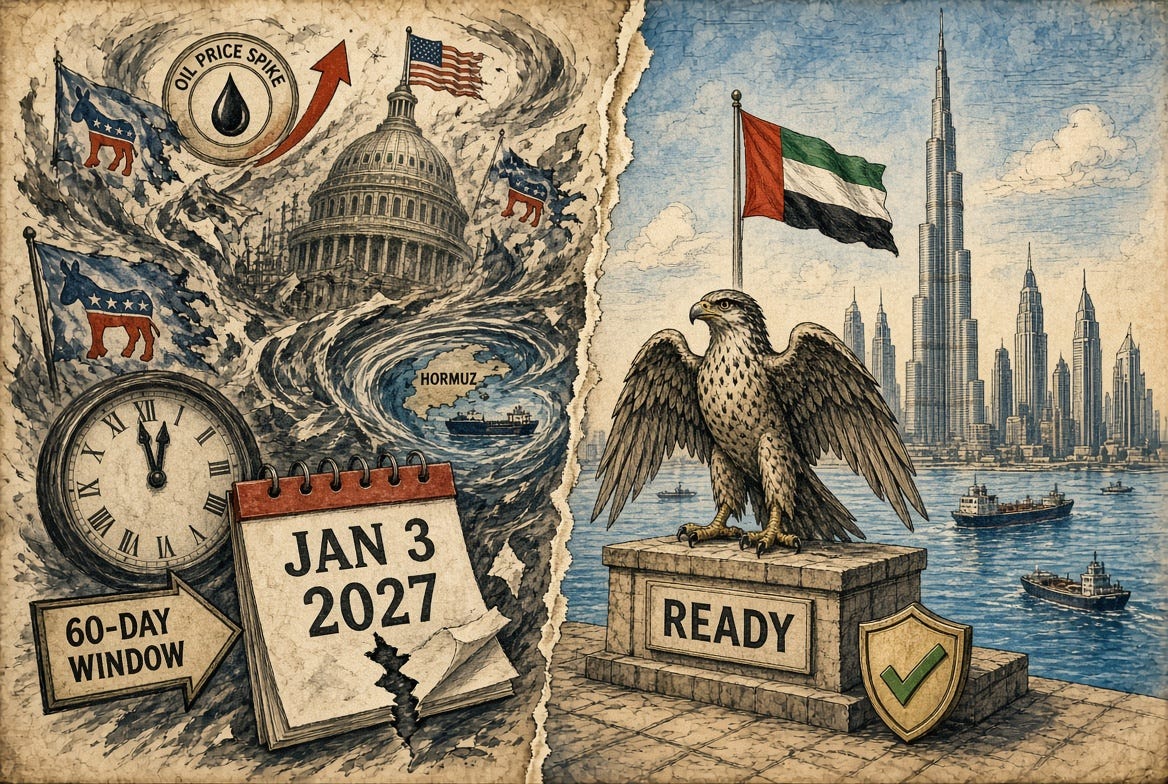
Democrats now control both the House and the Senate. The new Congress is sworn in at noon on 3 January 2027. That date is not a distant administrative detail. It is the institutional boundary after which committee chairs, subpoena power, funding leverage, and sustained oversight shift to the opposition. Between now and that morning, the executive still operates with the residual authority of the current Congress. After it, the domestic political constraints tighten sharply.
As a UAE resident, the American electoral calendar has always been distant noise. The midterms, the lame-duck period, the seating of a new Congress—these were events that registered in the news but did not rearrange daily life in Dubai or Abu Dhabi. After these results, that distance has narrowed. The regional consequences of the U.S. political calendar just became more immediate, and the next sixty days are the interval in which those consequences are most likely to arrive.
The midterms did not end the Iran problem. They compressed the political time available to resolve it. That compression is the fact that matters for the UAE. The outcome of the election is not a gradual shift in the balance of power. It is the creation of a short, intense window in which the incentive structure for both Washington and Tehran changes at the same moment.
The Republican Post-Mortem and the Political Incentive
The morning after the results, Vice President JD Vance wrote that the reason the party lost is the war. He stated that the president himself had said so the night before. In a lengthy post on X, Vance argued that any honest conversation about the path forward had to begin with that fact. He noted that voters who supported the Trump-Vance ticket in 2024 had shown up, but many of them had voted for Democrats this time. The reasons, according to the pollsters he cited, were the war, the cost of living, a desire to put America first, and dissatisfaction with the U.S. relationship with Israel. He singled out the war as the principal cause.
President Trump later told reporters that Vance’s assessment was largely true because the conflict had driven gasoline prices higher in the short term. He added that he would make the same decision again if given the chance, because the long-term alternative of a nuclear-armed Iran was unacceptable. The acknowledgment is narrower than Vance’s formulation, but it is an acknowledgment. The unfinished character of the conflict is the political liability. The decision to act is not, by itself, the problem the voters punished. The absence of a clear resolution is.
This distinction creates a specific incentive. A decisive outcome that can be framed as closed or resolved would allow two years for the immediate costs—higher fuel prices, market volatility, the daily reminder of an open-ended campaign—to recede. During those two years, Democratic control of Congress would dominate the news cycle with investigations, hearings, and legislative priorities. Americans have a short attention span. Historical patterns in earlier conflicts show that political costs fade inside an election cycle once the acute phase ends and other issues occupy the foreground. The incentive for a decisive move before 3 January follows directly from that pattern.
For Republicans to have a realistic chance in 2028, the conflict must be wrapped up, safe passage through Hormuz must be restored, and gas prices must drop before the end of 2026. The open mark on Iran is not an abstract foreign-policy issue. It is the continuous reminder that keeps high gas prices, high consumer prices, high rents, and the broader affordability problem in front of voters every time they fill a tank or pay a bill. If an intense or compressed series of strikes produces further spikes in fuel and consumer prices, those negative consequences need to occur inside the next sixty days. After that, the new Congress is seated, the news cycle shifts, and the memory of the costs begins to fade.
Americans have a short-term memory. One year from now, if the war is over and Hormuz is clear, most voters will remember that the conflict ended. They will not be rehearsing the daily price of gasoline from the fall of 2026. What they will see is a Democratic Congress focused on reopening the border, advancing extreme gender policies, and the rest of the agenda that was not the reason this election turned. This midterm was not a mandate for open borders, defunding the police, or trans extremism. It was a reaction to the open Iran situation, high gas prices, high consumer prices, high rents, and affordability overall. The unfinished war simply kept reminding voters of the day-to-day costs they already disliked.
The incentive is real. It is not a guarantee of action. Further escalation also risks additional price spikes and further backlash. The piece treats the political logic as operative without treating any particular outcome as certain. What is certain is that the unfinished war is now explicitly named, by both the vice president and the president, as a material reason for the midterm result.
The Delay, the MOU, and the Missed Window
The memorandum of understanding that emerged earlier in the year was a clear Iranian stall tactic. It gave Tehran time without producing a resolution, and it kept the conflict open through the period when American voters stop paying close attention to politics. Americans largely disengage from political news over the summer and reengage after Labor Day. A decisive victory by the end of July at the latest would have given the runway needed for the costs to recede before the fall campaign began. By the time voters returned to the subject after Labor Day, the war would have been over, Hormuz would have been clear, and the daily reminder of higher prices would have been months old rather than current.
My view is that the election results would have been substantially different under that timeline. The delay was a huge mistake. The MOU was a terrible miscalculation. It preserved the open mark on Iran precisely when that mark was most useful to the opposition as a constant reminder of affordability problems. It also consumed political and diplomatic bandwidth that might otherwise have been available for a serious effort on Ukraine and Russia. A closed Iran file by the end of July would not have guaranteed a Ukraine deal, but it would have removed one major competing claim on attention and resources heading into the fall.
That window is closed. The relevant window now is the one that remains: the next sixty days. The same logic that should have applied in July still applies, only with less margin. Any further spikes in fuel and consumer prices that result from action must be absorbed inside this compressed period if the political costs are to fade before 2028 becomes the dominant frame.
Iran’s Established Game and Why Waiting Just Became Cheaper
Iran has a documented pattern of using negotiations, ambiguity, and proxy activity to buy time. The JCPOA negotiations were characterized by repeated delays and demands for additional concessions while enrichment continued. In the current talks, similar tactics have appeared: proposals that shift goalposts, statements that preserve deniability, and the maintenance of proxy networks that continue to operate even when formal channels are open. This is not a new strategy. It is the strategy that has been used whenever Tehran judges that time is on its side.
The midterm result changes the cost of that strategy. With a Democratic Congress incoming, Tehran can reasonably calculate that sustained maximum pressure or repeated U.S. strikes become harder to maintain after January. Funding fights, oversight hearings, and the political cost of another fuel-price spike all become more salient once the new Congress is seated. Delay is therefore lower-cost than it was before the election. Iranian public celebration of the midterm result as a political defeat for Trump is usable evidence that Tehran currently reads the outcome as validation of its waiting approach.
Proxies fit the same logic. Houthis have already conducted operations against Saudi targets and continue to affect shipping near the Bab el-Mandeb. IRGC elements remain present in the region. The combination of Hormuz and Bab el-Mandeb gives Iran leverage that does not require a direct conventional confrontation with the United States. Probing, harassment, and limited disruption can be calibrated to keep pressure on shipping and insurance markets without triggering a response that would force a resolution before the new Congress arrives. That calibration becomes more attractive when the political clock in Washington is known and short.
The Two-Month Mechanism and Regional Exposure for the UAE
The institutional clock is clear. The current Congress remains in place until 3 January. After that date, committee control, subpoena power, funding leverage, and sustained oversight belong to Democrats. What remains possible in the window is executive action under existing authorities: short intense strike campaigns, targeted operations, or a forced negotiating outcome that can be presented as resolved. What becomes harder afterward is a prolonged campaign that requires repeated funding or that generates continuous political costs without a clear endpoint.
For the UAE the stakes are concrete. Shipping and insurance risk through Hormuz remain elevated. Potential Houthi missile or drone activity continues to affect the southern approaches. Oil-price and energy-volatility effects transmit directly into export revenues and refined-product costs. The possibility of retaliation against Gulf infrastructure if strikes resume is not theoretical; earlier phases of the conflict demonstrated that capability. The calculation that costs will blow over in two years is an American political calculation. The exposure in the next sixty days is regional. Even a limited or unsuccessful decisive move can produce probing or disruption while the window is open, because the incentive to act and the incentive to delay are operating on the same compressed timeline.
Economic Consequences Inside the Window
Oil prices illustrated the mechanism immediately. Brent fell sharply after the midterms on the expectation that Democratic control would constrain further escalation, dropping roughly 8–9 percent in a single session into the mid-$90s. It then rebounded as traders priced continued uncertainty and the possibility of renewed strikes. Escalation inside the window can reintroduce a risk premium capable of pushing Brent into the $110–125 range cited by some analysts. Any credible pause or deal talk removes it. The dominant feature until 3 January is volatility, not a clean directional trend. For the UAE this affects both the value of energy exports and the cost of refined products and jet fuel used by the aviation and logistics sectors.
Shipping costs carry a parallel risk. Hormuz war-risk insurance has been quoted in the 6–10 percent of hull-value range for tankers, versus 0.15–0.25 percent before the conflict. On a large vessel that translates into millions of dollars per voyage. The cost is already embedded in freight rates. Further perceived risk inside the compressed window can lift insurance and freight again even if physical volumes hold, raising costs for both energy cargoes and non-energy goods that still transit Gulf routes. The UAE’s expansion of Fujairah capacity and other bypass options continues independently of the U.S. calendar. Those investments reduce single-point dependence, but they do not eliminate the near-term insurance and freight premium that responds to headlines.
Tourism and aviation have already shown the sensitivity of sentiment. Emirates reported a 66 percent drop in first-half net profit, with passenger numbers down 22 percent, driven by airspace disruptions, higher fuel costs, and a confidence shock that reduced leisure and transit travel. Earlier in the conflict, Dubai tourism and hospitality recorded occupancy and arrival declines. Recovery has been uneven and remains sensitive to headlines about escalation. A two-month period of elevated uncertainty or limited strikes would likely produce another pause in forward bookings and higher operating costs for carriers. The absolute hit is expected to be smaller than the initial shock, because operators and travelers have already adjusted, but the sector remains the most sentiment-sensitive channel through which regional risk reaches the broader economy.
Near-term volatility is the cost of the political calendar. The UAE’s mitigation—alternative export routes, additional storage, non-oil buffers, and earlier stimulus measures—is already running and does not wait on Washington. If the primary Iran conflict reaches a conclusion, those same measures leave the UAE with lower residual single-point exposure and higher tested resilience than it had before the war began. The comparison is relative, not absolute. The country absorbed costs. The infrastructure and institutional response to those costs becomes a lasting advantage once the acute risk premium falls.
Steady Leadership Versus the Political Calendar
The UAE does not reset policy every two years. It does not subordinate long-term stability to the next news cycle or the next election’s fuel-price reaction. Continuity of leadership is the practical advantage. Decisions about alternative export capacity, storage, and diversification can be funded and executed on a timeline that is not compressed by an external electoral calendar. The mitigation investments already underway are evidence of that continuity. They were not contingent on the outcome of the U.S. midterms.
This is not a claim of immunity. The UAE remains exposed to shipping risk, energy volatility, and sentiment shocks that originate outside its borders. It is a claim of better positioning to manage the spillover from a compressed U.S. period and to convert the forced investments into lasting capacity once the acute phase ends. The difference is institutional. One system compresses major decisions into a sixty-day window because of the seating of a new Congress. The other does not.
The Remaining Variable
I already valued living in the UAE. After these results, that choice feels not only solid but fortunate. Dubai and the UAE have consistently stayed ahead of the curve, acting decisively and with clear foresight to defend the country’s security and prosperity now, for the years immediately ahead, and for future generations.
The leadership here has demonstrated, repeatedly and without theatrics, that it places the security, stability, and daily well-being of its citizens and residents above the noise of external political calendars. There is no midterm cycle that interrupts long-term planning, no seasonal campaign that subordinates infrastructure or public safety to the next headline, and no uncertainty about whether the people responsible for the country’s direction will still be there when the next challenge arrives.
That continuity is not abstract. It is the reason the mitigation investments already underway could be funded and executed while Washington compressed its decisions into a sixty-day window. Living here is safe. Visiting here is safe. Investing here is safe. It is still, and will always be, a great place to move your business to, grow your business, and be innovative. That will not change as a result of this compressed U.S. political calendar. The compressed U.S. political calendar will make things spicy in the region, but if anyone is prepared for this, it is the UAE.
Thank you for reading - James Frinzi