

October 6, 2026
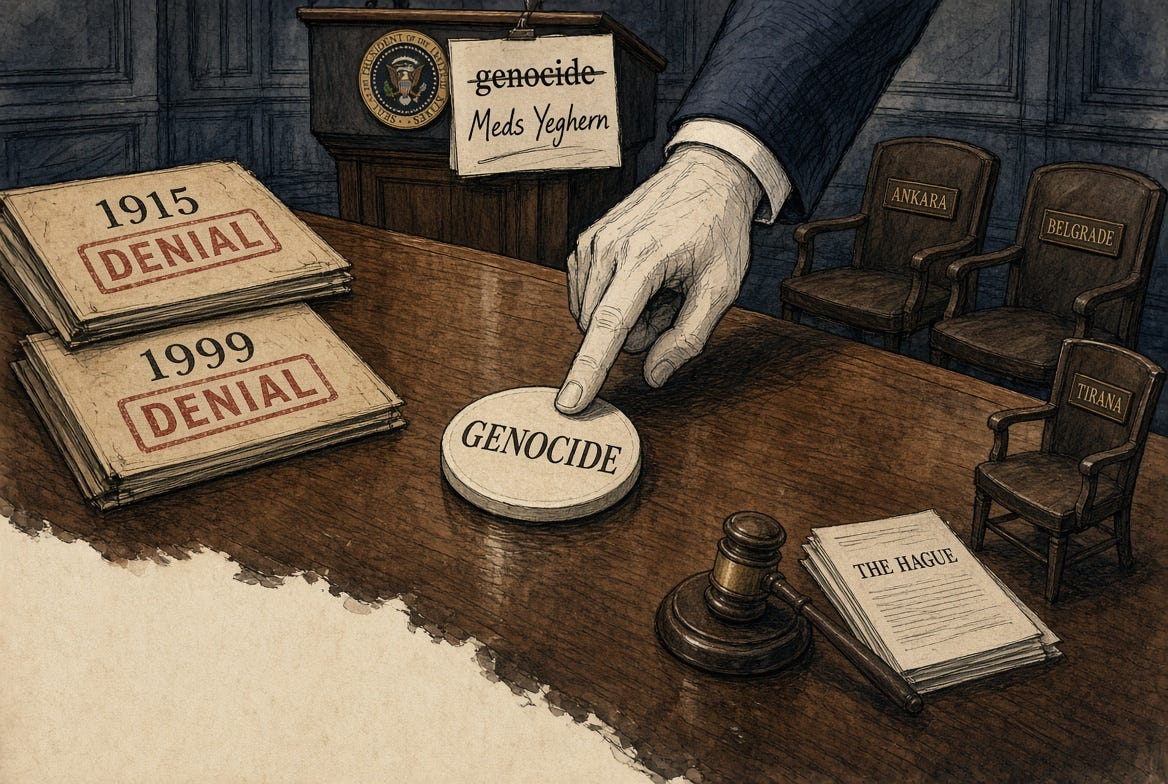
Congress recognized the Armenian Genocide in 2019. On April 24, 2021, a president said the word and matched that policy. Before that, the presidential noun had been a rental. Barack Obama promised it in writing and spent eight years enforcing a Turkish gag. Joe Biden printed it. Turkey rejected the statement, summoned the ambassador, and stayed in the alliance. The rupture Ankara had priced for a generation was smaller than the communiqué. Recognition is not a feeling. It is a word a government will or will not print. Leaving it off the page is a bargaining chip. The chip does not change what happened. It tells the next capital that an American sentence is for rent.
That chip is the subject of this essay, and it is not an Armenian specialty. Armenians and Albanians are not the same people, the same century, or the same grave. Ankara edits 1915 so a base and a pipeline can stay off the table. Belgrade edits 1999 so the European file can stay clean. Athens edits 1944 so the Cham drawer never opens. Washington has agreed, more than once, to read the edited page. The consequences are not literary. A patron that will not name the crime looks weak. The political result, not a missing count in an indictment, is that the defender of the unnamed crime becomes available for trial.
The state began by cutting off the head
On April 24, 1915, Ottoman authorities arrested Armenian clergy, political leaders, and intellectuals in Constantinople. The date is the remembrance day because the state began by cutting off the head of the community. Deportation orders and death marches toward the Syrian desert followed, inside a wider destruction that ran from 1915 to 1923 under the Committee of Union and Progress and the collapsing empire. On May 24, 1915, the Allied powers already called the killings crimes against humanity.
Outside Turkey and Azerbaijan, the scholarly range is about one to one and a half million Armenian deaths. Assyrian and Anatolian Greek communities were destroyed in the same collapse. Raphael Lemkin later coined the word genocide with this case in view. The Treaty of Sèvres contemplated trials. The Treaty of Lausanne, in 1923, recognized the republic and closed the file. The modern Turkish state inherited the denial: wartime relocation, mutual killing, Armenian provocation. The history that matters here is not a riot. It is a state policy, then a burial. Ankara still treats the noun as negotiable. That is the dishonesty. A border opening, a base, a pipeline, and a NATO communiqué are not evidence. They are prices.
Reagan had already said it
The threatened price of the word was always the same. Lose Incirlik. Lose the NATO flank. Lose the pipeline. Lose the ally. Ronald Reagan printed the sentence anyway. Proclamation 4838, April 22, 1981: “Like the genocide of the Armenians before it, and the genocide of the Cambodians which followed it.” Then the presidential noun vanished. That sentence has to sit in the record before Barack Obama is discussed. He was not the heir of a silence. He was the man who restored one, after calling the silence a lie.
Obama knew the word. He rented it out.
On January 19, 2008, Senator Obama told Armenian Americans that the genocide was “not an allegation, a personal opinion, or a point of view, but rather a widely documented fact.” He called an official policy that tells diplomats to distort the facts “untenable.” He attacked the firing of Ambassador John Evans for using the word. Then he made the promise in plain English: “As President I will recognize the Armenian Genocide.” Samantha Power told Armenian Americans he would keep it. This was not a mood. It was a commitment in writing. PolitiFact closed the file as Promise Broken. Eight remembrance statements. Zero uses of the English word.
The Armenian sale was not a one-off. It was his method. He drew a line in public, then asked the other capital for space once the line had a cost.
Syria is the method with a deadline. On August 20, 2012, he said a red line for the United States was chemical weapons “moving around or being utilized.” That “would change my calculus.” On August 21, 2013, the Assad regime gassed the suburbs of Damascus. Well over a thousand people were killed. Several hundred of them were children. On August 31 he said he had decided the United States should take military action. On September 10 he said the American military “doesn’t do pinpricks.” Then the strike did not happen. Russia took the disarmament file. The line was real until keeping it required a missile. He did not discover that sarin was complicated. He discovered that the sentence was expensive, and he sold it.
Russia is the method without the corpse. On March 26, 2012, a hot microphone in Seoul caught him telling Dmitry Medvedev, for relay to Vladimir Putin: “After my election I have more flexibility.” The subject was missile defense. The trade was the same. A public position, then a private request that the other capital wait until the domestic price fell. Do not hang Crimea on that whisper. Hang the habit on it. He asked an adversary for space, and he said the quiet part into an open microphone.
Armenia is the method with a gag. On April 22, 2009, Yerevan and Ankara announced a normalization roadmap two days before remembrance, so he could skip the noun. He used the victim government as cover. The protocols were signed that October and never ratified. Turkey tied ratification to Karabakh. He still did not say it. On the centennial, April 23, 2015, he wrote that one and a half million Armenians perished and that their culture and heritage were erased, then called the crime the Meds Yeghern. Two days earlier, Denis McDonough and Ben Rhodes had told Armenian-American organizations that the English word was not coming. The hostage was the air war against the Islamic State and the need for Ankara. Aram Hamparian of the Armenian National Committee of America named the transaction: a Turkish veto over U.S. policy, a gag rule Erdoğan imposes and an American president enforces.
He did not find new evidence. He did not change his mind in public. He described the firing of a diplomat for telling the truth as untenable, then ran that policy for eight years. Syria shows he would not fire when he had said he would. The hot mic shows he would trade a position for electoral convenience and tell Moscow first. Armenia shows he would let a foreign government edit an American remembrance statement after he had called that editing a lie. Weakness is not the failure to start a war over 1915. No one was asking for that. Weakness is printing the history and renting out the noun. That rental is a foreign-policy posture. The ally learns the sentence is negotiable. Rhodes later called it a mistake. Power said she was sorry. An apology from the aides is not a correction. The correction was a resolution he would not sign, written by men who would.
A disclosure, then the men who printed it
I know Senator Ted Cruz and Senator Bob Menendez personally and professionally. The reader should have that before the compliment.
Menendez carried this resolution across sessions, including years when the White House of either party wanted it kept in committee. Cruz co-introduced Senate Resolution 150 with him on April 9, 2019. On the floor he answered the excuse in one motion. Colleagues feared the resolution would push Turkey toward Russia. Twelve NATO states had already recognized the genocide. Allies can tell each other the truth. An alliance grounded in a lie does not hold.
The House passed its resolution 405–11 on October 29, 2019. The Senate passed the Menendez-Cruz resolution by unanimous consent on December 12, 2019. On March 19, 2021, the two senators, with thirty-six colleagues, wrote the new president and told him Congress had already settled the policy. Use the word. They did the thing Obama would not do. The credit is joint. The excuse they killed is the excuse he had enforced.
The first president who matched the policy
On April 24, 2021, Joe Biden said it. He was the first sitting president to make the annual remembrance consistent with the policy Congress had locked in 2019. The statement remembered those who died in the Ottoman-era Armenian genocide, and it said the plain thing: we affirm the history. He told Erdoğan the day before that he was going to say it. Turkey rejected the statement and summoned the ambassador. No new legal duty attached. Incirlik did not close. Trade did not collapse. The rupture Ankara had promised for a generation was smaller than the communiqué. The hostage had been theatrical.
That fact cuts both ways, and the credit should be stated before the cut. Biden did what Obama had promised and then rented out. Saying the word did not cost the patron the alliance. Withholding it had not been prudence. It had been a choice to look manageable. The first president to match the congressional policy proved the price was a bluff. Allies can hear the noun and remain allies. The sentence was never the threat to the base. The refusal to print it was.
On June 28, 2026, the Israeli cabinet recognized the genocide unanimously. The next day Nikol Pashinyan said Armenia need not respond, because entering the “weaponization” of the genocide was not in the republic’s interest. From the late 1990s until the fall of Nagorno-Karabakh in 2023, Yerevan had called foreign recognition a national-security imperative. After the depopulation of Artsakh, the same office called it no longer a priority. The diaspora built the machine. The homeland used it, then stepped off it. The chip had changed hands. The history had not.
What the withheld word buys
Non-recognition does not lose a base. It spends a reputation. A superpower that has called the history a fact, then lets the perpetrator’s capital edit the noun, has announced that American language is a concession. That is weakness in foreign policy. Not the weakness of a lost war. The weakness of a patron that can be bargained out of its own sentence. Allies notice. So do the capitals waiting to see whether a crime has to be carried or only managed.
On the Armenian side the bill is a century long. The withheld word kept reparations talk and the classroom narrative inside Turkey’s frame. It kept the destruction available for redescription as relocation and mutual killing. Unfinished memory did not cause the 2023 emptying of Artsakh. A century of successful denial made that emptying easier to file as a territorial dispute rather than the second use of a denied method. When the victim government itself then shelves the noun for a border opening, the patron’s old gag has done its work. The history is still the history. The political cost of repeating it has been transferred to the people who survived it.
On the Albanian side the bill is more recent, and it is sharper. In 1912 and 1913 the Carnegie Commission found Serbian and Montenegrin troops using massacre, village burning, and expulsion “with a view to the entire transformation of the ethnic character” of regions inhabited by Albanians. London drew the border and closed the file the way Lausanne closed the Armenian one. In 1944 and 1945, forces under Napoleon Zervas expelled the Muslim Chams from Thesprotia. Estimates of the expelled run from about 25,000 to 35,000. Several thousand were killed. Property was not restored. Athens treats the file as closed. Greece can withhold recognition of Kosovo at no memory price. That is Incirlik in Balkan form.
The emptying, then the dock
The recent file is not a metaphor. In 1998 and 1999 Serbian and Yugoslav forces killed on the order of 7,000 to 9,000 Kosovo Albanians and drove roughly 850,000 over the borders. The Humanitarian Law Center later put Albanian dead and disappeared from the wider war at about 8,700. More than a thousand people are still missing. This was not a battle that spilled. It was a removal.
Operation Reka, in late April 1999, makes the method plain. In Meja and Korenica, Yugoslav army, Serbian police, and paramilitaries killed at least 377 civilians, 36 of them under eighteen, and expelled thousands toward Albania. Thirteen of those taken are still listed as missing. The bodies did not stay in the village. They were trucked north and buried on the training ground of the Special Anti-Terrorist Unit at Batajnica, outside Belgrade. The graves there held 744 Kosovo Albanian civilians. Most had been incinerated before burial. Investigators were kept off the range. A refrigerator truck pulled from the Danube in April 1999 was carrying eighty-three corpses and the parts of three more, on the same northbound route. Vlastimir Đorđević was later sentenced to eighteen years for the cover-up and for the persecution and deportation. Šainović, Pavković, and Lukić were convicted of crimes against humanity for the expulsion. The officers on the ground at Meja were not indicted. Belgrade’s word for this is still counterinsurgency. No allied capital has locked genocide to the campaign. The tribunal found deportation, persecution, and murder. That legal limit is real. It is not a permission slip. I am making the political demand the courts did not make.
This next point is editorial commentary, and the court fact comes first. On September 16, 2026, the Kosovo Specialist Chambers convicted Hashim Thaçi of war crimes: arbitrary detention, cruel treatment, torture, and murder. He was sentenced to twenty-five years. Kadri Veseli, Rexhep Selimi, and Jakup Krasniqi were convicted with him. All four were acquitted on the crimes-against-humanity counts. There was no genocide count. The judgment is not final. The court did not accuse him of genocide. Some of those detained and killed were Albanians labeled collaborators. That fact does not rewrite the war he was in.
Nor did non-recognition write the indictment. The Specialist Chambers exist because of Dick Marty’s 2011 report to the Council of Europe, the European investigative task force that followed it, and a 2015 Kosovo law passed under European pressure. The mandate was individual guilt of KLA leaders. It was never a court for every crime in the war. The Serbian chain had already been in the other tribunal, under the lower noun. Serbia did not prosecute Thaçi. A Kosovo court with foreign judges did, as the price of the Euro-Atlantic path.
The insult is the moral order, and it is a consequence of the missing word. He was defending his country against a Serbian campaign of ethnic cleansing that emptied Kosovo, trucked the dead to a police range, and still has no genocide recognition. The state that perpetrated that removal keeps the manageable noun and a European file. The defender becomes the available defendant. Once the emptying is not called what it was, the war can be tried as a crime scene whose accused are Albanian. The Hague then looks like the reckoning. It is the reckoning of one side. The verdict reads like a dispatch from an alternate universe. Denying the noun did not create the court. It made the prosecution of the defender politically costless, and it made America and Europe look like patrons who can be bargained out of the larger crime. That is what a chip buys.
Tirana has kept its own noun optional, which is the Pashinyan move in Albanian. In October 2025 the Albanian parliament rejected a resolution on Serbian genocide in Kosovo. On September 17, 2026, the day after the verdicts, a draft declaration put “acts of genocide” into the parliamentary vocabulary. The word appears when it is useful against The Hague and disappears when it would cost the Belgrade channel. A homeland that trades the file cannot complain when other capitals try the winners and leave the emptying unnamed. Armenian Americans spent a century refusing that trade. Albanians have not yet refused it.
Older than the republic
There is a foreign-policy bill, and there is a domestic one. Armenian Americans and Albanian Americans are not a lobby attached to a distant quarrel. They are the file, living inside the country that keeps renting the noun. The United States also holds Turkish Americans and Serbian Americans. That fact is not a reason to omit the word. It is the reason the omission fails. Four communities older than the republic now share its schools, its churches, and its election districts. A silence that feels like neutrality in Washington is a permanent argument in those districts about whether the bodies moved.
Americans mishear this because the United States is young. The Armenian church, the Albanian language, the Serbian medieval state, and the Ottoman successor that still edits 1915 were already old when the Constitution was written. A 250-year-old state hears “genocide recognition” as ethnic score-settling, a special interest, a risk to a base. The peoples hearing it do not. For them the noun is not a hobby and not a vengeance statute. It is the sentence that lets the next argument be about borders, alliances, and courts instead of about whether the crime occurred. Leaving that sentence unresolved does not age into harmony. It freezes the quarrel at the first question.
Owning the file is the rational alternative, and Biden is the proof that owning it is not a rupture. He named 1915. Turkey remained in NATO. The ambassador went home. The descendants of the perpetrators and the descendants of the dead still live in the same American cities. What changed was that the American government stopped pretending the argument was undecided. The Albanian file has not been owned. That is why 1999 can still be filed as counterinsurgency, and why the man who fought the emptying can still be filed as the crime of the war. Naming is not a demand that Serbian Americans or Turkish Americans disappear. It is the end of the bargain that asks them, and everyone else, to treat a record as optional. Identify it. Own it. Then the work of living with it can start. Unresolved denial is not the work. It is the refusal to begin.
The history is not the chip
Return to the sentence a White House would not print until 2021. Armenians and Albanians do not share a death toll, a perpetrator, or a century. They share a maneuver, and they share the bill for letting the maneuver stand. Ankara edits 1915. Belgrade edits 1999. Athens edits 1944. Washington, under Obama, agreed to read the edited page. Yerevan has now agreed to stop asking. Tirana mostly never asked. A noun in a statute book is leverage. A noun left off the page is a concession that can be photographed. The ally learns the sentence is for rent. That is the foreign-policy weakness. Not a lost base. A lost refusal.
Denial is not a sophisticated reading of a tragic war. It is intellectual dishonesty. The record of 1915 was not awaiting a Turkish historian. The record of Meja was not awaiting a Brussels mediator. Bodies were trucked to Batajnica. Intellectuals were arrested in Constantinople. A president who had called the distortion untenable then enforced it. Another president later matched the policy Congress had already locked, and the alliance held. None of the earlier rental was geopolitics doing its job. It was geopolitics being allowed to grade the past. The grade has a consequence. Artsakh could be filed as a map dispute. Thaçi could be filed as the crime of the Kosovo war. The perpetrator’s capital, in both cases, kept a cleaner sentence than the defender.
Cruz and Menendez printed the noun Obama had rented out. Biden showed that saying it did not break the alliance. He was the first president to make the remembrance consistent with the recognition. None of that changed 1915, and none of it changed Meja. What it changed was the price. Ankara kept a denial. Belgrade kept a lower charge. The emptying of Artsakh could be described as a border dispute. The man who had fought the emptying of Kosovo could be tried as if his war were the crime, while the state that trucked the bodies kept the cleaner file.
Armenians and Albanians are not the same grave. They are the same test. A government will either print what happened, or it will sell the silence. America has done both. The silence does not make the history smaller. It marks the past as negotiable, and it leaves the defender easier to prosecute than the perpetrator. The peoples who carry the files are older than the country now asked to host the argument. Leaving it unresolved does not spare them. It only tells their children that the past is still for sale.