
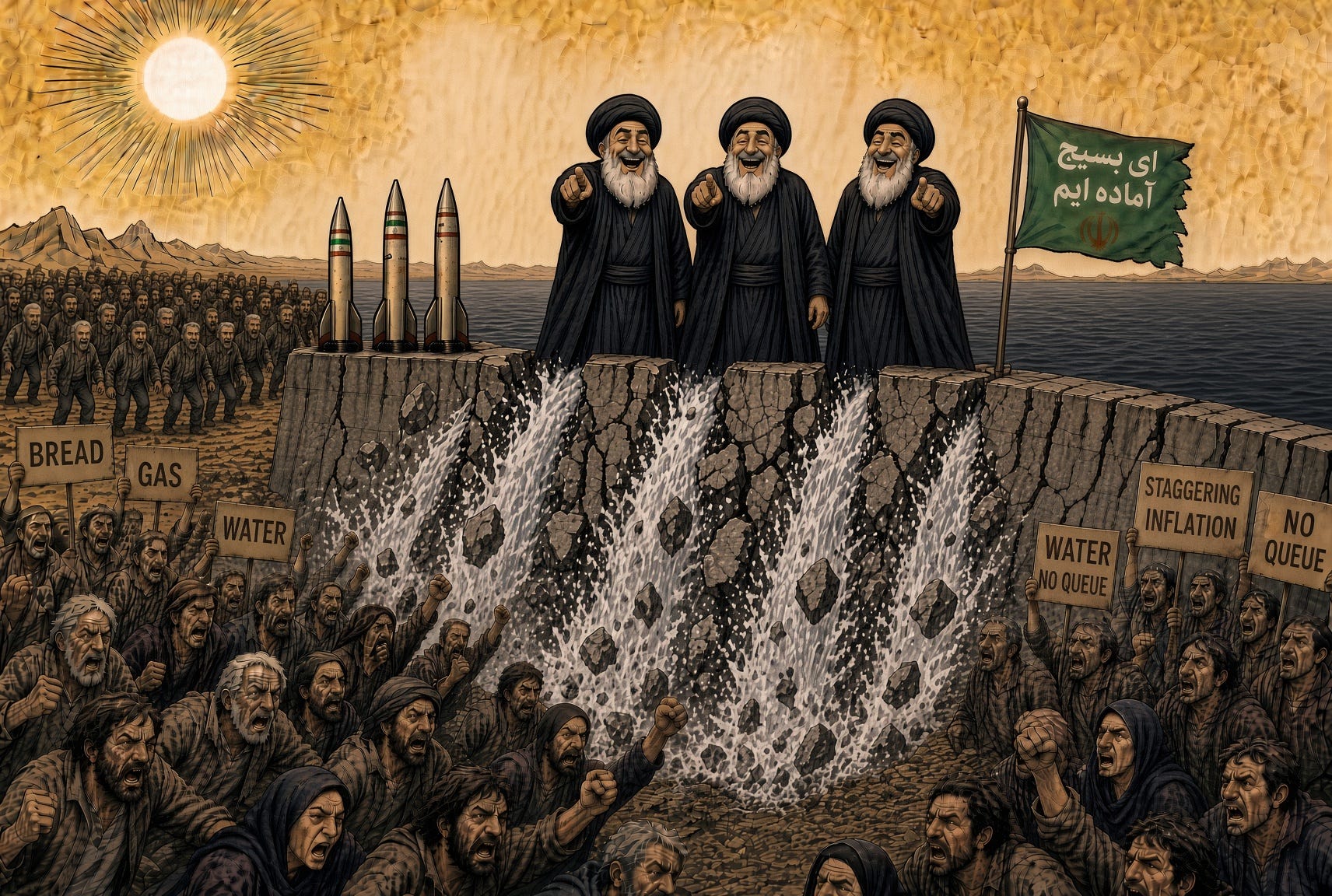
Hossein Taeb ordered it.
That is not a rumor from a Telegram channel. Three senior Iranian officials told the New York Times that the head of the Basij militia gave the order for the July attack on three merchant ships in the Strait of Hormuz — the strike that collapsed the emerging understanding with Washington. The officials say a hardline faction took the decision without the knowledge of the government and without the knowledge of IRGC leadership.
Read that last clause twice. Not only the civilian cabinet. The Guard’s own command, they say, was out of the room.
Washington had signed a memorandum with Tehran on June 17. Overnight on July 6–7, three commercial vessels were hit. One was a Qatari gas tanker. American strikes followed. Sanctions followed. The truce did not survive the morning. Masoud Pezeshkian was visiting Iraq when he learned. He confronted Revolutionary Guard commander Ahmad Vahidi. Vahidi said he had neither authorized the operation nor known it was coming. Iran’s Supreme National Security Council, the same reporting says, was also unaware.
A president who finds out about a war from the road is not running a state. He is touring one.
The useful lie of “unauthorized”
Iran never publicly claimed the July ships. It reportedly told Washington that unauthorized operators were responsible. That sentence does two jobs. It offers the Americans a ladder: you can keep talking to Pezeshkian. And it offers the hardliners cover: the guns still work when the diplomats are in Oman.
Do not confuse a cover story with weakness. Think-tank readers have already floated the other interpretation — that IRGC naval units may have been acting under standing authority against ships that refused Tehran’s “approved” lanes. That may be true of later incidents through the summer. It is not what the three officials told the Times about July. They named a man. They named a faction. They said the formal command did not sign.
Both readings can live in the same building. Standing authority is how a cartel works on a normal Tuesday. A named order from the Basij chief is how a cartel vetoes a deal it hates. The word “rogue” is what Western desks type when they want to keep the president in the room.
Taeb is not a footnote. He is the veto.
Western headlines still introduce Hossein Taeb as a former official. Stop doing that. He ran IRGC intelligence until 2022, when Israeli operations inside Iran and his own political freelancing cost him the title. He did not go home. The Financial Times has reported that Mojtaba Khamenei — the son who inherited the office after his father was killed in the 2026 war, and who still will not appear in public — put Taeb over the Basij.
The Basij is not a youth club. It is the street-level machine that turns a protest into a file and a file into a funeral. Giving that machine to Taeb was not rehabilitation. It was a statement about which faction the invisible supreme leader trusts when the cameras are off.
Now three senior officials say that same man ordered a maritime attack that blew up a U.S. understanding his president had just signed. He opposed the deal. He did not need a cabinet vote. He needed boats, crews, and the certainty that punishment for shooting is lighter than punishment for looking weak.
Call him retired if you need a softer noun. The Times sources do not. They call him the man who gave the order.
The invisible man and the loud militia
Mojtaba Khamenei remains out of public view. State media reads statements. The presidency issues proof-of-life language. Officials, in the same cluster of reporting, are no longer sure that orders issued in his name are his. That is not mystique. That is a succession that never finished.
A hidden leader is a gift to every faction that already owns hardware. If no one can produce the man, everyone can produce a memo. The Basij does not need a televised blessing to move. It needs the knowledge that the formal IRGC chain can be skipped and that the president will be told afterward, in another country.
Pezeshkian’s camp keeps warning that a long war will finish the economy. They are actively proving this is correct. The rial is already a death certificate. The reservoirs were already a verdict before this war’s first bomb. The hardliners keep a different ledger. Confrontation is the business model. Missiles, proxies, smuggling routes, construction contracts, and the fiction of “resistance” are how the Guard and its militia eat. A truce that opens oil and unfreezes cash without restoring their veto is not peace to them. It is a hostile takeover.
Taeb’s order, if the three officials are telling the truth, was the takeover bid. Not a press conference. Three ships.
Hormuz is the invoice
A fifth of the world’s seaborne oil still has to thread that strait. Every “warning shot,” every one-way drone, every sermon about “illegal routes” is a price tag hung on Europe, Asia, and the Gulf states that thought a June signature had demilitarized the waterway. It had not. It had been rebranded.
Through the summer the pattern repeated even after July. CENTCOM reported more hits. Iranian officials called it ceasefire management. Parliament security men said the strait is governed by Iran. That later pattern is policy. July, according to the Times sources, was a faction deciding that policy would not wait for the president.
When the Americans struck back — around Hormuz, then farther, including Chabahar — they were answering the men who can force a decision. Pezeshkian can fly to Baghdad. Araghchi can sit in Muscat. The man who can order three merchant ships hit without copying the IRGC commander is the man who owns the night.
Do not refinance the faction that fired
The June memorandum was sold as off-ramps: oil sales, unfrozen money, reconstruction language, a pause that would keep tankers moving. The July ships were the first audit. The audit failed. A government that cannot stop the head of the Basij from lighting the strait is not a counterpart. It is a collection of offices.
Western diplomats love “unauthorized.” It lets them keep Pezeshkian at the table and treat Taeb as weather. Readers who have watched this system for forty-seven years already know the weather. The IRGC is not an army that sometimes disobeys. It is a holding company with a firing squad. The Basij is the street franchise. Bonyads, docks, telecoms, dams, missiles — and now, again, the chokepoint that feeds the world.
If Washington bargains with the president while the Basij chief keeps a veto at sea, the cash will not buy quiet. It will buy the next magazine. That is the same argument as the water story, the rial story, and the gallows story. The regime does not fail because it is disorganized. It fails because the organized part is a racket, and the racket would rather burn a truce than share a toll.
What the three ships actually said
They said the deal had no owner inside Iran. They said Mojtaba’s silence is not stability. They said the president learns about war from the news. They said a Qatari tanker is cheaper, to some men in Tehran, than allowing Washington to claim it closed the file.
They also said something more specific, if the three officials hold: the formal IRGC command can be cut out. That is the detail that should end the “one Iran” talking point in every foreign ministry. There is a letterhead. There is a militia chief. They are not the same desk.
It is not only the pen. It is the guns — and the guns still cannot feed a country.
In Iran the guns can seize a night. They cannot seize a functioning country. A militia can humiliate a president. It cannot put bread on a table in Qom or clear a gas line in Ahvaz. Playing “unauthorized” in the Strait of Hormuz does not fill a refrigerator. It does not bring the tap back. It does not make the rial into money again.
Hossein Taeb and the men around the IRGC who smiled at the wreckage of June 17 are enjoying the power move now. They proved the point they wanted proved: the political leadership does not own the trigger. They cut Pezeshkian out. They cut Vahidi out, if the three officials are right. They told Washington that “unauthorized operators” had been at work, which is a polite way of saying the deal was on a leash they hold.
They also widened a crack that was already in the dam. The dam was the economy, the empty reservoirs, the execution lists, the blackout weeks, the joke that petrol can be cheaper than bottled water and still impossible to queue for. Every extra month of shooting in Hormuz is another month without the oil cash and sanctions relief the memorandum was supposed to buy. The hardliners did not replace that cash with glory. They replaced it with American strikes and a tighter vise on the same streets the Basij is paid to police.
Civil unrest does not need a manifesto when the queue is the manifesto. The Guard can break a demonstration. It has done so. It cannot break a country that has already learned the regime can start a war without telling its own president, then ask that country to stand in line for fuel. They made the effort to undermine the political leadership. In the end they undermined the only story that still kept some Iranians from walking out again: that someone, somewhere in the official building, was still trying to stop the bleeding.
A veto at sea is not a government. It is a delay. The flood they opened is not theoretical. It is the bill for a power move that feeds the men who ordered it and starves everyone else.
Say when to drop this into the file. The Balkan comparison can stay in the earlier grafs and stay out of this section.
The investigation will keep leaking. Names will be denied, then praised, then denied again. None of that changes the sentence the Times sources already put on the record: Hossein Taeb, head of the Basij, ordered the July attack. The government did not know. IRGC leadership did not know. Until a system that works like that can produce a single chain of command, every truce is a rumor — and every ship in that strait is walking through someone else’s argument.
Thank you for reading - James Frinzi