

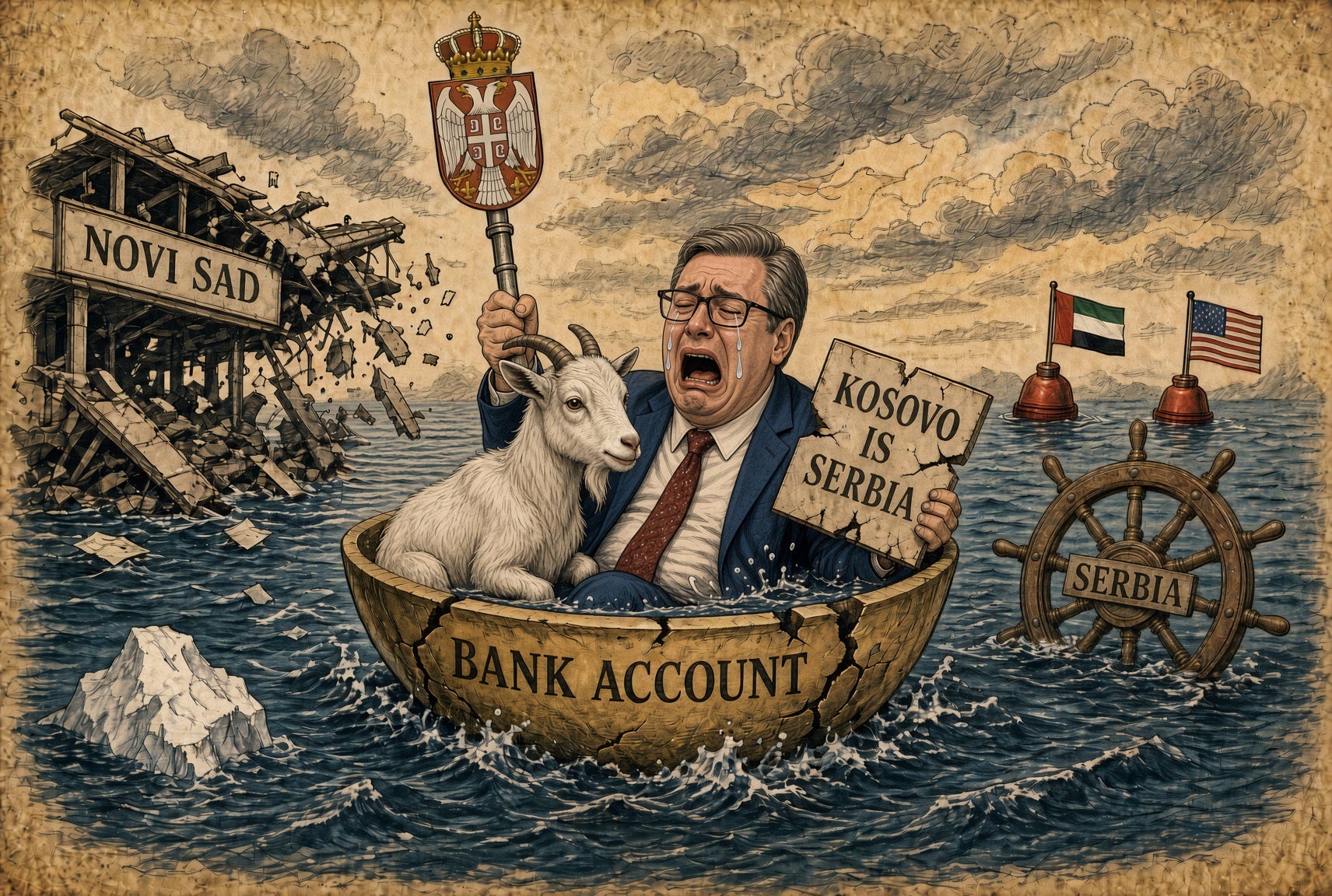
Aleksandar Vucic’s defeat is good for Serbia first. It is secondarily good for Kosovo and for ethnic Albanians. The order is not rhetorical. A state that cannot execute ordinary public works, enforce its own procurement rules, or maintain institutions free of patronage cannot stabilize its neighborhood or attract capital that stays. The fourteen-year machine that treated foreign policy as a personal and party ledger has ended. What replaces it will be judged first by whether it can rebuild capacity at home. Everything else follows from that.
Vucic did not govern Serbia toward a destination. He managed a network. The foreign-policy record was not a multi-vector strategy for positioning a medium-sized European state. It was a series of transactions. Special laws, summit visits, and selective openings existed to feed the network and to provide political cover when domestic failures accumulated. When the network required a rallying cry that could not be answered with another infrastructure announcement, Kosovo supplied it. The “Kosovo is Serbia” formulation was not a fixed constitutional end-state pursued with consistent means. It was the available lightning rod. A kleptocrat needs a villain. The villain kept the patronage intact and moved the canopy collapses, the cost overruns, and the captured regulators off the front page for another news cycle.
The canopy collapse at the Novi Sad railway station in November 2024 was the visible tip. Sixteen people died when a structure that had been renovated under the previous administration failed. Subsequent reporting and prosecutorial steps documented cost inflation, political pressure on contractors and inspectors, and the routine use of exemptions that bypassed ordinary oversight. The episode was not an isolated engineering failure. It was the point at which the accumulated practice of treating public works as network opportunities became lethal and politically unsustainable. Transparency International’s Corruption Perceptions Index for Serbia stood at 33 out of 100 in the most recent reading—an institutional decay metric, not a talking point. Special legislation had already become the ordinary method for large projects: heritage protections lifted by decree, procurement rules suspended, land arrangements structured to favor connected parties. The pattern was consistent across sectors. The canopy simply made the pattern impossible to deny in public.
The Belgrade Waterfront development and the later proposal linked to Jared Kushner for the former General Staff site illustrate the same mechanism from the capital side. Both were positive economic openings. UAE-backed capital brought scale, employment, and a visible transformation of underused riverfront land. The Kushner-linked proposal offered a substantial private investment in a central Belgrade site, with the stated intention of converting a location associated with the 1999 bombing into commercial and residential use. A competent government would have executed either project under ordinary legal rules: competitive elements where appropriate, heritage procedures followed rather than waived by special act, and clear allocation of risk and return. Instead both were processed through exemptions and political direction. The Kushner side withdrew after indictments touched senior officials and after public and legal controversy made continued participation untenable. The withdrawal was the rational response to an execution environment that had been deliberately degraded. The opportunity itself remained positive. UAE capital and American commercial interest arrived with the capacity to mark development. The machine layered patronage onto them and failed to deliver clean execution. That failure sits with Belgrade.
The destination was never a functioning Serbian state integrated on transparent terms with its larger economic partners. The destination was the preservation of the network. EU accession rhetoric supplied one set of meetings and one stream of pre-accession funds. Russian energy contracts and Security Council coordination on Kosovo supplied another. Chinese project finance supplied a third. Occasional American commercial openings supplied a fourth. Each vector was usable so long as it fed the ledger or provided diplomatic cover. None of them was pursued to the point of institutional constraint on the network itself. When domestic accountability threatened the network, the external villain was available. The protests that began after Novi Sad and continued for nearly two years were Serbians acting for Serbia—demanding that public works not kill people and that institutions not function as extraction mechanisms. They were not outsiders seeking to alter Serbian law or culture for the benefit of non-citizens.
Good for Serbia First
The Student List’s victory ends that particular machine. Preliminary results gave the list a clear majority—roughly 52–53 percent of the vote and 135–140 seats in the 250-seat parliament—on turnout near 69 percent, the highest in decades. The mandate that produced those numbers is domestic: rule of law, transparent procurement, media freedom, judicial independence, and the reversal of institutional capture. The published program and the statements of leading candidates have been consistent on sequencing. Foreign-policy questions, including the pace of EU alignment and the Russia sanctions issue, are secondary to the restoration of ordinary state function. Vucic’s concession prediction that the new government would impose sanctions on Russia within months has already been rejected by the list. The deeper claim—that the winners will prove unable to govern—is the standard exit rhetoric of a defeated patronage system. The measurable test is whether the new majority can convert a protest mandate into procurement rules that hold, regulators that are not directed by party offices, and public works that do not require special laws to proceed.
That domestic focus is the precondition for any subsequent gain. Serbia cannot reliably import the intermediate goods and energy it needs, cannot retain its own skilled population, and cannot attract capital that remains after the political cycle turns, while its institutions remain organized around extraction. The end of the machine does not automatically produce competence. It removes the organized interest that treated competence as a threat.
Disclose the Continuity, Then the Gain
The new administration will not recognize Kosovo’s independence. Its memorandum and program treat Kosovo and Metohija as an integral part of Serbia under the Constitution and United Nations Security Council Resolution 1244. They oppose unilateral independence and membership in international organizations, and they reserve the right to review the constitutionality and implementation of prior Belgrade-Pristina agreements. That position is continuous with the formal stance of every Serbian government since 2008. It should be stated without euphemism.
The continuity does not cancel the practical gain for ethnic Albanians. A patronage machine requires a standing external villain to justify its exemptions, its media narrative, and its claim on public resources. Once the machine’s survival is no longer the organizing principle of government, the daily political utility of the “Kosovo is Serbia” rally cry declines. The new administration’s predicted work—cleaning procurement, restoring regulatory independence, and rebuilding diminished administrative capacity—has less structural need for permanent mobilization against a neighbor. Younger Serbs register the Kosovo question. Survey data from 2025 showed a plurality favoring reconciliation-first approaches and a sharp drop in support for military return among younger cohorts. They are not obsessed with the issue in the manner of the generation that lived the wars of the 1990s. Intensity can fall even while the constitutional claim remains on the books.
For Kosovo the reduction in instrumentalization is the immediate effect. Parallel structures, license-plate and currency disputes, and periodic security incidents become harder to sustain as standing policy when Belgrade’s political energy and administrative bandwidth are consumed by domestic reconstruction rather than by regime preservation. For ethnic Albanians in the Preševo Valley the representation gain is already measurable: a unified list increased the number of seats held by Albanian parties. A Serbian government less dependent on the southern pressure point as a domestic rallying device has reduced incentive to treat those communities as a permanent instrument. For Albania the lowering of regional temperature follows directly. None of these effects requires the new government to amend its constitutional position or to accept Kosovo’s independence. They require only that the position cease to function as the daily fuel of a patronage system that has now lost its electoral majority.
The Next Decade
Once the kleptocratic machine no longer needs a standing external villain, what does the next decade actually look like for the Kosovo claim, Serbia’s external alignments, and the capital that was previously squandered?
The war cry will tone down. Formal non-recognition will hold for years. The direction, however, is no longer frozen by the survival requirements of a network that needed the conflict as political oxygen. Recognition remains a multi-generational process. It is no longer blocked by a regime whose domestic legitimacy depended on keeping the claim at boiling point. Over the next two decades the intensity can decline far enough that practical arrangements—on missing persons, on property, on the status of remaining Serb communities, on trade and movement—become negotiable without the requirement of daily theatrical confrontation. That is the plausible trajectory once the machine that required the villain is gone.
The multi-vector pattern will tone down as extraction. Domestic rebuild is the priority, and that priority shapes external choices. Serbia’s population is not looking at the recent protests, the scale of legal and illegal migration, and the associated integration and security problems in France, Germany, and the United Kingdom and treating those countries as examples of desirable functioning states. Those governments have been widely read, inside Serbia as elsewhere, as subordinating the priorities of their own citizens to the management of large non-citizen populations. Serbia does not want or need that trajectory. It is counterproductive to the political movement that won on the demand that Serbian institutions serve Serbians. The protests of 2024–2026 were citizens acting for their own state, not migrants or activists seeking to rewrite law and culture.
The clearer positive reference is Poland. Poland has preserved core elements of its national heritage in public policy and has maintained a low tolerance for illegal immigration while still participating in European economic structures. That combination is legible to a Serbian electorate that has just removed a government for failing to maintain basic state function. The preference is a political and social factor in alignment. Serbia has practical room to deepen ties with the United States in investment, technology, energy diversification, and trade. It can retain Russian cultural links, continued energy supply arrangements, and smaller-scale economic cooperation. While the current American administration pursues improved relations with Russia, Serbia is positioned to draw commercial and technical benefit from the American side and residual energy and cultural benefit from the Russian side without being forced into an exclusive choice. European Union economic partnership and the conditional reforms required for closer market access remain available. The social and migration model now contested in France, Germany, and the United Kingdom does not.
The new administration will have every incentive to encourage the return of investment under ordinary rules. The United States has a standing interest in capable regional partners that can execute projects without special-law exemptions and political risk that deters capital. Commercial re-engagement follows from cleaner procurement and regulatory practice. UAE capital, which has already demonstrated scale in Belgrade, faces no structural barrier where real-estate and development opportunities can be contracted with ordinary legal certainty and without the requirement that heritage or procurement rules be waived by political direction. The prior openings were positive economic developments. The inhibition was the Serbian practice of processing them through patronage. Remove that practice and the capital has a rational basis to return.
Vucic’s machine needed the villain to survive. The government that has replaced it does not. That single change is good for Serbia first, because it removes the organized interest that treated functional institutions as a threat to the network. It is, secondarily and as a consequence, good for Kosovo and for ethnic Albanians, because a Serbian state occupied with rebuilding its own capacity has less political need to instrumentalize its neighbors. The rest is execution: whether the new majority can turn a protest mandate into procurement rules, regulators, and public works that function without special laws and without a standing external enemy. That is the test that matters.
Thank you for reading - James Frinzi